
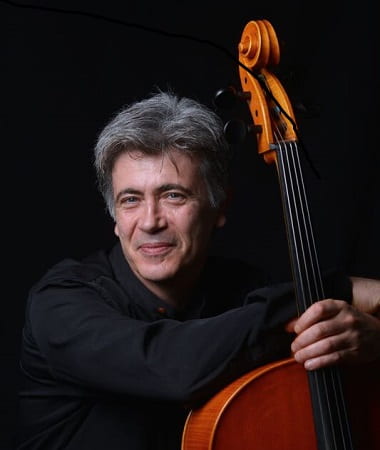
On Sunday, January 21, 2018, in the Vatroslav Lisinski Concert Hall in Zagreb, a celebratory concert was held to commemorate the hundredth anniversary of the birth of Antonio Janigro. The concert, directed by Marko Magdalenic, and organized by the Antonio Janigro Association, was attended by Julius Berger, Thomas Demenga, Monika Leskovar, Zagreb Soloists, Cello Ensemble, “100 Cellists 100 Years” Orchestra. Guests of honor Michael Flaksman and Giovanni Ricciardi who, at the end of the concert, we were lucky enough to be able to interview. We started precisely from the memory of Janigro.
Many of today’s great cellists have been, directly or indirectly, students of Janigro. What are, in your opinion, the reasons that have enabled him to obtain such excellent results with his teaching?
I think there are many reasons for this: undoubtedly his teaching ability, we realize it from the value and the amount of the technical material left, but also his humanity, the ability to see the specificity of each and to increase his skills without flattening the personality, enhancing the natural qualities of his pupils. Then he was certainly a charismatic man, and he was also a cellist who incessantly studied the instrument. On the Milan – Paris train, he was always looking for an empty compartment to practice or, after the concerts, he immediately stopped to study the steps he had not liked during the concert. A great humility and a great empathy for all the musicians with whom he worked, combined with his genius, were qualities that remained etched in the minds and hearts of the students, even those who met him only once.
There are, in your opinion, compositions that, however, a teacher should include in the course of studies of his students (if so, which ones) or it would be necessary to select for each student a different path suitable to reinforce the weaknesses and enhance the points of strength of each?
There are many compositions useful at the educational level, for the legato, the staccato, and the capo … however, what I have found for years in the courses that I hold, is that the desire to play a particular piece makes the student forget that there are certain “compositions” that are good for all ages, called scales, arpeggios, thirds, sixths, octaves. Often, with the students I meet in the Masters, I find this lack. I ask them if they have a method of scales and arpeggios and many answers no or have “studied in the past”. Then I ask them to play a four-octave scale and there you can listen and see the mastery of the instrument. Many times I meet students who have a talent, they feel like musicians, but they do not have the technical bases and consequently they can not express themselves as they would like. The scales, and the double arches, however difficult to study, both help to form the left hand (intonation, correctness of the positions, independence of the fingers, changes of position, etc.) and the bow (this is the control of the distribution and direction of sound on two strings), not secondary qualities for those who want to study and learn the instrument.
When you look back at your studies, are you satisfied, or if you could go back, would you change something?
After graduating from the Conservatory, at which time, despite having received the highest marks, I did not know many things yet, and I realized the things that I had to study in order to improve, I was lucky enough to meet Michael Flaksman. Under his direction, I continued my studies both at the Hochschule in Mannheim and in several other courses. He is a wonderful teacher, as a former student of Janigro. Michael opened my eyes to a whole technical part that I had to deepen and also believed in me over time, involving me as his assistant and inviting me to play on many occasions (just in Ascoli Piceno, at the festival of which he was artistic director, I met the great Basque violinist Felix Ayo with whom I recorded the trio of Brahms op.87). Now 30 years have passed since that first meeting with Flaksman, I taught in the Hochschule class of Mannheim where I studied, I continue to teach with him. I can say with certainty that the care and humanity of my former teacher have been unique and I am certainly very satisfied with this. We all sometimes have crises, more or less, but the cello, however, has always been a wonderful travel companion.
When you perform in concert, you prefer to perform alone, in a duo with a piano, in a quartet, as a soloist with the orchestra, or in a group with many other cellos …?
I do not have a specific preference, playing solo or groups of cellos are beautiful experience, because there is an important exchange between colleagues, young people, and the elderly … but also chamber music is a real gift. In general, the important thing is to be happy in what you do, for the rest, as my friend Ezio Bosso says, “Music is made together”.
During your career, what were the concert experiences that gave you the most satisfaction?
Undoubtedly the important concerts in which I played Dvorak or Schumann, for example. To be in the middle of a composition that is a dialogue between soloist and orchestra is a wonderful experience. Certainly, chamber music played with Ayo, Gandelsman, Flaksman, Bosso, and Holliger is a great satisfaction, but also playing Bottesini with Giuseppe Ettorre, or Vibrez with Sandro Laffranchini together with young people are important moments. I am oriented on the romantic and contemporary repertoire, I find that in contemporary music there are thousands of ideas to enrich his own technique and try to keep the mind open to the new, a means to renew and feel young and full of life in the heart, but in general this is the effect that music has on us all. I believe that the opposite of being a musician is closure. I am particularly fond of Debussy’s sonata, of music for cello and piano of Schumann, Prokofiev’s concertante symphony, and Bach’s Suites, a collection of perpetual youth, which helps to take stock of one’s own sound.
What are your musical projects for 2018?
I have a lot of projects. From returning to Iran in April for masterclasses and concerts to taking care of the Festival in which I was entrusted with the artistic direction, Entroterre Festival, in Emilia-Romagna, in Bertinoro, a Festival that includes several paths including the international advanced courses, the Classical Music Festival – this year with names ranging from the Fonè Quartet to Massimiliano Damerini, Antonio Meneses, Olaf Laneri and many other good performers. I’ll have a masterclass at the Hochschule in Mannheim, and prepare a new large reunion of cellos with the Italian Cello Consort in October, an event that I would once again be dedicated to the memory of Antonio Janigro and many other things. I have also an important non-musical project, on the other hand: taking a holiday with my family, something that has not happened for a few years due to work commitments
Thank you so much and … have a good holiday with your family
A site to quickly and effectively find everything a cellist asks on the web