

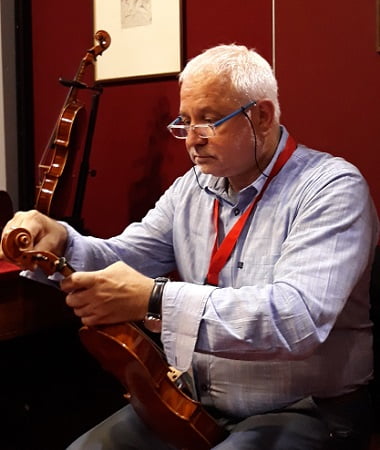
Walking through the stands of Mondomusica, I stop in front of stand n.79 “Negroni Massimo e Davide”. A violinmaker is carefully examining a violin under the watchful eye of a young violinist. He is explaining to him how to clean the strings of his instrument. He explains with kindness, patience, and passion. I wait for the end of the explanation and introduce myself. I tell him I’m looking for a luthier available to answer some questions about how to take care of a cello. He accepts with pleasure.
Negroni Massimo o Davide?
Massimo. Davide is my son, a luthier himself too.
I heard you were explaining how to clean the violin strings. Is that explanation okay to clean the cello strings too?
Certainly. When someone puts the pitch on the bow hair, there is a risk that the pitch will remain on the strings. Alcohol is very good for cleaning, but it is important to avoid drops of alcohol accidentally falling on the sounding board and damaging the paint. Keeping the cello in a horizontal position, with the strings down, is always the best method for not taking risks: it is difficult for a drop “to fall” upwards …
And to clean the cello? Especially in the summer when your hands are sweating…
A cotton rag is always the best solution. Grandma’s old sheets are fine. Be careful not to listen to Grandma when she gives advice on how to clean your cello. It is true that your cello is made of wood like the table in the living room, but it can not be cleaned with floor wax or oil (olive or walnut … every grandma has her own recipes: all equally unsuitable for the situation). And above all, the cello should be cleaned every day, when you stop playing, especially in summer, to prevent sweat and dust from forming a layer of dirt almost impossible to remove. Obviously, a cleaning, at least yearly, made by the violin maker is always recommendable.
But can sweat cause damage to the paint?
Yes. It is always better to protect the cello by placing a rag on the legs when you are studying during the summer with shorts. It even happens that, in some cases, even clothes colored with poor quality colors (for example some types of jeans) leave traces of their color on the bands or on the bottom of the cello.
And for the care of other parts of the cello? The bridge, the fine tuners, the pegs?
To ensure that the fine tuners always turn easily, you can extract them from their hole, unscrew them completely, and then pass them in the paraffin (or in the wax). For the pegs, it is better to use the semi-lubricating paste. The string notches on the bridge should be lubricated using graphite. It is fine to loosen one string at a time and pass in the string notches on the bridge with a normal pencil. Care must be taken, when changing the strings, not to change the position of the bridge. The bridge can move accidentally even in the event of a collision, especially when the cellist, perhaps a little novice, does not know how to handle his instrument. The correct position of the bridge is very important!
And when do you travel with your cello?
Obviously, we must be careful to avoid collisions. But changes in temperature and humidity can also be dangerous. The temperature too cold puts at risk the strings that can break, while the dry can damage the wood. When you are in a very dry climate, the pegs tend to shrink and do not stay in the peg box. This can result in the sudden loosening of one of the strings, even during a concert. In the case of concerts in dry climates, the dumpit can be used as a precaution: it is a simple and invisible object which, provided the dry is not excessive, helps to keep the instrument’s humidity level under control. The excess of humidity creates much fewer problems: at most, the wood of the pegs swells and the pegs tend to get stuck or to be more difficult to turn. Do not overdo the wet, however. When you play outdoors, in the event of rain, the concert should be stopped immediately and all stringed instruments should be dried as quickly as possible. Of course, violinists and violists are more fortunate than cellists and bassists, because, in case of uncertain weather, they can keep their instrument cases under the chairs and shelter their instruments very quickly.
Thank you very much, master. Thank you for your kindness and for your valuable advice!
A site to quickly and effectively find everything a cellist asks on the web