
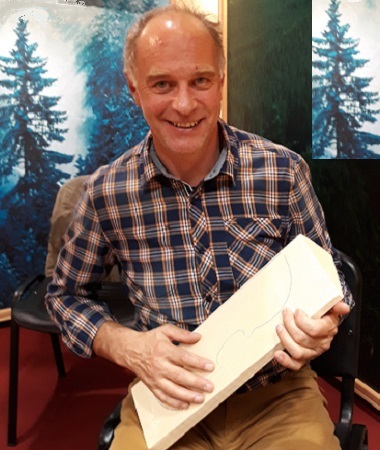
In Cremona, in one of the Cremona Musica stands, I meet Giuliano Zugliani, Forest Inspector and commander of the Paneveggio State Forest, in the Autonomous Province of Trento. Behind him, beautiful photos of trees and mountains. I introduce myself and then ask him for some information on the characteristics of this very special forest. He gladly answers my questions.
First of all, where is the Paneveggio Forest located, and what are its characteristics?
The Paneveggio Forest, also known as the “Foresta dei violini”, is located in Trentino at the foot of the Pale di San Martino. The Forest extends for 5000 hectares, 3000 hectares of which are wood. The remaining territory is occupied by pastures, alpine tundra, and rocky walls of the mountains that surround it. The Forest is composed entirely of conifers, with more than 90% of spruce and the remaining 10% of larch and pine. From an altimetric point of view, the Forest develops between 1500 and 2000 meters of altitude, so it is considered a subalpine forest and, given its continental-type climate, here the spruce, which dominates in an unchallenged way, finds its best climatic conditions. Us foresters manage the forest following the criteria dictated by naturalistic forestry. The choice of trees to be cut is made by trying to favor mainly natural renewal, favoring the growth of plants with better genetic characteristics and creating a forest structure as diversified as possible, with groups of plants of different ages and, where possible, a mixture between different species.
The “older” trees also reach 200/250 years, and they are the great-grandparents of the forest but, next to them, there are the grandparent trees, adults, young people, adolescents, children, and babies. Exactly as it happens in a family. There is the tree that was born in a particularly “happy” position, which grows straight and strong and lives very long, and the one that has had the misfortune of being born from a seed that has slipped between two rocks, which grows exposed to the winds and bringing in its twisted trunk the signs of the hard struggle it has fought to survive, but in a stable forest ecosystem and in ecological balance both plants are important. The functions of the forest are the most disparate and not only the economic ones, ranging from soil protection to the recreational landscape function to that of giving us oxygen and fixing carbon dioxide and, not least, the cultural one: more and more in the wood becomes culture, through guided tours, conferences, and in recent years also concerts, to highlight one of the outstanding products of this Forest, resonant spruce wood.
But then does the forest not only have an economic function? It is, therefore, similar to a large family of trees, where life takes place as in a community; do adult trees protect help, and defend smaller ones?
Certainly, the trees that form a natural forest live forming more or less large families, which we foresters call “collectives” and “micro collectives” according to their size. These tree communities interact with each other through the root system, which favors their stability and the exchange of nutrients, at the same time, by combining their foliage, they form a single large crown that protects them from the wind and a load of snow in winter. The forest is a complex, magical, and wonderful environment. We foresters are aware of this and are proud to know almost every aspect of it.
These trees also grow at high altitudes, in this Forest the vegetative season is rather short. How do the climate and the morphology of the territory influence the rhythms of their growth?
In the Paneveggio Forest, the vegetative season generally goes from May to September. In this period the trees carry out their vegetative functions to the maximum, grow, produce flowers, reproduce, and finally release their seeds. In the remaining months of the year, the plants are like in a kind of lethargy, the lymph circulation decreases and all vital functions slow down. However, the short vegetative period favors the formation of very tight growth rings, a peculiar technological characteristic for having excellent wood for violin making. A famous German saying states that “there is no music without the mountain forest” and this is certainly true if referred to our Forest.
When men discovered that these trees had characteristics different from those of other trees, and started using them to build musical instruments?
Certainly in the XVII sec.: the great Cremona master violin makers knew the characteristics of wood from this forest from this valley and used it for the construction of their best musical instruments. It is said that Stradivarius came here in person to choose the trees, but it is almost certainly a legend. At that time, the timber was brought to the valleys and the plain by floating on the streams and then the rivers. Certainly, many famous instruments, from dendrochronological analyses performed on them, have been built with this light, elastic, and defect-free wood. This means that, since then, thousands of luthiers have continued to use this wood for the excellence of its technological features.
But are the spruce trees that grow here all “resonant trees”? What is the best part of a tree?
Certainly not. Resonance trees are a small percentage, about 1% of the plants that are cut. The largest quantity of wood produced is used in other sectors such as carpentry, industry, and other uses. Every year part of the wood destined for violin making is sold to sellers of precious woods; a large quantity instead is processed directly by us and sold directly to luthiers from all over the world. Normally the best woods are obtained from the basal part of a plant. The characteristics that a good resonance wood must have are the complete absence of defects (the presence of knots, compression, and traction wood), having contained and regular growths, the straight fiber. The added value that our wood has is lightness and an excellent elastic modulus.
Has the forest always been managed by man?
From some documents, it is clear that the Forest was known and managed already in the Middle Ages, then passed ownership of the Counts of Tyrol, and finally, until 1918, the house of Austria was the owner. During the First World War, some areas of the Forest were the scene of fighting. In those years, for war purposes, almost a million trees were felled (more or less those that, with the current management, fell in 25-30 years) creating large openings in the woods. Fortunately, in the years following the war, great reforestation works began, rebuilding the wood we visit today.
I see… then there was the disaster caused by the wind in October 2018. And now? How is the situation?
The Forest of Paneveggio, last autumn, was hit hard by hurricane “Vaia”. Some sectors of the forest are completely destroyed and an estimate is calculated that about 10-12 annual revivals (about 60-70 thousand cubic meters) have been eradicated. Immediately after the event, it was a struggle against time, to remove fallen trees and thus prevent pests such as the Bark beetle from proliferating in the warmer months, and the weather conditions significantly diminished wood. Now (and we are a little more than a year) away from the event, we have collected more than 50% of the felled plants, but the work will still be long and demanding. In recent months, there have also been numerous activities in solidarity with the Forest and for the safeguarding of its wood from violin making. To remember the twinning with the prestigious school of violin making in Cremona. Many were also the musicians who came to Paneveggio to play, driven almost by the desire to “console” the trees that remained alone after the fall of their “brothers” shot down by the wind. I am sure, however, that Nature has been “slapped” with the “Vaia” hurricane and, in the coming years, it will “caress” us, making a wood grow again, strong, luxuriant, and lasting. We just need to have so much patience …
Thank you so much for your availability. But above all, thank you for the passion with which you watch over the rebirth of our favorite forest. For our readers, “the forest of cellos”.
A site to quickly and effectively find everything a cellist asks on the web