
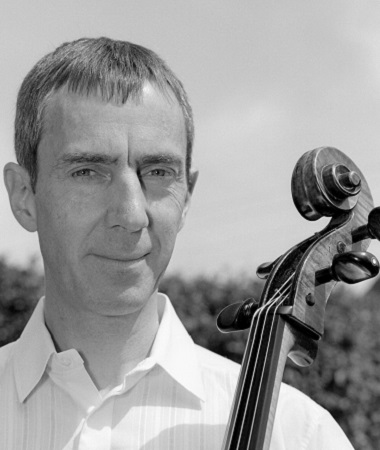
Dear Maestro Waterhouse thank you for your interest in our website but above all thank you for agreeing to answer our questions.
Can you briefly give us some information about your background, about your life as a musician, related to your studies and training? Were there already musicians or composers in your family?
I was born into a musical family in North London. My father was a bassoonist and my mother a pianist, who trained in Munich and became a violin teacher. As children, my sisters and myself were soon started on stringed instruments and piano. Whilst a musically inclined schoolboy at a London public school, the emphasis was on a broad musical education. Cello was always my main instrument, but I also sang in a choir, learned piano, organ, composition and conducting. At University I studied composition and musicology; at German Hochschulen, I studied cello, also conducting and for a short while piano as well. The wide field of study was partly influenced by my father, who, besides being an eminent bassoonist, was also a musician of wide interests, embracing piano, viola, and musicology (more specifically organology – the history of musical instruments). I have always pursued a varied musical life, finding the different disciplines complementary to one another, especially cello and composition. Whilst cello playing and composing have remained constants, I have also worked as a conductor and a pianist. In recent years composing has become a greater priority.
Why did you choose the cello as your instrument?
To be frank, as six-year-old I did not choose cello, but my mother did, seeing I had strong hands and an apparent affinity for the instrument.
Who were your most significant teachers? Have you worked with other musicians who have, obviously, influenced your artistic growth?
My most memorable cello teachers were Maria Kliegel, Young-Chang Cho and Siegfried Palm, each of whom combined cellistic prowess with a high degree of musicality. Another strong influence was Celibidache, who encouraged me as a composer when I played under his direction with the Schleswig Holstein Festival Orchestra. In conversation, several of my literary London friends have offered inspiring ideas, as have also musician colleagues, family members, publishers…
Did you have other references in the composers of the history of music and then characterize your choices?
Countless composers have been among my favourites, but I always admired Haydn and especially his quartets, learning from them in my string writing. Also Britten and Stravinsky were influences in their flexible musical languages and sophisticated compositional technique. Among the less well-known composers I admire are Szymanowski, Foulds, and Alkan, mainly for their untamed fantasy and boldness in uniting apparently contradictory musical material.
Can you briefly tell us the most significant passages of your composing career?
Probably the two Summers in the late 80s playing for Celibidache, whose remarks on phrasing, musical form and the balance of instrumentation with intensity were an eye- (ear-)opener. More recently my work on the Composition PhD at Birmingham City University brought me into closer contact with contemporary English musical scene and provided the impetus to compose a series of chamber works (including a piano quintet and a piano quartet) culminating in Incantations for Piano and Ensemble. Another influence over the years has been Summer Courses for string chamber music in UK (NCMC) and in Germany (Streicherfreizeit) and France, at which I could conduct own works for String Orchestra and try out new chamber works with expert colleagues in informal surroundings.
Why did you decide to settle in Germany?
Our family was always Germano-phile. I was encouraged by my father to learn German at school, was intent on extending my studies in Germany after finishing at Cambridge University. As a student I gradually became involved in musical life in and around Cologne and Essen, joining a chamber orchestra, then a professional Piano Trio; eventually I settled in Munich where I now live with wife and son. I admire the high standards, the seriousness with which the musical profession is taken, and have a wide circle of wonderful musician friends and colleagues I perform with. Despite living in Germany, I like to keep the connections to UK, e.g. as a composer-in-residence of the National Chamber Music Course and in a recent tour with the Munich Piano Quartet.
Can you tell us about your commitment as a teacher? Did you publish texts for teaching music?
Since teaching at Summer Schools as a teenager I cherished the interaction with young players and consider I learn from them as much as they from me. Analyzing aspects of technique and explaining them to students else is beneficial to one’s own playing. I make no distinction between teaching younger and older, advanced players and have always worked with both. I have published a number of pedagogical pieces, several of which were written for our cellist son when he was small (e.g. Thomas Tunes, publ. Breitkopf u. Haertel). The only text I have published is my doctoral thesis.
How do you compose? For example: on paper or on the computer? What inspires and helps you?
This question occupies the thoughts of all composers. I have no regular method. Sometimes I work entirely away from the piano, sometimes not. In principle, I write on paper (I still use the thick cartridge manuscript paper dating from 1905, which my father bought as a young man thinking he might become a composer). Inspiration is an elusive, hardly definable subject. In the first instance, one scours one’s own musical memory for snatches of rhythm and melody fragments, which may be re-composed, re-put-together from musical shreds in the recesses of one’s mind. Technical aspects, e.g. l.h. pizzicato, string-crossing, or sautèe can give rise to the invention of motives. A major source of inspiration is the musicians one is writing for – the way they play, move, even talk. Poetry (e.g. Morgenstern, Lewis Carroll, Schiller), also paintings, architecture, even politics (Brexit Quartet being created just now!), historical events can influence the way in which new pieces arise. One relies on the subconscious and cannot identify exactly where “inspiration” comes from, but one trusts that in an active and varied life the well-springs keep flowing.
Trying things out on piano, cello or with colleagues is a necessary part of the process and changes are sometimes made after the first performance. Setting the notes on a computer comes late in the process: though editing is often done on screen, enabling the testing of certain markings and deletion if they prove unsatisfactory. For publication, I prepare the pieces on a computer.
Coincidentally, I am aware of two-time scales operate in composing. Whereas the invention of material is instantaneous, the working out and the fashioning into a coherent piece is a long, drawn-out procedure.
In your opinion, what is the direction in composing music for this millennium? I mean: the interest of the public but also the trends of your colleagues?
In an age of increasing globalism and multi-culturalism the former barriers and divisions, cultural and political, are being redefined. Whether music originates from Europe, Asia or the Americas, even whether it is so-called serious or popular, becomes less relevant. People are curious about anything they can relate to, regardless of origin. For composers, greater flexibility and adaptability are called for. There is a huge educative and civilizing potential in music and its functions within society can be manifold, for instance, performances at schools, hospitals, even prisons may bring huge rewards to both performers and listeners. Composers can be at the forefront of harnessing the power of music to bring people together, to provide edification, joy and a common point of reference. Whether writing for brass bands in the Midlands of the UK, for youth choirs in Paris, for street rappers in Berlin, composers should go out into the world and engage with their possible players and audiences. One can already see this happening in some countries.
What can you tell us about the relationship between classical music and other forms of art or clients: movies, advertisements, commercials, videos, and TV?
Music has enormous suggestive and emotive powers and from the very outset, film and tv producers have of course been quick to tune in to this. Personally, I have had only minimal experience with films or television work, but would be entirely open, should the opportunity arise. I particularly like the symbiosis of music and movement or dance/ballet and one of my favorite recent projects was creating a Ballet for 12 dancers and String Quartet to an own “libretto”.
What compositions have you recorded on CD and with which record companies?
I have made two Portrait CDs featuring my own works: 1) Chamber Music with piano, clarinet, cello (Cybele label) 2) String Orchestra and Wind Music (ECO, Endymion) (Meridian label); a 3rd CD featuring Piano Chamber Music is due for release in April 2020.
Which publishers did you collaborate with?
My first publisher was Hofmeister, Leipzig, then I had Lienau/Zimmermann, Frankfurt. A number of works are with Heinrichshofen, Wilhelmshaven and Breitkopf and Haertel, Wiesbaden. From 2019 my future works and several past works will appear with Schott Music, Mainz – a recent development which I am very happy about.
Considering the web with all its potential (but not only those, unfortunately) what do you think (briefly) about the music and copyright rights of musicians and composers, the market and record companies and also live music?
GEMA and the German Society of Composers raise these concerns are regularly and I am a member of both societies. The arrangements with Spotify and Youtube are not properly thought through and do not seem fair, in that a composer is hardly remunerated and CD sales plummet the minute the moment the composer’s work is on either of these platforms. But this is not stopping me from investing in my next CD project. To paraphrase the words from Die Fledermaus – “What you cannot change it is not really worth getting worried about…”.
If you can tell us: what are you working on right now? What notes are on your desk?
Currently, I am working on the Brexit Quartet – a somewhat politically motivated piece with a certain relevance since 31st Jan 2020. The piece is designed partly with a cathartic nature to vent my frustration at the outcome. I am also completing my Variations for Cello Solo which are due to be published shortly, also working on a Song-cycle for soprano and piano entitled Unbeschriebene Blaetter (Blank sheets).
Dear Maestro Waterhouse, we thank you very much for your availability in answering my questions: best wishes for your future, both from a professional point of view but, obviously, for your life in all its aspects.
Many thanks for the interesting questions. It was a pleasure to share some ideas with your readers…
A site to quickly and effectively find everything a cellist asks on the web