
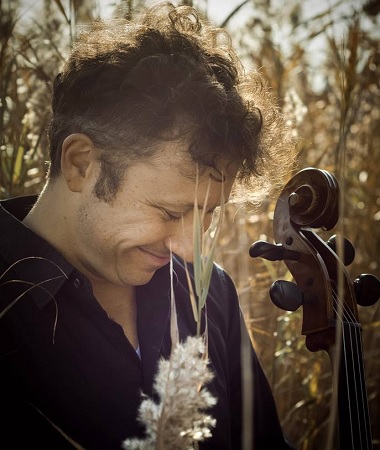
Principal cello of the Teatro alla Scala in Milan, passionate about cars, cooking, and nature. Agrees to answer our questions …
Son of a cellist. Your choice to play this instrument seems very natural, but … have you ever wished to play another musical instrument?
Of the cello, as with any other bowed instrument, the fact that it is only partially polyphonic weighs on me. Therefore, I would have liked to play the piano, which I play in an elementary way, in order to at least understand better the harmonies of what I am studying or writing.
What are the advantages and disadvantages of living under the same roof as your teacher?
From a strictly musical point of view, it is an advantage, because there is continuous control by the Maestro. By the law of retaliation, now that I’m a father, I tend to play a lot of games with my son.
What other cellists have been important in your training and from what points of view?
I have always had two teachers: my father at home and Maria Leali in the conservatory. Without her charge of positivity and confidence, I would have been unable to continue. For this reason, I realize that many of the kids often need to be supported psychologically, as well as technically directed towards an in-depth and effective study method, for example, the study of the various types of vibrato, phrasing, etc. Returning to me, I then studied for 4 years with Rocco Filippini at Stauffer, and, with him, I had a great time: great culture, and great refinement in the solutions of handling the bow, and fingering that he proposed. With Mario Brunello, I attended courses at Romanini in Brescia for 3 years. His touch and communication in creating empathy for the feelings of the public are absolutely unattainable. At the Musik Akademie in Basel, I studied with Thomas Demenga. He has been a wonderful teacher. A kind of hippie of great refinement and artistic caliber. It leaves the students free to express themselves, but also gives very technical/musical advice if asked. I certainly cannot forget the lessons in Venice, at the Fondazione Cini, with Eugenio Bagnoli, a great pianist of the past. He talked to me about how to improve my communication and expressiveness. And finally the chamber music lessons with the Amadeus Quartet, whose summer and winter courses in London I have followed for years.
Which cello do you play and which other cellos have you played during your artistic career?
The cello I currently play is a cello built in the early 1900s, whose characteristic is to have sound projection and ease of sound emission. Before, I used to play a 1730 Carlo Antonio Testore. Sweetness and quality, but we are in an era of Italy where there are no rooms with acoustics that allow these noble characteristics to emerge, if not supported by many dB. If I lived in Germany, Japan, and Switzerland, it would be different for that fantastic instrument, but here, with the dry acoustics of our theater, something that really pushes is needed.
A portfolio of important competitions. But, from your point of view, which were the most significant? Which one did you experience with the most emotion, and which one gave you the greatest satisfaction?
The chamber music and orchestra competitions I have made, and sometimes won, are the result of years and years of truly great sacrifices. I remember that the normal strategies of trying to always do everything better, in the classic triad of sound rhythm intonation, at some point were no longer enough, and I found my alternative strategies to try to differentiate myself from the competition. Some are small secrets, I can talk about others in general. However, a lot of creativity is also needed in the study phase.
A small secret, however, I want to reveal in this interview and concerns the use of colors on the physical part that is being read, in this way the instinctive mental association of emotion-color makes the communication of precise emotions more immediate and almost automatic, depending on the color you see. There would be a lot to say about the competitions, however, leaving aside any controversy and trying to filter a message that can help young people, I believe that creating its own poetics of sound and phrasing, once all the technical aspects have been well digested, is always the right way to get good results.
What is the concert you remember as “the first”? Remember what were the emotions of that moment?
I have a certain memory of the first concert I had with my father, when I was 9 years old, in Canneto sull’Oglio (Mantua). I remember that then they took me to visit a ceramic doll factory and they gave me one. But certainly, I was still more interested in the after-concert aspect, at the convivial moment of lunch or dinner together. And in fact, of the concerts with the orchestra, the thing that weighs me most is all the haste that colleagues have to get dressed, to go and take the bus. We often go home without dinner and without the slightest contact with the public. For this reason, whenever possible, I much prefer the milder and quieter rhythms of the chamber or solo music concerts, in which you can take less “Milanese life”.
Do you want to talk about your recordings? Which authors are they dedicated to and for which labels? What are your plans for future recordings?
Over the years I have made a couple of live recordings of Haydn’s concert in D major and, in 2015, a DVD of Bach’s Suites, for Limen. A project is now out, for an independent label, that will be found only online, it is about unconventional cello, my compositions-transcripts relating to some Pop songs ranging from the Beatles to pop and rock music written in 2018. I do not exclude being able to count on the distribution of labels, but it will depend on whether the conditions are created to be able to create interest in my works.
Playing at the Teatro alla Scala in Milan is the dream of all young cellists. And everyone wonders: how do you get there? What would you answer to this question?
I am a son of art, and I do not know there has been another case in the history of La Scala of a son of the first part who managed to repeat and work alongside his father with the same job. This has translated me into an innumerable series of auditions, which I have had to face in order to overcome this prejudice. Over the years, I made it to the final twice (once I went alone to the final) behind the curtain, and I did and won the row and concert auditions while I already had a fixed-term contract as the first cello. All these auditions have been done with different commissions. In any case, I would say that our auditions were made in an absolutely transparent way, as evidenced by the fact that at the last cello competition, in a row, two cellists who were not part of the group of adjuncts who had collaborated for years won. If we go even further back, our concertino was also taken with the same criteria of meritocracy. I realize that this way of working is a bit the exception, but I would not know how to give different advice if not to try to express my best. The stress at competitions I think can be avoided with meticulous preparation, especially also from a psychological point of view. As far as I’m concerned, one of the limitations that have not allowed me to win even in international performance auditions is the fact that, if I am forced to play by heart, I play worse. So the important thing for young people, at some point, is to try to understand what their range of action is, and not to venture too long steps than what you can then realistically aspire to do.
Of all the orchestras with which you have collaborated, which one have you found yourself most comfortable with? And which director do you appreciate most?
I found myself very well with the World Orchestra for Peace in the years in which he conducted the maestro Valery Gergiev. The so-called “seasonal” orchestras have the advantage of not having those fixed orchestra mechanisms in which one feels bound by many obligations, and therefore the pleasure of playing with colleagues is overwhelming compared to other problems. When, for a time, I collaborated as the first cello with the London Symphony, I found that the British have a great reading ability at first sight and great group-level cohesion. Without rhetoric, I can say that Maestro Riccardo Celi is absolutely the person with whom I found myself best, both from the point of view of concertation and execution. It is no mystery that his gesture is absolutely the most precise that exists and the construction of the phrasing takes place in a way that is very clear and intuitive to me. There has always been, I think I can say, a natural empathy. With all the other conductors I have worked with, I have been more of a pupil trying to find something to transfer in my way of understanding the context of phrasing or the harmonic context. The great advantage of playing in an opera orchestra is that of facing an author on a field in which the author himself is forced to say much more about himself because he has to place his music in psychological and explicit words. I give an example: if a person wants to face Ravel’s instrumental music and has never played or seen the opera, the L’Heure Espagnole cannot understand many things. The same goes, of course, for all the other composers from Beethoven to Verdi to Janáček, Šostakovič, Stravinskij, etc etc.
Equally important are the collaborations with chamber ensembles. Which ones gave you the most satisfaction and who are the musicians with whom you have collaborated more often and willingly? What are the characteristics you appreciate most in a colleague?
For 6 years I was artistic coordinator of the Ensemble of the Teatro Grande in Brescia. I thank Superintendent Angelini who gave me this chance. Nowadays it is no longer enough to be a good artist, but you must also be an entrepreneur and know how to keep good relationships with colleagues and good “neighborhood” relationships. There are definitely many features that an interpreter needs. I’m still working on a part of myself to try to be the 360° artist that the market requires today. In general, of all my colleagues, including those to whom I am perhaps the least likable, I try to study and learn the good part they have, and transfer it and adapt it to my being. I never completely throw anything away from a colleague. Because I always think about the day I retire, and I would like them to exchange Christmas greetings.
You performed the Bach Suite for solo cello in Shanghai. How is Western music in general and in particular cello compositions considered in China?
The show Cello Suite was combined with great choreography and therefore the Bach Cello Suite was proposed alone, in a “raw” way, I don’t think they were suitable for such a large audience. So, welcome this formula of the most cello solo ballet, which has had some success. I think, however, that we should not focus too much on this type of repertoire, and that we should instead offer music in a less specific way to the public who does not perceive the cello as a special instrument, or protagonist of a special repertoire: many simply want to attend something that makes them think and allow them to build, with their mind and heart, something beautiful and positive. In the use of the concert, they review a part of their day during which they rework their thoughts and rearrange them. If they leave the concert hall with a mind and heart that satisfies them, they will return to listen to another concert.
But his artistic career does not only embrace the so-called “classical” music. What is your relationship with music that is normally defined as “popular” and what prospects does a comparison with this type of repertoire offer, particularly to a cellist?
I’m sure of a few things in life, but this is one of them. You need to quickly and effectively expand your possibilities, and be able to readjust and compose. As I mentioned before, simply making the Bach Suites better and better is not a winning choice. At least, if you want to have a relationship with the “real” public, and not always with the usual specialists. But passion is also needed. If some musician faces this alternative repertoire just because he tries to open up a new slice of the market, then I don’t recommend him to do so. Mine for Pop Funky rock music is a true love I’ve always had, ever since I was a kid. And then the fact of being reinvited when he brought a program in the previous season says it is longer than many other considerations. Over time, I am developing my own way of approaching these songs: transcribing them, adapting them, and adding parts of fantasy. I also tried my hand, following the same procedure with some strictly classic pieces, such as Barber’s Adagio, and there is no doubt that these works require a mental effort, in my opinion, not a small one.
What do you think will change in music and its world after the events linked to the Covid-19 epidemic? Not only from an organizational, and professional but also from a mental and psychological point of view, in an art that expresses feelings and passions, therefore also fear, the fragility of existence, and the possibility of death?
From my life experience, I think there will be a certain period of adjustment, in which everyone will think, first of all, of solving their own practical and organizational problems. Subsequently, there may be a phase in which even normal people (the public) will be a little more receptive to new musical perspectives. Death is always a taboo in modern society. The military tanks in procession leaving Bergamo have remained etched in the minds of all of us and I believe that this thought will remain latent in our consciences for a long time. But I also believe that precisely for this reason, even more people will want a positive message and escape from part of the artist. This does not mean that a small part of the concert program cannot be dedicated to the intense suffrage of these deaths. In parentheses, I also wrote some verses concerning this very topic a few years ago. Going to the mountains I thought of all our young people who died during the first and the world war, people who gave us back a free Italy and that perhaps we have forgotten a little …
What would you like to play in the first concert open to the public? And what are the other projects you are working on right now?
On 29 May I was in Cernobbio, in Villa Bernasconi, to record a concert that will also be available on my YouTube channel. I wrote the music from scratch for a 1976 short film by a French film director who asked a Formula 1 driver to race through the streets of Paris aboard a Ferrari at full speed. The video has the soundtrack of the 12-cylinder Ferrari as its only soundtrack. For a car enthusiast like I am, that would already be enough, but I decided to write a composition that can speak of this short film that represents a crazy race through the streets of Paris not respecting any rules (In fact the director le Lelouc underwent a trial and was sentenced to one year in prison), but then it ends happily because there is an appointment with the pilot’s lover.
We will be happy to watch this concert and hope that many of our readers will have the opportunity to see it online. We also hope, however, that the concerts will soon be back to what we are used to, and that, after the concerts, you can have a lot of pleasant moments with your friends and colleagues … Thanks for your availability!
A site to quickly and effectively find everything a cellist asks on the web