
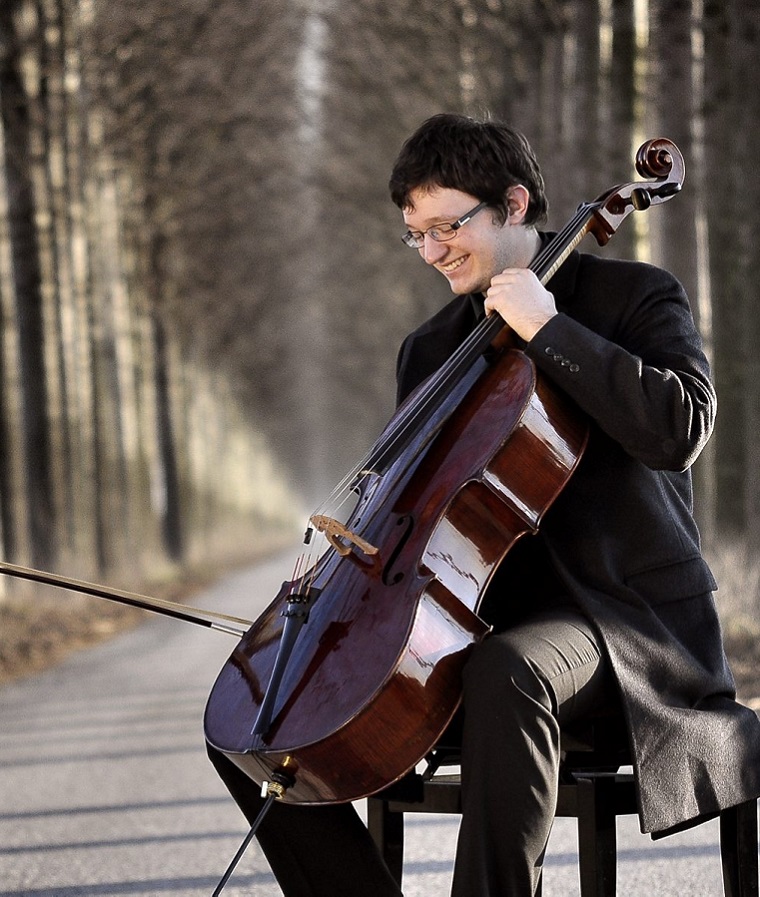
A young cellist and composer, an Italian but resident in London, kindly answers our questions. How and when did you meet the cello in your life?
I started studying cello at the age of 9, after attending a concert lesson held in my city by a professor at the Conservatorio di Udine. I had already approached music, first with the study of the piano, and flute, and then participating in the courses of musical propaedeutics. The cello was an instrument already present in the house; my father, in fact, had taken some lessons, after being inspired by a memorable concert by cellist Alain Meunier held in Portogruaro in 1985. The spark for the instrument struck in me, however, only at the age of 16, after meeting the famous cellist Teodora Campagnaro. The passion, the determination, the tenacity of this person made me discover a vital tool full of “sacred fire”. Shortly thereafter I should have joined his class in the conservatory, but unfortunately, she passed away following a serious illness.
Can you briefly tell us about the most significant stages of your studies?
My training began with Professor Federico Ricardi di Netro in the Conservatorio di Udine, a fundamental figure. After graduating in Venice, I continued my studies with Giovanni Sollima at the Accademia di Santa Cecilia in Rome, my idol along with Mario Brunello. Later I moved to London to study with Melissa Phelps, a student of Jaqueline Du Prè, at the Royal College of Music. Melissa was a very decisive and very generous teacher, to whom I owe a lot.
What are your most important interpreting experiences? Do you prefer to perform as a soloist or in chamber ensembles?
I like to perform both as a soloist and as a chamber musician. As a soloist, I played with Claudio Scimone and I Solisti Veneti, a truly unforgettable experience. I happen to play in many solo cello recitals, with a repertoire including classical composers, and my compositions, that are often supported by electronics. I am a member of the Trio Klein, a London-based string trio, and I am about to debut a new project in the formation of a trio with piano. Certainly, my most important performances include the concerts in quartet formation with Mario Brunello, the 100 Cellos experience with Giovanni Sollima, my recital at the Royal Albert Hall, and my compositions performed at the Southbank Center.
How important is it for you to choose the place where a concert takes place? What are the characteristics of the places where you love to perform?
The venue is important to me. In general, I always look for a place that predisposes everyone to listening. The theater is certainly my favorite, but I also feel very comfortable performing in unconventional places for the inspiration I usually get. For example, outdoor places, such as mountains, old castles, rivers, lakes, and also photographic studios, or old industrial buildings. They all are able to convey people’s stories in music.
How important is the choice of instrument? His, what cello is it?
I play an instrument built in 2014 by the master luthier from Cremona, Edgar Russ. The choice of instrument for me is very important, it is a part of my being, something that fits perfectly on an intimate level. In the beginning, like everyone else, I was looking for an ancient instrument. I wanted some nice names from the early twentieth century, but when I met Maestro Russ and played the instrument I own today, I felt in perfect symbiosis with the cello I had in my hands.
Which record labels have you collaborated with and for which projects?
I collaborated with the Velut Luna, and Concerto labels and I hope soon to be able to make a solo album with Limen and Orpheus. The lockdown has unfortunately postponed many projects and I hope to be able to resume them soon.
How did you approach the composition and what are the composers you consider as its main models?
I approached composition at age 18, after my eighth-year exam. I wanted to understand how composers managed to write their music. Counterpoint in particular fascinated me very much and I wanted to master it. I was good at harmony and I was very passionate about Daniele Zanettovich’s books on which I studied. I started privately with Maestro Mario Pagotto who immediately encouraged me. Afterward, I continued my studies with Battista Pradal until my admission at the Conservatory of Trieste under the guidance of Fabio Nieder. Last September I signed a contract with Piero Ostali for his Sonzogno Music Publisher in Milan. I am inspired by composers from all eras and styles, such as Bach, Beethoven, Schumann, Strauss, Pink Floyd, Giovanni Sollima, and Ennio Morricone.
What are the expressive possibilities offered by electronics? How do the sounds generated by the fingers, wood, and strings of a traditional instrument interact with each other with a “synthetic” sound, conceptual like mathematics, born from a “non-instrument” designed by the mind?
Electronic music allows us to greatly expand performing possibilities in a very creative way. You can create polyphonies, harmonies, sound spaces, and colors very effectively. The contrast between the material nature of a classical instrument and the algorithm of digital software is a source of great inspiration for me. I think this is also a synthesis of our contemporaneity. I always try to find a good balance between the act of live playing and digital effects in order to avoid the feeling of something too artificial.
On the occasion of dramatic events, such as those that we have recently experienced during the pandemic, music must, according to her, constitute an escape from a reality of suffering, or must entice the listener to reflect on the value and on the meaning of life?
Music, like all arts, is Beauty and we need it every day, especially in moments of despair and confusion like what we have recently experienced. Art, in general, played an essential role during this lockdown, there are countless initiatives and online participation in cultural events of every kind. Personally, I was the promoter of the very first live online music festival called “#AndràTuttoBene Online Music Festival”. An initiative that began on March 14 that offered every day a 15-minute-long performance; an almost desperate act to respond to the silence created by the cancellation of all cultural activities. Today it seems that things are starting again and perhaps we have rediscovered the emotion of the live concert again.
What will be the next commitments pinned on your agenda? What are your dreams and plans for the future?
I will return to London in late August and in the meantime I will have several dates with a repertoire for solo cello, soloist with orchestra, and a project dedicated to cellist Josè Bragato, Friulian like me, conceived by my piano collaborator, Andrea Boscutti. My dream is to be able to play a lot of music, in many places, and meet people to collaborate with.
Thank you so much for your availability and good luck with your next dreams!
A site to quickly and effectively find everything a cellist asks on the web