
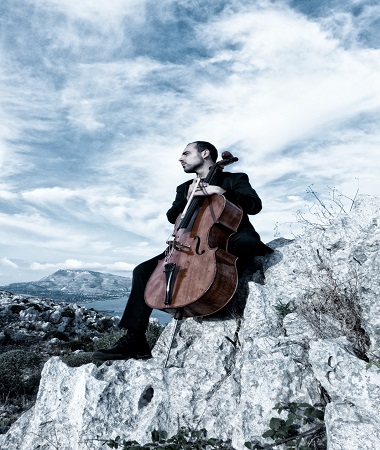
Good morning Alessio Pianelli. Thank you for your interest in our website and our readers.
At what age did you approach the music? In your family, did anyone already play the cello or any other instrument?
Music has always had a fundamental role in my life. When I was a child, I started playing the piano together with my dad, a jazz pianist. When I was 10 years old, I met the cello and my first teacher, Giovanni Sollima.
Can you tell us something about your studies up to the diploma, and about your first teachers?
Until graduation, I studied exclusively with Giovanni Sollima. I met him in the Conservatory of my town, Trapani. After a few years, he moved to the Conservatory of Palermo and, of course, I followed him until my graduation, in 2007. I have always seen him as a father. He never imposed anything on me, he never told me how to study, or imposed on me an arch or fingering, even in the years near the diploma. He played together with me and, always together, we approached the technique directly on the repertoire pieces. He always encouraged me to be curious, to find the highest number of possible solutions to a single problem, avoid focusing only on cello, and classical methods. In a few words, I tried to develop as many points of view as possible, to be free to find “my” solutions, always serving my instinct.
After graduation, how did you improve your knowledge of the cello?
After graduation, I remained in Sicily for a year, to complete my high school studies. Then, I participated in a few Masterclasses with Mario Brunello, Massimo Polidori, Maria Kliegel, and Reinhard Latzko. After the experience of one year as principal cello at the “Orchestra 1813” of Como’s Teatro Sociale, I met Thomas Demenga, who invited me to study with him at the Hochschule für Musik in Basel. Demenga welcomed me making me feel all his appreciation for my “freedom”. He was able to guide me toward the direction of academic rigor, avoiding any traumatic way. He taught me the importance of simplicity, clarity, and honesty. I learned not to be obsessed with career and short-term results, focusing mainly on the learning process.
In your curriculum, there are already important acknowledgments: could you remember the most important ones?
The most important acknowledgments for me are the simplest and least conspicuous ones. I remember the tears of a lady and her very strong hug, that lasted an eternity, after a concert in Ukraine, a few months ago, or even the eyes of a student and her “Grazie” at the end of my Masterclass in the summer of 2016. When I understand I’ve really touched the soul of a person, I can recognize the real power of my music. If instead, we want to talk about awards that would have made my career easier, the most important are the Prizes the Janigro, the Mazzacurati, the Renzo Giubergia Competitions, and then the Borletti Buitoni Fellowship.
What about your CD? What are the record companies with which you have produced the CD? What are your short-term projects?
I recorded chamber music for Claves, Nami Records, and Concerto. I also regularly collaborate with Almendra Music, a Sicilian label founded in 2012 with which I have already recorded a CD for cello and piano dedicated to Beethoven, Brahms, and Hindemith and two CDs, “Prelude” and “Sulla Quarta” for solo cello. These last two are part of a 6-album project. Each CD includes the presence of a Bach Suite, combined with contemporary music or the largely unpublished 1900s. It is, therefore, an integral of the Suites, but unveiled over the years: a journey that can tell the intellect, the timbre, and the human growth of a musician in his twenty and thirty years. A path of eight or nine years in which, album after record, one of these milestones in the history of music for cello, is flanked by the music of the century just past and the new one, today, close to the culture and perceptions of a born boy in Sicily in 1989. Now, I’m working on a CD for cello and orchestra that, thanks to the collaboration born with Borletti Buitoni of London, will be released in 2020.
I know that you played in Bergamo too, at the International Alfredo Piatti Cello Festival. What do you remember about this experience? Is Alfredo Piatti today again a reference for a cellist?
Piatti and his compositions are obviously a reference for a cellist. He developed the technique of our instrument enormously and made his fortune by emigrating to England. An example also for the young people of our time. To play in Sala Piatti, in the presence of that enormous portrait of the Maestro, was an honor and also gave me a certain sense of responsibility.
You are also a famous composer: is this an important aspect of your career? Can you briefly describe your commitment in this area?
To compose is a fundamental part of my life. The cello is movement: airplanes, trains, concert halls, rehearsal rooms, dinners, and company. It is the main factor that every day leads me to be in touch with people and with the outside world. To compose is instead that meditative factor that allows me to enjoy the solitude of being closed indoors for days, to listen to my emotions and my thoughts, and to be able to put everything on paper and to really grow up. I started composing for myself, to study and to develop my imagination and my musical consciousness so that my playing cello could reach levels that only study on the instrument could not allow.
Soon, however, commissions arrived, invitations as “composer in residence” and then I began to compose for the public too. My last commission in order of time came from the Zurich Philharmonic Orchestra, who asked me for a piece for cello, harp, and orchestra that will be performed in March 2020.
Which cello do you play and how did you choose it?
Now I play an Evasio Emilio Guerra, a cello of the early 1900s. I am very grateful to the patron who entrusted it to me because it is a beautiful instrument, with an exceptional sound projection that allows me a particular “comfort” in every acoustic situation. But I must confess that I have not yet found the cello that acts as “my” voice. I have a color clearly in mind, with all its nuances, and I look forward to the day when I and that cello meet!
Thank you so much for your kindness. Best wishes for your career as a musician and composer.
A site to quickly and effectively find everything a cellist asks on the web