
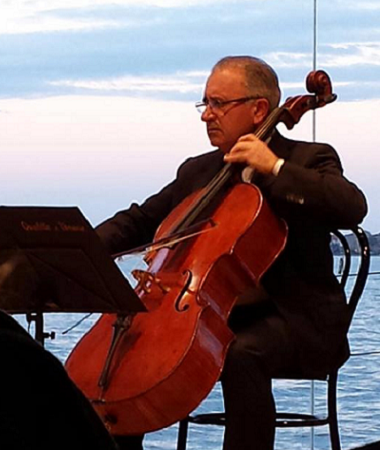
I write to Angelo Zanin, cellist of the Quartetto di Venezia, to ask if he is available to answer some questions. He willingly accepts and responds by e-mail. I would like to have the opportunity to meet him in person, but a thousand commitments force me to be content with a virtual contact.
When did you start playing and why did you choose the cello?
I started studying the cello after singing in the choir and playing the piano. A little late compared to my peers, that is 14 years old, but I came from a family where music was neither considered nor expected. So I think it was normal for me to have developed this desire and the need for this study a little later with age. I mean that I did not have the family support that many guys have (dad or mom musicians, the luck of having music at home since childhood, and the desire to go to concerts and listen to records) and then I had to become aware of my attitude and be able to develop it. But this meant that immediately I had a clear awareness of my passion and determination in the study and sacrifice that the study of music requires, something that is not so obvious in many children, especially at that age. Why the cello? Maybe it was a bit ‘random… I studied piano. I had a neighbor who played the horn in the orchestra of La Fenice, perhaps the most important theatre of Venice, and he, knowing my passion, suggested I study the cello… “So you can play Bach’s Suites”. At the time I did not know the cello and much less I knew who Bach was, but this story intrigued me so I went to a concert at La Fenice to see what a cello was. I was very impressed by the Symphony n. 40 by Mozart, by the Unfinished Symphony No. 8 by Schubert, and by that row of cellists who played, sometimes accompanying and sometimes singing beautiful themes. I was enchanted by the color of that sound, warm, fascinating, and sinuous, and at that moment I decided that the cello would be my instrument.
Which teachers were most decisive in your training and from what points of view?
I was lucky enough to have formidable teachers and I think this is one of the most important things for a guy who starts studying an instrument. And it’s also a very important thing in a music school… How many kids have been neglected and ruined by people who have nothing to do with the teacher figure! Teaching is not a profession suitable for everyone: it takes love, passion, dedication, willingness to sacrifice, as well as of course important instrumental skills… My first Maestro was Aldo Pais, the first cello of the orchestra of La Fenice that made me discover Mozart and Schubert. He was very old, but he took me from the first lesson to the fifth-year exam, giving me excellent bases, stimulating my love for music, and making me discover many styles, in particular, the twentieth century… I was very young for the technical possibilities that I had and he was pushing me to study Hindemith and Malipiero. I loved it. It was the grandfather I had never had, patient and good, never a bad word, never a loud voice. I was so fond of him and I always went to see him. Sometimes I made him feel something, Boccherini, on which he worked, and his studies… When I needed to talk or to ask for advice, he was always there. He helped me a lot and I owe him a lot. I must tell this anecdote about my first teacher because it always seemed very strange to me. In that year I studied the fourth volume of Stutschewsky’s studies. I knew I should soon start Duport’s studies and I was very excited about that idea. Knowing that only two studies of that volume were missing, one day I went to class and told him: “Dear teacher, I would like to start Duport, this volume is now almost over …” He looked at me with his calm and good eyes and replied: “Let me see which are the three studies missing…” I gave him the book and he flipped it through to the end. Then he said to me, “Angelo, not yet: this of Hindemith must be done absolutely.” Then I went home and, although I did not understand why I had to do it, I studied it. Years later, maybe forty years after that lesson, we had a proposal from Rai (the Italian national television channel) to play a quartet of Hindemith, and when we got the part and flicked through it to start studying it… I did not want to believe it! I went to take out Stutschewsky’s old book to compare it and it was just him! Fourth time of the quartet, a time where the cello has an important solo part: it develops a beautiful theme, which gives the piece a rhythmic and lively, almost rhapsodic character… Beautiful indeed? Also incredible! I studied Hindemith when I was so young, and the quartet still was not in my thoughts… I studied Hindemith when I was so young, and the quartet was not in my thoughts… I’ve always found it a strange coincidence! When M ° Pais retired, I passed into the class of Maestro Adriano Vendramelli, and there everything changed. He was a rather gruff man, diametrically opposed to my previous teacher, and with a completely different teaching method… Initially, it was very hard for me: I had to change a lot of things in my way of playing and, finding myself studying Popper and Servais, it was very complicated. Then, slowly, I got used to it, I understood its methodology and I adapted. He helped me a lot in many things: sonority, agility, vibrato, awareness, and technical development. And with him, I finished my studies. He was also the first cello in the theater, and with him, I had my first, and unique, experiences in the orchestra. At the time I was in my seventh year and, for me, playing in the orchestra of La Fenice was a dream. Thanks to him I was able to live, even if for short periods, the environment of the theater, of the opera. I remember Falstaff, Traviata, Maria di Rudenz, and Trovatore, but also symphonic and contemporary music concerts: fundamental experiences for a young student. My teacher accompanied me along this path, helping me, advising, and suggesting, and this was very important because I had his guidance not only at school but also in the professional environment. But my most important teacher was certainly Paul Szabò, a Hungarian, cellist of the famous Vegh quartet. At the time, we were talking about the years 80/81, I had not yet graduated, but I had already started the activity with my quartet and, although we were young, we already had concerts and we studied a lot. Almost by chance, we had enrolled in a quartet course in Assisi, with Sandor Vegh. He was a legendary figure in chamber music, but at the time we did not even know him. Our first lesson was like a bomb… a new world opened up before us, and we were impressed and fascinated. It was incredible! From that moment on we started to follow him and I developed the idea of studying the cello with someone who was on this line. So when the name of Szabò came out, I flung myself from him. I remember our first meeting. He lived in Locarno. I had asked for a lesson and had let him hear the prelude of Bach’s First Suite. When the execution was over, he said to me: “It’s not bad… I see we have similarities” (and I was enthusiastic about these words) “Well, let’s get started!”. From that moment it’s been nine years!!! Beautiful years and hard work, years in which I changed my way of playing, but also my philosophy of life… I changed everything: I studied the whole repertoire with him and… studied many compositions (for example, Popper’s studies). Szabò has shaped me, during my studies, making me discover a different way of playing. I was attracted to it, like a bee from a rose. I absolutely wanted to play like him, but this was not easy at all, because he was an incredible musician, with first-rate technical and musical qualities. He had a sound, a bow, and an exceptional vibrato, which I found only in great performers. He fascinated me when he said: “Casals told me ‘do it this way'”, or when he talked about Bartok, Kodaly, his Hungary, or the great musicians he played with, like Rudolf Serkin or Artur Grumiaux. Or when he was telling me about that concert in Tokyo, or the recording of Schubert’s quintet with Casals and Prades… In short, it was an inexhaustible source of anecdotes and memories of legendary people. With him, I studied and increased my repertoire, especially the classical repertoire, and I had from his teaching everything that I am today. With him, I also studied the quartet repertoire and I played the quintet of Schubert, the sextet of Brahms, with Bruno Giuranna in viola, and also quintets of Boccherini and Borodin. I apologize if I have dwelt a little on the teachers I have had but, as I said at the beginning, I will not tire of remembering how having a good teacher is very important. I also owe a lot to the teacher with whom I started my activity of ensemble music. This person was Sirio Piovesan, a Venetian violinist of great musical and human quality. With him (I was in the fourth year) I started to study the great repertoire (Haydn, Mozart, Wolff, Britten, Vivaldi…). We were a small string orchestra that played wonderfully and gave me the basics of playing together. And finally, I can not forget Piero Farulli, the legendary viola of the Italian quartet, with whom we studied at Fiesole and at the Accademia Chigiana in Siena, who was able to transmit a part of his character and human vivacity.
To have good teachers is essential… but it is also important to be good students! In your opinion, is there a way to understand if a child has the chance to become a good cellist?
It is not always easy to understand if a child can have suitable characteristics to deal with this type of study. It is easy to see if he has natural talent and musical quality, but it is very difficult to understand if he has willpower, stubbornness, resistance… The study of an instrument is complex and difficult: sometimes very talented young people do not have the ability to to sacrifice their time for study. This is why I believe the personal choice of the boy is decisive and not the imposition on the part of the parents: only the conscious choice determined by the passion for music can make progress on a journey so long and fraught with difficulty. I believe that a good teacher must first understand the qualities of the boy and then stimulate his growth by activating in him curiosity, joy, and lightness in the study trying, through seriousness and constancy, to increase the passion.
And what are the main difficulties that the cellists have to overcome at the beginning of their studies?
I think that, in the case of stringed instruments, the main difficulty is being able to extract a decent sound from the instrument, which initially seems able to produce only scratches and whistles. But it is also important to have a correct setting of the left hand, which allows the notes to be well-tuned. A very difficult thing for some is therefore the posture of the instrument, the correct position, and also the setting of the arc grip, and of the correct touch. I go back to talking about the importance of having a teacher who is capable and available in the first part of the studies because it is essential to be able to be followed and corrected consistently by a capable and expert person.
But can a teacher always offer his students the same sequence of pieces and exercises to study? Or should you calibrate them to the specific difficulties of each student?
I think there are a number of pieces almost necessary for cellists. They are studies mainly, which remain fundamental for everyone and from which everyone must pass. I am thinking about study No. 5 of the 113 Studies of Dotzauer, at No. 8 with the double strings or the arpeggio study of Duport, or the caprice n.2 of Servais, or nos.6, 10, 22 of Popper, or nn.1 and 12 of Piatti… All very important studies, which we have all studied, and on which we had to sweat… But I also think that every student must then follow a path that can be very different from that of another student. The important thing is that, in any case, this path gives the boy the opportunity to accumulate in his preparation the skills necessary to play the great masterpieces of the repertoire.
And when do you start playing with other musicians? What are the difficulties to overcome? Is it easier to learn to play with other cellists, or in quartet, or with the piano, or in orchestra?
It’s a complex question that I think has very personal answers. I can talk about my life experience, but I think it’s very different from others… I’ve had a strong desire to play with others from the beginning. For me, it has always been a fundamental and indispensable need. I remember that, already from the first studies of Dotzauer, I was excited when the Master sat at my side and accompanied me to the cello. I felt that the humble melody I played at home alone was enriched, and expanded… and I liked it so much! So I immediately looked for collaborations: first in class with my fellows. I remember that, shortly after, I had formed a duo of cellos with Alessandro Zanardi (then the first cello at La Fenice). Together we had fun playing the sonatas of Breval and Boccherini and we also wrote some of our friends, composition students. As I said before, in the fourth year I started the string orchestra with Piovesan, and from there the quartet with the piano and string quartet were natural consequences. I have always had the desire and the passion to play with others because I believe that sharing is not only the most beautiful thing in music, but also the most important for every musician, and so I recommend it to everyone right away. Playing with another cellist is very simple because the problems are common and can be easily solved together. Some more complications are given by the piano (especially in the first period of study) because often the pianist has no chamber experience and tends to submerge the sound of the cello. I believe that the practice of chamber music should be made mandatory for all pianists. In the quartet it is wonderful, and I was immediately in love with it, so much so that I made it my reason for living. I do not think there is a more beautiful, difficult, and perfect ensemble of the string quartet. As Luciano Berio says, not only is it the symbol of Western musical civilization, but also “a school of democracy that everyone should have attended”. Playing for me in the quartet was the natural landing for my “desire for music”: I just needed to find three other fellows with the same idea and, fortunately, I found them already at school (we have been together for over 35 years. I think it’s a record!). Playing in the quartet is very simple and very difficult at the same time, and the first thing you must do is always take a step back. Then you come to know how to listen, to follow in a natural way, to shape your idea by forging it with that of the other three, to have respect for the will of others, to try to assemble your sound with their sound, their intonation, their vibrato to the service of a common purpose. You must dedicate yourself exclusively to this activity neglecting and leaving other things and… without ever thinking about money! In the end, you must have a great passion and a great spirit of sacrifice. The personal qualities are not enough: it’s a unique quality that has to come out… a four-person wedding and a unique instrument with sixteen strings… I see many guys who are dedicated to the quartet today and this fills me with joy because only knowing that a musician tries to devote himself to the quartet gives me a sense of great respect. I must say it is very easy to start, there is enthusiasm, desire to play, and infinite musical beauty… then there are the problems of music and nature. So, if you are not supported by two basic things, passion, and the spirit of sacrifice, sooner or later you will stop. For this reason, as I said before, we must always be able to take a step back in our decisions in favor of the common good. Finally, for the orchestra, I have to say that I do not have enough experience to be able to give any advice, but what I heard playing at La Fenice in these short periods of my youth has thrilled me, introduced me to the world of Opera and made me love this world. I think working with singers is one of the most important experiences: when you are lucky enough to meet a high-quality singer, you have the opportunity to learn a lot. In my short experience, it was when I could admire the soprano Leyla Gencer. Being able to hear those wonderful sounds was a very informative moment. But I always refused the idea of playing in an orchestra that did not have an important quality. Wasting years of studying and becoming a sort of music clerk was not in my expectations. I never liked the approximation in music and I learned to never underestimate even the simplest theme and the one you know best, so I always looked for a preparation that would give me the opportunity to play as I wanted to play and I always had studied the parts a lot, but this was not very common at all… I have always wanted to be in charge of what I was playing and I always tried to prepare to play it. At the time there were many orchestras that did not have this quality, and this prevented me from even just being able to stay inside. Today the level is much higher in general because there are many talented and talented young people who have given quality boost to many orchestras. I think being able to play a cycle of Beethoven’s Symphonies could be the dream of every musician, and I miss other great symphonic masterpieces, but in your life, you can not have everything…
In your professional activity, have you got more satisfaction in playing or in listening to any of your good pupils?
They are two completely different experiences and one does not exclude the other. Playing a great masterpiece with my quartet gives me joy and great satisfaction because it is the realization of my dream as a young artist. But I had many talented students and when I listened to them in concert (for example some soloists with the orchestra) I always experienced a natural pride and a paternal emotion, but it is a different satisfaction from what you feel when your fingers give life to music… Very often I get very excited to hear a student of mine because I see myself in him in many things. So I try to take off my teacher dress (not to fall into the error of listening with the critical ear) and I simply enjoy the moment.
If you were asked to organize a concert for elementary school children to present the cello, what would you play?
I would like to try to present the cello in the easiest way for children, without talking too much and playing a lot. I would play everything, not just simple things, but also our most important repertoire, trying to highlight the sound and the tonal and expressive possibilities of the instrument. I would like to play pieces of various styles and ages, until today, to clarify that with the cello you can play everything, both Bach and a little tune.
What if they ask you to organize a concert for teenagers?
Adolescence is a difficult time… Teenagers already have their own very defined tastes, and they are more difficult to approach. We should find a way to explain what we play and how we play, without being pedantic, but I think it is important that they also understand the difficulty of playing well an instrument like the cello. Then I think the most important thing is to draw attention immediately, proposing a piece, for example, something of Sollima, which could be close to their sensitivity… and then you could lead them into the heart of the repertoire and let them discover our musical pearls. I speak of Sollima because I consider him an author who can have a very strong impact, because he makes the pressing rhythm and the immediate melody his main characteristic, which is well suited to such a young audience. A good idea could be to bring a small group of young students of music, to play some famous songs and to understand the enormous and unique possibilities of this instrument.
Which are your favorite authors and which ones… you just can not stand it?
I love all the music… the “beautiful” music, which you can find in every style and in every era… I’m used to this, and I try to push my students in this direction. With the group of cellos I created with some of my students, I study and prepare concerts with various programs. I always wanted to stimulate the musical curiosity of young people with all types of music, from the ancient style to the transcriptions of famous songs, to the important pieces of the repertoire for this ensemble, to modern music, to jazz and contemporary rock. I encouraged composer friends to write for us, to clarify that beautiful music can be found everywhere, and good performance depends only on the study. That said, I think I could never be without Bach’s Suites and, for the quartet, never without Beethoven. I can not stand bad quality music, without passion and without study, I can not stand music without inspiration and without a sense.
What are your musical projects for the immediate future?
For this year the realization of the “Brahms – Schumann cycle” at the Fondazione Cini in Venice, together with some exceptional friends such as Mario Brunello, Andrea Lucchesini, Danilo Rossi, and Alessandro Carbonare. Then a busy tour in South America, and finally the completion of the Beethovenian integral, in Mantua and in Trieste.
I wish you a nice trip in the company of the music you love with so much passion and… thanks for your kindness!
A site to quickly and effectively find everything a cellist asks on the web