
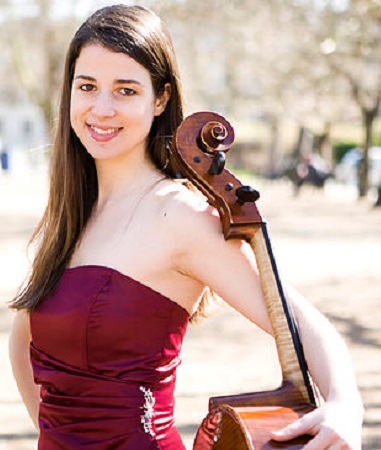
Dear Elena Cappelletti well found. Thank you for accepting this interview and for your interest in our website.
Thanks to you!
The occasion for this interview, among others, is the award you have recently received at the Loiacono Competition. Can you tell us about this experience?
It was a very constructive experience. I had never been in a competition that required both a musical performance and a written paper. I came to know about the award through the website MyCello and found the competition format very interesting. The program to record immediately motivated me to participate and I thought it would be a great opportunity to write an essay on pedagogy that I can use also for the Postgraduate course in Performance Teaching that I’m attending this year at the Guildhall School of Music and Drama of London.
However, this was not your only award in a competition: which are the most significant ones?
I believe that the most significant awards were those with my String Quartet and Alauda Quartet. We recently won first prize at the “Massimiliano Antonelli” chamber music competition in Italy and a special prize at the “Orlando Festival and Chamber Music Competition” in the Netherlands. Other significant awards were in London, where we were selected several times as ‘Concert Artists’ by leading British music associations such as Making Music or Park Lane Group.
But let’s go back to the origins: why the choice of the cello? In the family, there were musicians or even cellists?
The choice of the cello depends on my father, clarinetist and clarinet teacher, who, fond of cello, gave me a cello at the age of eight, and gave me the opportunity to discover this instrument.
Can you tell us very briefly about your education, studies, and specialization courses?
I started studying at the Conservatorio O. Respighi in Latina, with the teacher Vincenzo Cavallo, from the Selmi school. Then I moved to the G. Verdi Conservatory in Milan, where I continued my studies in the solid school of Maestro Marco Scano. Finally, I completed a Master of Arts at the Royal Academy in London with teacher Felix Schmidt. I finished my studies with the quartet, with a Master’s degree in Chamber Music at the Hochschüle für Musik in Hannover, under the guidance of Oliver Wille, violinist of the famous Kuss Quartet.
What are your significant experiences with orchestras, chamber groups, or as a solo cello?
I had many orchestral experiences, one of the most memorable was the one with the Lucerne Festival Academy Orchestra in 2015, which opened me up to the world of contemporary music. In Italy, I played with the orchestra of the Teatro San Carlo, the orchestra of the Fondazione Teatro Petruzzelli of Bari, the orchestra of the Maggio Musicale Fiorentino, and the orchestra of the Philharmonic of the Teatro Comunale di Bologna. In England, I often collaborate with the Philarmonic Chamber Orchestra of London. I was lucky enough to play as a soloist with the Cuban National Orchestra, the Cali Symphony Orchestra, and the Latin Philharmonic Orchestra, in my city of origin.
Now let’s talk about the Alauda Quartet (Alauda Quartet): who are the components of the quartet and how is it born?
The Alauda Quartet was born at the Royal Academy of Music, right at the beginning of our studies, in 2011. We met by chance on a ‘Chamber music speed dating’ day, organized by the Royal Academy, and there was immediately a beautiful understanding between us three founding members of the Quartet, with the two violinists Cristina Prats Costa and Milan Berginc.
What is his favorite repertoire? Which scores are most frequently on your music stands?
At the moment we are building our repertoire by comparing works from different musical eras. Mendelssohn and Shostakovich are among our most popular authors!
What are the future programs of the Alauda Quartet?
We will participate in the “Evolution of the String Quartet” summer program at the Banff Center of Performing Art in Canada, studying repertoire, style, and interpretation of the String Quartet from Baroque to Contemporary with the Eybler Quartet, Parker Quartet, and Jack Quartet. In September we will be at the Master4String in Pistoia, with the Quartetto di Cremona. We are preparing for a chamber music competition to be held in Lugano in September.
The Quartet has already recorded an important CD dedicated to Roffredo Caetani: why this author? Can you talk about this job? If I’m not mistaken, even major magazines have reviewed your CD well…
The proposal to record the music for Quartetto by Roffredo Caetani came from the Roffredo Caetani Foundation, active in the province of Latina. The pianist Roberto Prosseda, also a native of the province of Latina, has in the past recorded music for Caetani’s pianoforte works, but his chamber music works had never been recorded. It was very interesting but also difficult to approach the music of this author not having previous references, but he gave us the opportunity to discover and bring to light a very interesting Italian late romantic composer. Yes, his music has aroused the interest of many international music magazines, the two quartets of Caetani have been described by Strad Magazine as the missing link between the music of Brahms and that of Schoenberg
And now the last question: your programs for the near or distant future?
Quartet, Quartet, and Quartet! No… I’m joking. There are also other projects to be completed, concluding the Postgraduate Course in Performance Teaching, a collaboration between music and theater for a show inspired by Italo Calvino’s ‘Invisible Cities’ and the concert tour offered by the Loiacono Award!
Many thanks again for your availability. From all of us the best wishes for your life and your future as a musician!
Thanks a lot!
A site to quickly and effectively find everything a cellist asks on the web