
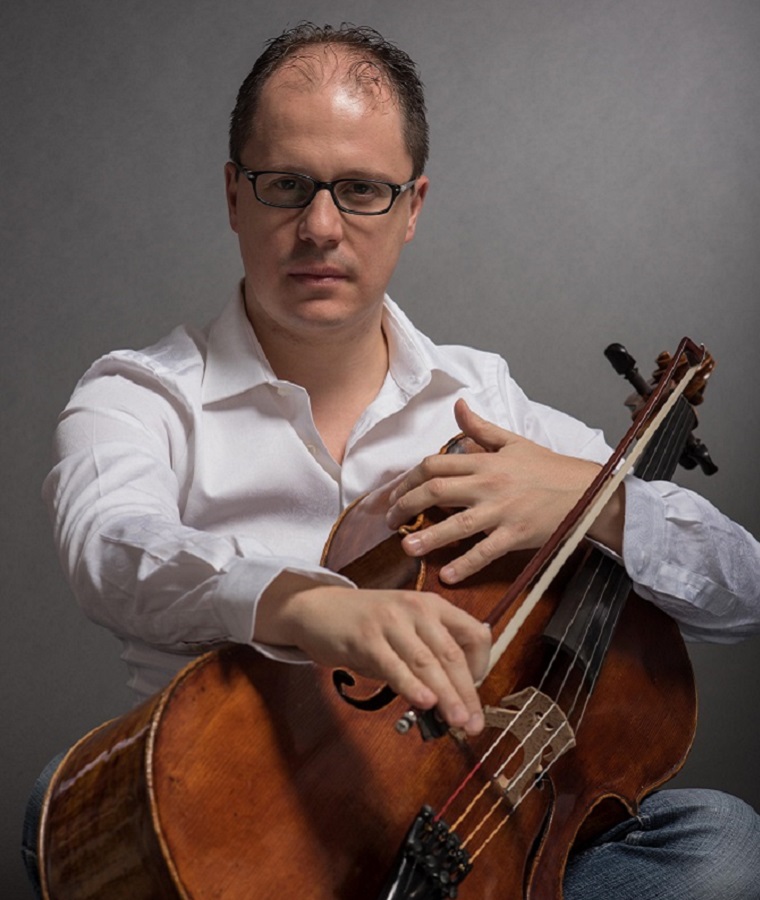
Giovanni Gnocchi needs no introduction. During the quarantine period, his busy life stopped for a moment and Giovanni wants and has time to answer my questions.
Do you think that being born in Cremona, the home of luthiers, has somehow influenced your choice of playing the cello? Do you remember when you first saw and heard a cello?
It certainly influenced my choice of cello! Thanks to a German friend: Reiner Hertel, a German biologist, my father’s partner in the Ghislieri College of Pavia, and then a professor at the University of Freiburg, took his violinist son, Wolfgang, to Cremona to look for an instrument to buy, and I first listened to the sound of the violin, a beautiful instrument by Bissolotti that had fascinated me and completely kidnapped me! The warmth of the sound, the magic that was caused by the rubbing of the hair on the strings, the depth of the vibration and the ability to immediately tune in to the depth of our emotion and really “talking to us”, as I had never heard, marked me for always! Then my events within the Cremona music school were a little complicated, certainly not rosy or happy from the beginning. It was then a reality just born and at the beginning, and therefore also very provincial and in some ways a school for amateurs. I think I was put in the cello class a little to fill a half-empty class when the violin ones were full, and strangely I didn’t give up like all my companions, but maybe even then my perseverance, loyalty to a task came out, or simply if you prefer, the hardness of my head … Then I also had the good fortune to meet a couple of people who certainly helped me not to feel like an “alien”, and maybe they really changed my life then: the luthier Marcello Villa, who is also an excellent violinist, with whom, since I was 12 and he was 24, I spent several afternoons in the shop talking about music, listening to recordings and who made me know a lot, about the history of music, the repertoire, and with whom I certainly shared the great passion for listening, research and discovery, and the violinist Andrea Rognoni, a few years older than me, who is now the soloist and shoulder of the second in Fabio Biondi’s Europa Galante, and who as a young man was very seriously determined to be a professional musician (which he is doing very well, playing precisely as well as with Biondi, with Zefiro, Ottavio Dantone and the Accademia Bizantina, the Collegium of Gent with Herreweghe, and in his fantastic AleaEnsemble!), even if such a choice, in Cremona between the 80s and 90s, seemed absurd and a huge gamble, almost crazy, unfortunately. So, especially thanks to them, in the beginning, I managed to survive and hold on! Then, certainly, the opportunity to listen to the lessons of Rocco Filippini in Cremona, as well as those of Accardo, Giuranna, and Petracchi, who clearly had the merit of being able to attract the best young instrumentalists in circulation at that time, contributed substantially, thanks to which I discovered, listening to the lessons, another repertoire, and I learned some musical and instrumental principles. I remember very well the lessons and concerts with the young Marco Decimo, Relja Lukic, Simonide Braconi, Francesco Fiore, Alfredo Persichilli, Federico Guglielmo, Massimo Quarta, Sonig Tchakerian, Marco Rizzi, Sergey Krylov! I think I spent whole afternoons sitting in those classrooms diving, into sharing music and discovering a world that I already felt was mine. In retrospect, Simonide (Braconi) confessed to me that they said to each other: “Who is that boy who stays here all day?”. Of the cello sound listened to as a child, however, I have some memories that are not perfectly defined, but I remember a Triplo by Beethoven with Accardo, Filippini and Maria Tipo and the Chamber Orchestra of Europe, which Accardo often invited to the Cremona Festival, and then a concert by Paul Tortelier in Cremona, where he presented and played his Mon Cirque! My parents have always been very passionate about music (they told me I was born on the notes of Pergolesi’s Stabat Mater!) And I was lucky enough to be able to go to concerts since I was a child. In particular, my mom loves opera (Mozart and Carmen his favorites!) while my father has always had a great culture of the German instrumental repertoire. For example, it took me, around the age of 12, to hear the Takacs Quartet playing Webern and the Quartet op. 132 by Beethoven and I remember that I was a little bit upset in hearing that these instrumentalists “quarreled” or had real “musical quarrels” on stage, but then I was very intrigued, so much so that, in the early days of my second media, there was not a morning that I didn’t listen to a bit of the Op. 132 before going to school!
Often those who start playing an instrument have a particular piece of music that they have heard played by a great player and they dream of playing that piece. Was there also this song for you? And a great player?
I would not like to disappoint those who follow us and read this interview but … to be honest I really do not remember such a dream, in particular, let’s say that in the period between 12 and 14 years I fell in love with all the pieces I heard (and that then I listened to exhaustion, as I believe my sisters and parents can testify … but every now and then I put on headphones!), I can certainly say that I “consumed” the recording of the Schumann Concert with Misha Maisky, Bernstein, and the Wiener Philharmoniker and the Concert Barber with Yo-Yo Ma! Surely these two performers had a huge impact on me right away, the first for the incredible beauty of the sound, warm, round, and cantabile, the second for this very personal way of being able to speak directly to those who listen to him since the first notes of a concert. But I must also mention the Variations on a theme by Haydn op. 56 and the First Symphony of Brahms with Georg Szell and the Cleveland Orchestra, Mozart’s Requiem, Concerto K 466 with Ashkenazy… In short, not only cello!
A cellist, usually, studies with a teacher and then specializes with others. Confronting the point of view of a teacher other than your own, in your opinion, is it useful at any age? Or is it better, first, to proceed for a time under the guidance of a single teacher? In your case, how did things go?
I can say that, from a certain age onwards, it is certainly very useful to be able to deal with different points of view and approaches. The problem perhaps arises when children do not get used to putting information in perspective, and not only in music, from an early age. The development of the critical sense, the ability, and habit of knowing how to contextualize any information that you hear or receive feed your continuous curiosity and get you used to ask questions. It is also useful for questioning the great certainties in order to “explain better” and therefore understand them better, wondering what more can be done and also know how to check where the work has gone. These are all things that anyone could and should be educated to do since he was a child, also because in society they are responsible and aware citizens, and not just objects, I think. If you are lucky enough to have a serious teacher who follows you and also explains the profession of music frankly and with the right “secularism”, then there should be no problems with the comparison between different ways of expressing the same concepts or different points of view on the same aspects. (When studying The Divine Comedy in high school or Leopardi in middle school, footnotes often tell us about different interpretations of some passages!) I, in the last years of study, more or less in the same period, was a pupil of Clemens Hagen at the Mozarteum and followed the Steven Isserlis’s Masterclasses in Cornwall and then Natalia Gutman’s in Fiesole, three cellists who have, for example, a tradition of using the bow and a very different sound imagination, but I can say that I was very happy and lucky to have been able to work with them and learn from them! In the current situation in Italy, there are more and more excellent conservatory teachers. Unfortunately, however, they often have to extricate themselves in a world of continual unfortunate laws dictated by politics and, above all, they are appointed by the Ministry of Education absolutely too late in the school year, and are often forced to move from one city to another, which it means very often not being able to build a class over time (because this process needs time to be able to root a mentality also in the territory) and obviously create problems for the students: often changing teachers, maybe even with the school year started, is a nightmare. Then, on the other hand, we know that there are also a lot of examples, and my friends and colleagues talk to me all the time, about people who are not suited to the job they are called to do, or who do not want to devote themselves passionately to most important years of the training of people first, and future professionals then: at this moment, with these truly unfortunate ministerial laws and reforms, we need even more stable reference figures, with the right professionalism and competence, dedicated body and soul to this cause. In the last 30 years, a great example has certainly been Luca Simoncini, with whom I have had the good fortune to graduate, and with whom, even studying only in the last year of the course and a little the following year, I learned more than in all previous years. It would be nice if the figure of the basic teacher was recognized with great admiration also by society (and therefore ultimately also by his own students), the recognition of the importance of this role would allow, over time, also, possibly, to have more passionate and gratified teachers in this very difficult and very important profession! Then, of course, I also witness a huge epochal change in the basic habits of young people. In the way of learning, the internet has helped in some ways, but it has also created a lot of damage. The first damage among all is the great and disarming superficiality to which it can get used: I can say that when I take Masterclasses in recent years, beyond specific professional skills, techniques, ability to use the bow or even purely musical theoretical knowledge such as harmony or some principles of executive practice (all things that can be learned over time!), the aspect that alarms me most is the poor habit of thinking, the total lack of initiative. Often I see guys who, in normal life, are bright, funny, ironic, and extremely alive, while when they sit with the cello they look like other people, unmotivated, dull, uncritical, and abulic. I believe this is an aspect to be considered seriously. Without generalizing, of course, but I challenge anyone to deny that when a brilliant or simply good young pupil is found, in many circles it is often spoken of as an exception! (Think if a high school graduate in Medicine was considered an exception … well, we would not be in good hands in our hospitals, and instead look these days how much we owe to our fellow citizens who work for Health, and that I would still like thank you very much …). My mother, who taught in elementary schools, always told me that if the results of a verification test are too negative, it means that it is too difficult, but if it goes too well it means that it is too easy. In a class, there should always be a fair balance between students who are more gifted and who are “doing well” and others who are “less well”, with all the middle ways. Let’s look at the final marks of the exams in the Conservatory, often very good, and with various honors and mentions (in Italy as well as elsewhere, but let’s start with us!). And then let’s see, after 10 or 15 years, which work those guys are doing and let’s ask ourselves if it is not appropriate to review the right selection, even in the first years of study.
A site to quickly and effectively find everything a cellist asks on the web