
Good Morning Ida. Thank you for your availability for this interview. Thank you for your attention to our website.
Good morning, and thank you for contacting me.
Can you briefly describe the family environment in which your cello interest was born? Were your parents musicians? Or did you have any other music lovers in your family, like grandparents or other relatives?
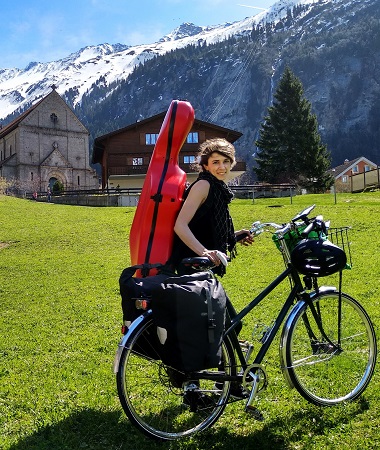
I grew up in the most wonderful home for a child who is interested in music. Some generations back in our family there are composers, opera singers, pianists, and other artists. My grandparents met in the youth orchestra, and both my parents like to play several instruments in their spare time. In our home, you could find almost any kind of instrument, and pick the one you liked the best. My first instrument was the recorder – which I now also play as a professional. We are 4 sisters, and as my younger sister started playing the cello, I completely fell in love with the instrument. I remember coming for her lessons at the music school and secretly practicing it at home when I thought nobody heard it. Of course, my parents knew, and after a while they let me have my own lessons at the music school. At this time I had no idea how many surprising experiences this instrument can bring you. Or that I would be traveling thousands of kilometers with this big and unhandy instrument on a bike. There is one question you get very often as a cellist. “Don’t you regret that you didn’t choose the piccolo flute?” I get it a lot when I’m on the bicycle. But, neither as a child nor now, would I regret my choice of the best instrument in the world! – And my piccolo recorder fits perfectly inside the cello case together with the cello.
Where did you study cello? In which Conservatory? Who were your first teachers?
My first teacher came from Iceland, Örnólfur Kristjánsson. He completely shared my love for the cello. I remember coming early for my lessons to listen to the previous student through the door. He had a special ability, which is still a mystery to me: My sister and I shared a cello. – An old instrument from our grandmother built in 1761. My sister had her lesson earlier in the day and left the cello at the music school until my lesson. Our teacher liked the instrument and sometimes he played it in between. The interesting thing is, that when I came, I could always tell if he had been playing it or not. It felt totally different, it somehow resonated more and reacted faster to the bow. If I asked him, if he had played it, he would just answer “yes” or “no” as if he didn’t know what he had done to it. Later I studied at the Royal Danish Academy of Music in Copenhagen. I had very skilled teachers. Among those were Professor Morten Zeuthen and Jakob Kullberg. They both managed to convey their experience in the field of music in different ways. Professor Zeuthen had the ability to make you play an etude in the double tempo of what you thought you could, just by playing a simple accompaniment on the piano. Jakob Kullberg, had a bunch of his students coming at the same time. His style of teaching minute bow technique and intonation was somehow so addictive, that you just wanted to hang around for the other students’ lessons.
Did you attend advanced courses after the Conservatory? With whom? What was their influence on your way of experiencing music?
After the Conservatory I had some unforgettable lessons with the Dutch cellist Anner Bylsma. I especially remember one thing he said: “A teacher is someone you come to once a week, but often some of the most important lessons come to you from somewhere else. It could be a novel that you read or a comment from a friend who is not a musician.” This has influenced me a lot because what he said, is a reminder that music is both the innumerable hours of practicing technique and theory, but equally important hereafter is the link between music and life. To me, that is the key to the magic of music.
What were the first experiences with the audience? Who was playing with you?
It was in the spring when I was 8. We had a school concert tour with the music school orchestra, and it was the first time I played for a big audience. I played a fast solo piece on the recorder with my beloved teacher, Kæthe Kristiansen, at the piano. She really knows how to prepare and motivate her students with challenges. We didn’t attend the normal school that week, but traveled around on a bus and played several concerts a day. I loved it and thought, that was just how life should be.
In a few words, how the cello is seen in your country?
A very common comment when you say you play the cello in Denmark is – “How wonderful. That is my favorite instrument.”
I think the cello is very popular in Denmark. Maybe it resonates with the Danish winter mood. It can be quite cold and dark here in the winter, and the melancholic tone of a cello fits well.
What are your plans for the future? At least the nearest.
For the next two years, I have five plans:
– The first is a biking tour through Denmark in May 2019. Denmark is not very big, but still, it will be 500 km and more than 33 concerts in one month…!
– The second project is recording a CD with a Danish record label. It will be my own Bach-inspired compositions and one of Bach’s cello suites.
– The third is a concert tour on a tandem bike. I have an invitation to play in Berlin and I will find a pianist who is willing to share a bike for 500 km and play concerts in churches and castles along the road to Berlin.
– In the fourth project, I will build one more cello. – Did I tell, you that the cello I’m playing is a product of a new brand: a Montagnana-inspired model that I built myself last year. I still haven’t varnished it, but it sounds so wonderful, that I can’t stop playing it! The next cello will be inspired by Guadagnini’s Simpson 1777. I have played some instruments of this model, and I love how the tone is warm and deep, but still very projecting. Building a cello is a big project, I have to say, it takes around 800 hours.
– The fifth project is a ‘Trading Cello’ project in 2020. I will travel around Europe on an interrail ticket and see what you can get in exchange for a cello suite by Bach in different countries. Maybe a cup of tea in London and a local specialty in Rome? – Suggestions are welcome.
And now, perhaps, the main question: what is the origin of your interest in cycling? Why would you popularize your instrument to people cycling in different countries and not by other means of transportation, even less tiring?
I really love classical music, and I think a lot of people will love it too, if they just get to hear it. Think about Bach’s music in an old church. Just one cello alone in a big room. The air is somewhat cold and there is a beautiful smell from the dusty, humid stone walls. The tones fly up high under the ceiling untouched by gravity and your thoughts fly with them. Who would not like that? I love to bike and I love to perform. In Denmark, it is very common to bike everywhere. You can even see the Danish prime minister biking to work. I think for my biking concert tours there have also been a lot of people in the audience who don’t usually go to classical concerts, but who might be enthusiastic bicyclists. By taking the cello out on the roads, I think I meet more people who then get to know about cello and classical music. Also, there is an unexpected benefit from the combination of biking and playing concerts: I think most cellists know the challenges of playing Bach. You always play by heart, and there are often tricky parts to memorize. I have counted the number of notes you play if you play two cello suites and the Partita for flute in a concert, and it is more than 10.000 notes to remember. What I have found out is, that your concentration ability improves a lot from biking in fresh air and being in good shape. Memorising Bach become so easy, and traveling in nature and meeting people is very inspiring for the interpretation in the concerts.
Briefly: what was the itinerary of your trip? How many Km have you cycled and in which states?
I started in the Swiss Alps 2.500 m above the sea. There I played an open-air concert in the snow. From Switzerland, I passed through Liechtenstein and Austria. Then I came to Germany, from there a part in France and finally all the way through Holland to the North Sea. It added up to more than 1.200 km and 36 concerts in two months. I only brought my cello, my bike, and 10 kg of luggage.
The bicycle is the perfect machine but at the same time the most essential, almost the poorest. Inexplicably, however, in the world, there are millions of sports enthusiasts who practice cycling and who follow the great international tours, the classic cycling competitions. This sport retains a legendary charm even in spite of its simplicity: the champions of the past are still alive in history. Is there a relationship between a bicycle and a cello, a musical instrument, which is complex to study and requires technique and years of preparation?
That is a good question. To me, there are some similarities between biking and playing an instrument. I think when you master a piece of music, it means that you have an auditive memory of it. You could say a melodic memory of it. You also have a visual memory of how the sheet music looks bar after bar. And then you have the physical memory, or the muscle memory of it, which means that you can actually play it without really thinking – your fingers know it. And this last type of memory is very similar to biking. Biking is so simple, and it is a muscle memory you use. You never forget it even if you don’t do it for years. With music that you know very well, it is the same. That movement from the 4th suite by Bach that you haven’t played for years, but as soon as you start, one note takes the next and your fingers remember everything. It is a muscle memory like biking.
Music requires preparation but also “contamination” from the environment and relationships. Can the bicycle encourage this unmediated contact with a world to be described by playing?
Very much I think. There is something very musical to the flow of sceneries that passes by when you bike. Some people sing in the shower, and some sing on the bike. To me, biking is the best time for inspiration. I also compose, and very often an idea for a theme comes to me while biking. It is not very practical, because it is difficult to try it or write it. I sometimes record it on my phone while biking and hurry home to try it on the cello.
What kind of reactions have you had in different places, proposing yourself as a cyclist and cellist? How were you accepted?
One concert venue in Germany told me that, at first they thought my email, with a concert offer, was spam mail. They thought it sounded so unusual to make a concert tour by bike. But as soon as they heard the attached video, they booked me for a concert and invited the local TV station. Americans seem to think it is very dangerous to bike with a cello – which it would be in The States with all the cars and no biking lanes. A lot of people can’t believe how you can fit such a big and unhandy instrument on a bicycle, but actually, I met an Italian guy, who told me he thought it must be the meaning of life to bike around the world with a cello. Like a modern version of a troubadour.
And now the most difficult question: if you puncture your bicycle tire, do you know how to fix it or do you have to look for a ride to the nearest village to get help?
I try to travel with as little luggage as possible on concert tours by bicycle. For example just two sets of clothes and a small concert dress, I learn everything by heart so that I don’t need to carry sheet music and a stand. In total, it is 10 kg of luggage, but the most important is the 500 g bike repairing tools. I have been very lucky to have no punctures on any of my biking concert tours so far, but in case it happens, I’m ready!
Thanks again for being patient with us and for answering our questions. Best wishes for your career as a cellist and cyclist.
Thanks a lot for your reflected questions and all the best for the future of your website! Follow my projects on my website
A site to quickly and effectively find everything a cellist asks on the web