
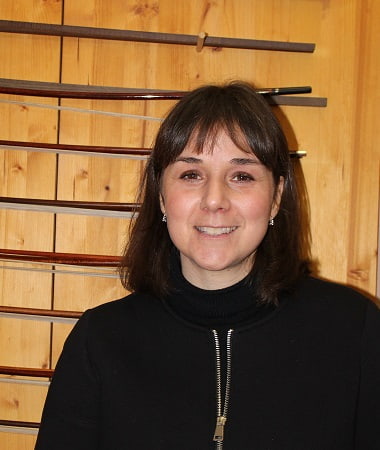
I have just entered the Cremonese Academy, where the secrets of the construction of the arches are taught, and I see a postcard on a table. I take one in my hand and ask Marta Lucchi what they are.
They are postcards that have been designed for children who come to visit the school. Children are always very curious to know what the different parts of the bow are called, and which and how many materials are used to build a good bow.

Only children come to visit the school?
Our Fondazione Lucchi welcomes people of all kinds and backgrounds: tourists curious to know the techniques of processing a “local product”, experts in the artistic production of wood, violin makers, students of the Conservatory, already established musicians who come from the other side of the world and families with children who live within walking distance from here. We also organize excellent courses at the amateur level for those who are not satisfied with a simple visit. Among the aims of the Fondazione Lucchi is precisely that of responding to this desire for knowledge.
Knowledge of how to work and disconnect many different materials, but above all wood: the wood of the stick. What is the “right” wood to build a bow?
The best wood is normally pernambuco, while for the baroque bows snake wood is used. The quality of the wood to be used for an arch is directly proportional to the transmission speed of sound through the wood. When the use of carbon fiber was introduced, my father immediately wanted to try using it. Even in the case of carbon fiber, there is actually fiber and fiber. The risk of carbon fiber is the excessive speed of sound transmission through the bow, which causes a loss of the lower harmonics of the sounds produced by the strings. The carbon bow is perfect for generating crisp and bright sounds but unsuitable for creating soft and mellow sounds. Then there are carbon arches with a pernambuco soul that tries to mediate between the two types of bow.
I look at her perplexed. Marta takes a pine cone and uses it to make me understand how the scales rub against the strings. I understand and I am ready for the third question.
So rubbing on the strings the hairs lose the scales, so as the tires rubbing on the asphalt become smooth?
In Japan, teachers tell their students that horsehair should be changed every three months and horsehair is changed systematically every three months. Obviously, the duration of horsehair depends on how much the bow is used, and therefore to establish a fixed-term change is perhaps a little exaggerated. Under normal use conditions, horsehair change is necessary at intervals ranging from six months to one year.
How do you understand that the right time has come to change horsehair?
Horsehair is to be changed when they break easily when playing or when a large amount of rosin is needed to make them play. One thing you should not do is clean horsehair with liquid substances. Above all, if the operation is carried out with the bow in a vertical position, it is possible to wet the wood under the ring, which could swell and seriously damage the bow.
And to clean the wooden parts of the bow? Hands, especially in summer, always leave traces of sweat on the wood …
All wooden parts should be cleaned every day, when you stop using the bow, with a soft dry cloth, just to prevent the formation of a layer of dirt that is difficult to remove.
What elements should a musician consider when evaluating the quality of a bow?
My father usually advised the musicians to put the bow in 5 stress positions at the same time and evaluate his response in terms of grip: playing with the tip of the bow, playing the fourth string, not playing two strings at the same time, playing near the bridge and play the piano. This is the situation that allows you to better distinguish a good bow from a bad bow. However, first of all, everyone should feel comfortable with the bow that decides to buy. And this depends on factors that no one has yet managed to measure “objectively”. The musician must try the bow without haste until it is necessary to make his assessment. And it is a time that can be very variable. There are those who feel immediately at ease with the new bow and those who must gradually become familiar. Who tries for hours, who asks to try the bow for a few days, and who decides in a few minutes.
Marta stops … asks me to wait a moment and then comes back with a bow in her hands.
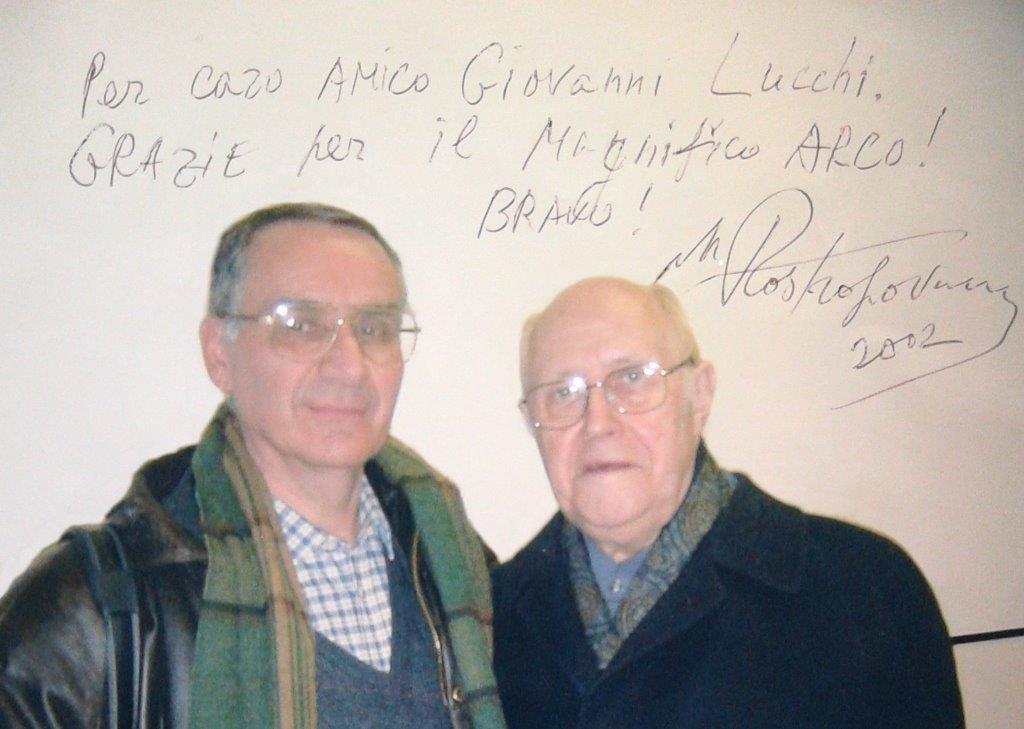
For example, in Rostropovich, when he passed from Cremona, it took only a few notes to decide that this arch was the right arch for the concert he had to make that same evening. Rostropovich managed to grasp the ability to jump out of the arc in a few minutes. Then my father built one specifically for him and gave it to him instead of this, which we now jealously preserve as his memory.
I look at the fascinated bow, touch it with my fingers, and connect the words of Marta to the title of the film by Bruno Monsaingeon dedicated to Rostropovich recently presented in an Italian preview: “The indomitable bow”.
In my brain appears the image of a wild horse, running free on a beach. White horse, white beach, blue sea. A white horse … is it really horsehair that gives the bows the chance to “jump” over every obstacle and make the cellists “indomitable”?
A site to quickly and effectively find everything a cellist asks on the web