
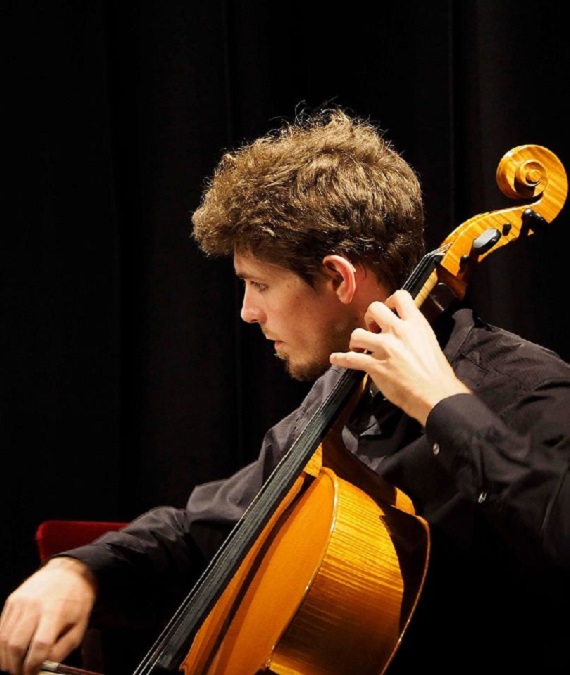
Martino Olivero recently won the Loiacono Competition and gladly agrees to answer some of our questions.
Can you explain to our readers what compositions you have decided to propose for the competition and what is the peculiarity of this competition?
Of course, the peculiarity of this competition is that, in addition to having to play, competitors must face a composition test. For the occasion, I composed a sonatina and recorded it together with the three tempos of the Third Suite of J.S. Bach (Prelude, Sarabande, and Giga). The “extra” test I believe changes from year to year, in fact, last year an essay was written, in addition to the more ordinary part of the execution.
What are the characteristics of the sonatina that you have decided to compose for this competition, and what musical language have you chosen to use?
The sonatina that I composed for the competition is in two movements, the first slow and relaxed and the second more marked and rhythmic. For the language I was inspired by John Coltrane and the cellist Stephan Braun, also I added a quote to the Prelude to the Fourth Suite of J.S. Bach.
What was the course of study that allowed you to reach this goal?
As for the cello study path, I did the classic path in the Conservatory, with the old Italian system; later I also took the second level degree in the same instrument. As for composition, I am self-taught, but I am going to start studying it seriously.
Which teachers and what experiences, in your opinion, have had the greatest influence on your training?
What a difficult question! I am really afraid of not being able to thank all those teachers who, between schools and the Conservatory, have helped me to grow with many small teachings; it is very difficult if not impossible to reconstruct the causal line that led me to learn and integrate certain notions and techniques. In general, I feel very influenced by Enrico Bronzi (whom I met at the master classes of the Portogruaro festival in Veneto), a complete musician, who taught me to consider the compositions in their entirety. Then Damiano Scarpa (with whom I prepared for this competition) played a very important role, and followed me in the years after the Conservatory. Finally, I thank the teachers who followed me to the Conservatory, professors Andrea Scacchi and Massimo Macrì.
Who is the author you love most? What are the compositions that you played with more pleasure? And which ones do you plan to play in the future?
The composer I love most (and who I would play all my life) is Sostakovic, although, unfortunately, I have played little. The composition that I played with the most pleasure is the Sextet op. 36 by Brahms, which I was lucky enough to play with Bruno Giuranna at the Giuseppe Verdi Conservatory in Turin. An experience that led me to love chamber music. In the future, I intend to explore new repertoires, also different from the classical ones, such as jazz and improvisation in general.
Do you prefer to play as a soloist, in chamber music groups, or in an orchestra?
Personally, I prefer chamber music, for the dialogue that is created with other voices. Although, in reality, I always feel like a chamber musician, both in the orchestra (even if in a row), and also when I play solo since most of the cello repertoire only needs the piano, another instrument, or even an orchestra that “accompanies”. When I find myself playing alone, I love the freedom of not having to adapt to someone else and being able to manage the speech independently, however, I always feel the lack of a “confrontation” with someone else.
If you have to do a concert in a primary school, to make her instrument known to children, what would you play?
I would look for short pieces with a simple structure, to keep the attention alive, such as the First Caprice of Dall’Abaco, and other classic pieces, such as times taken from Bach’s Suites. Then, it is always difficult to guess what compositions might or may not be liked: each child is an individual in himself, with his own tastes and attention span. Once, I happened to play the first movement of Hindemith’s sonata in front of a class, a very harsh piece like harmony. I remember that I expected indifference, distraction, and … the most complete mess by the children. Instead, they were all very careful and the piece was highly appreciated. I don’t know if it was a coincidence, but it led me to think that we could be more courageous with the repertoire choices for the younger audience. Obviously, I don’t want to say that only Lutoslawski and Xenakis should be heard, but that perhaps the horizons of the climbers can be widened a little and hope, by the law of large numbers, that one out of twenty might be interested…
And if you had the opportunity to play as a soloist with a large orchestra, which concert would you choose?
One of Sostakovic’s concerts of course, but … I don’t know which one to choose between the two! I heard them both as a kid and they remained deeply impressed on me.
What cello do you play and what is your relationship with your instrument? Your cello is always okay for you or, sometimes, it does not respond to your requests?
My instrument is a Sante Allegri of 1978, a lutist who lived in Glorie, in the province of Ravenna. It is a direct and powerful voice instrument and it is very reliable, you don’t need too much effort to bring out a penetrating sound, but, at the same time, it doesn’t suffer if you want to go more towards the bridge to dig the sound.
What are your next projects and your dreams for the future?
For the moment I am engaged in the wheels of the newly graduated musician: I teach in some private school, I play with some orchestras and I try to build professionalism in this not-easy environment (especially in these times of COVID). Even just being able to have a more stable life, and doing what I like for me at the moment are the main goals, and these days it will be even more difficult than normal.
And we hope that stability will come soon, in the life of all of us … thank you very much for your availability, and good luck with your future!
A site to quickly and effectively find everything a cellist asks on the web