
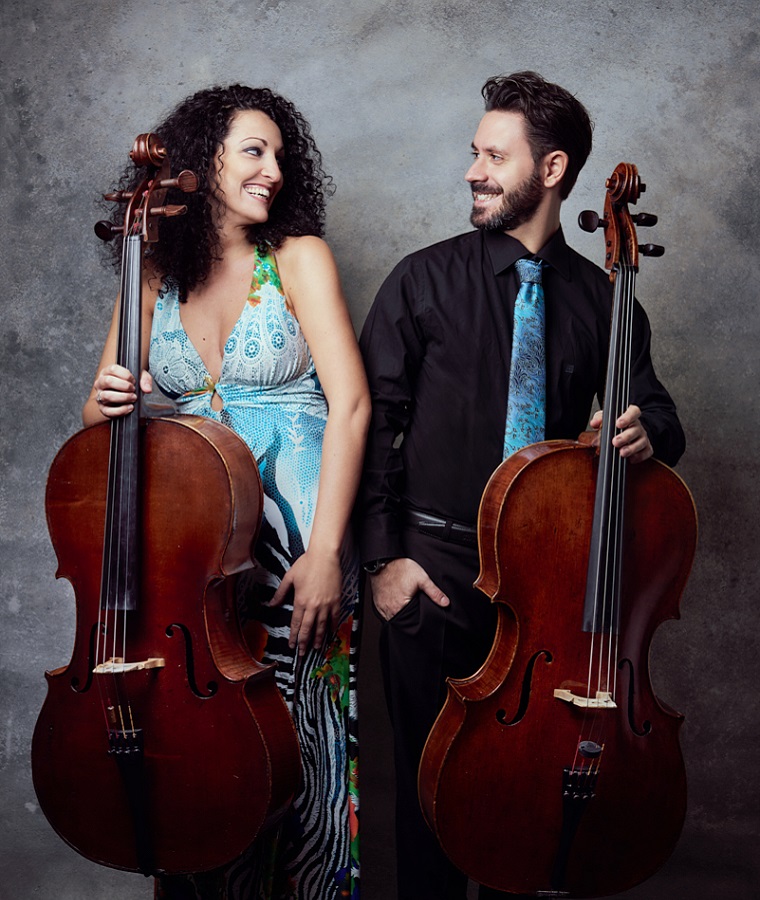
Mr & Mrs Cello, Massimiliano Martinelli, and Fulvia Mancini, companions in life and on stage. Two cellists with great experience in the solo and chamber concert world, between classical and pop. They answer our questions together.
First of all the origins: did you inherit a family tradition for music? Were there cellists among your relatives?
Fulvia: My grandfather Lino was a skilled clarinet player and my father continued this tradition by joining the carabinieri as the first clarinet of the Bologna Fanfare in the 1960s. Then he continued his career differently, but he introduced me to the study of the piano and then, later, to that of the cello. Furthermore, already at an early age, I came into contact with the music of the great composers, since it was traditional to listen to it at home.
Massimiliano: My father taught flute and, during his studies at the Conservatory of S. Cecilia, in the ’60s, he met Selmi, then the first cello of the Rai of Rome, which inspired him to such an extent that he then made me study cello.
Briefly, can you tell us about your training as a musician? Starting from the first courses up to the Conservatory Diploma?
Fulvia: I started my studies with Maestro Egidio Eronico in Ribera, Sicily. Unlike other people, I have had a path dotted with different teachers, but I can say that Egidio has been a great guide for me, especially from a human point of view. Afterward, I studied with Prof. Chen in Modena, where I graduated, and she encouraged me to study in Switzerland, first with Patrick Demenga and then with Antonio Meneses. In the meantime, Maria Kliegel has been my musical model of reference, and I have followed masterclasses with her.
Massimiliano: I started studying the cello at the age of 7 and I graduated from the Conservatory twelve years later. I was lucky enough to have a single basic teacher, Vito Paternoster, and, in the 5-6 years of specialization that followed, I was inspired by several international teachers including Francesco Strano at the Academy of Santa Cecilia, Rocco Filippini, Enrico Bronzi and Ivan Monighetti. Each of them contributed to my technical, human, and artistic training.
Who has contributed significantly to your artistic and professional growth and maturation?
Fulvia: All the teachers and musicians I came in contact with. From cello teachers to Maestro Muti, each of them left me something that then mixed with my way of being, even if, in any case, this remains original in each of us.
Massimiliano: Each of the teachers with whom I was lucky enough to study, but also the Masters Riccardo Muti and Daniele Gatti, and listening to the splendid and refined recordings of Enrico Dindo.
Do we list the prizes, awards, and your participation in the competitions, at least the main ones?
Fulvia: I don’t like to talk about the number of prizes, because the real prize in a musician’s career is not a certificate, but it is the experience within a Festival or Competition if this is positive. In any case, the year of the diploma (2004), I was the absolute winner of the Vittorio Veneto Prize and later also of the International Music Tournament 2004-2006 and of the AGIMUS Virtuosité competition in Padua. In addition, our duo received a special prize at the first First International Vienna Competition in 2019.
Massimiliano: Participation in competitions has been a constant during the entire period of my studies; I think I have made almost forty of them starting from those close to my Conservatory, to finish at the largest and most prestigious international cello competitions. I received 33 prizes, but the most relevant ones were the special prize at the ‘Isang Yun’ Cello Competition in South Korea, the first prize in Liezen (Austria), the first prize at Arturo Bonucci (Italy) and the special prize at First International Vienna Competition. Beyond the acknowledgments, participation itself in the competition and the preparation of the immense programs required, remain among the most formative experiences ever.
What were your most significant professional commitments, even with chamber groups or orchestras?
Fulvia: One of the most beautiful experiences of my life took place within Maestro Muti’s Cherubini Orchestra: his teachings, mixed at my young age, significantly shaped my musical attitude. As far as other orchestras are concerned, my role as firstcello in Pierre Amoyal’s Camerata Lausanne was significant, when it still existed. We had beautiful tours and concerts in large halls, as in the Moscow International House in 2013 and, as the first cello, it was a great opportunity. Later, participation in other tours in Korea and Germany came under the guidance of Daniel Hope with other orchestras. As a soloist, the memory of the concert in the Sapporo Hall of Hokkaido with Massimiliano, of the performance of the Gulda Concert in Winterthur, and of many other beautiful chamber music concerts, of which I have lost count, is wonderful. But none of this could really belong to me like the “Mr & Mrs Cello” project, a duo created with my husband in 2017.
Massimiliano: Certainly the three-year collaboration with Maestro Muti as the first cello in the Cherubini is among the most significant commitments. The Maestro gave me the opportunity to perform William Tell’s solo ten times on a European tour. Then the assignments in Zurich and Verona followed. As a soloist, the first of Shostakovich performed in Basel and the triple concert of Penderecki in Ravenna, a concert conducted by the same author. For chamber music, I can say that I played with many beautiful musicians who inspired me; it would be difficult to name them all, but the most authentic project is that of “Mr & Mrs Cello”, with my wife.
What is your activity as a teacher? How much does this activity contribute to your artistic and professional development?
Fulvia: Being a teacher is a status that is necessarily acquired during the musical journey of an artist. If this artist is authentic, has devoted his life to the study, and has become aware of how he has acquired these skills and is able to transmit them, explain them verbally, show them, identify problems, and activate a strategy to solve them. It is not an easy job as someone believes, because one enters a boy’s life path (Masterclass aside) and if one is aware of the meaning of one’s passage in the life of these people, much can be done. I could not live without teaching, because I love helping people, supporting them, and using a lot of life metaphors to solve instrumental problems. Therefore, in addition to my teaching activity in the canton of Zurich, I became a teacher at the Iclassicalacademy Foundation, which distributes online tutorials all over the world. I am happy to have integrated my musical and instrumental knowledge with knowledge that comes from the discipline of yoga and NLP and to be able to help people who have no reference points.
Massimiliano: I have been teaching cello for about ten years and, currently, I am a teacher at the “Giacomo Puccini” Conservatory in Gallarate. I love helping kids to reach their maximum potential and to express their personality through music and cello. Whenever I teach, I discover new technical and musical aspects myself. I would say that being a teacher is a fundamental and inseparable component of my being a musician.
The position of artistic director of the Regina Musica Festival in Maenza: briefly, what is it? what commitments and responsibilities does it entail?
Fulvia: To manage a Festival, various managerial, communicative, relational, and social skills are needed, which I acquired a little on the field and then also at the University of Zurich, where I obtained a Master’s degree in cultural management. The Regina Musica Festival of Maenza has been a great experience of generosity on the part of our staff, in making available to people hungry for knowledge and culture some of the most beautiful pages written for chamber music. In 2019 our new festival in Horgen was born which took advantage of the knowledge and knowledge acquired in Maenza to develop better.
When was your Duo formed? In which situation? What is the purpose of this partnership? Is there already a unity of programs and artistic choices? What will your next commitments be?
Fulvia and Massimiliano: The duo Mr & Mrs Cello was founded in April 2017 with the transcription of a piece by Sam Smith that we performed in an ancient room in Zurich sitting on Bionic Paints, or bionic pants created by a NOONE company, which we had seen by chance on the internet. We contacted them to find out if they would like to collaborate and so we experimented with these pants. This song has not seen the light of day, it will instead be included in our third album CROSSOVER THREE, on sale from February 2020. This experience was followed by video recordings in London of Einaudi’s music and so began our wonderful adventure as a duo, in life, and in music. The artistic choices are not decided at the table, because we did not set up for mere business. We arrange and play what we like best, a desire we have had for some time. If in a period we are “more classic”, we dedicate ourselves to all the authors of the Baroque and engrave in this sense, if, instead, we have a more pop-soul, or, as in the case of the song Shallow, we remain warmly inspired and surprised by this song, then we dedicate ourselves to this. It’s all the fruit of our heart and love of music. The next commitments are some participation in various Italian and international festivals, registrations, and participations such as… we still cannot say, sorry!
What did it mean to transcribe a piece by Einaudi for two cellos?
Fulvia and Massimiliano: It was very simple for us, being artists with a fairly broad background. As a child, I was 13 years old composing music for piano, as well as writing novels, while Massimiliano studied composition for 4 years.
Two studio albums already belong to it: Crossover One and Two. Crossover has a very specific meaning, but which characteristics must have a sound and the score of a cello that embraces multiple styles or at least does not want to be limited to a single style?
Fulvia and Massimiliano: The term Crossover means to name something that goes beyond a single style. Our desire is not to distort the sound of the cello, but to use our musicality and the simple language of transcription, which we work to make available to the whole world, thanks to Halidonmusic, our voice in that precise song or in that song.
Quali sono gli autori più presenti sui vostri leggii, al di fuori dei concerti?
Fulvia and Massimiliano: We embrace almost all composers, except contemporary music.
In a very interesting video, you play in front of a mechanical robot that, listening to your music, dances. The theme of robotics and artificial intelligence is certainly fascinating, also because it opens up new perspectives and hopes and food for thought, I believe, on issues that man has not yet solved and which could be amplified. But, starting from your simple, but clear experience, cellists will look for future astral of silent and technological spaces to get something new, or robots will be discovered to look for something ancient, made of wood, which generates a sound that comes from the past to understand your present?
Fulvia: What he says is very interesting. I believe that man’s love for melody will never fade, and that we all musicians are moving towards ever higher forms of interpretative perfection, in interpretation and instrumental technique. Collaboration with the robot that dances with live music is certainly an experiment of science that goes beyond the imaginable, but the purity of a sound will remain eternal, at least as long as man does not become extinct!
Would you like to talk about the Halidonmusic record company? What relationship do you have with this label and towards which projects are you projecting yourself?
Fulvia and Massimiliano: Halidonmusic is a great partner in our video and audio music production. They contacted us after discovering our video “Nuvole Bianche” which was distributed by our PR to different channels. After seeing what position they had on YouTube (1 million and eight hundred thousand followers), we signed a record deal with them and they are very active in the promotion and dissemination of our music. Since 2019 we have also signed an arranger contract with the largest pop music distribution company in the world, Hal Leonard. Our first collection of pop songs will soon be released with the title “Cello duets delight”, distributed by Hal Leonard.
To conclude: Astor Piazzolla (yours the two videos of Grandtango and Esqualo) has transformed a popular musical language, mainly dedicated to playing and dance, into an erudite and cultured language, making it universal and a carrier of the feelings of all people. The cello is not a popular instrument, yet it marries its music very well. What is your opinion about it?
Fulvia and Massimiliano: In our opinion, the cello is one of the most suitable instruments in Piazzolla’s music, in classical, pop, and rock music. Playing Piazzolla is a lot of fun and gives a lot of satisfaction.
Thanks to Fulvia and Massimiliano for the kind availability for this interview, with best wishes for everything, not only in the professional sphere but also for every other aspect of life.
A site to quickly and effectively find everything a cellist asks on the web