
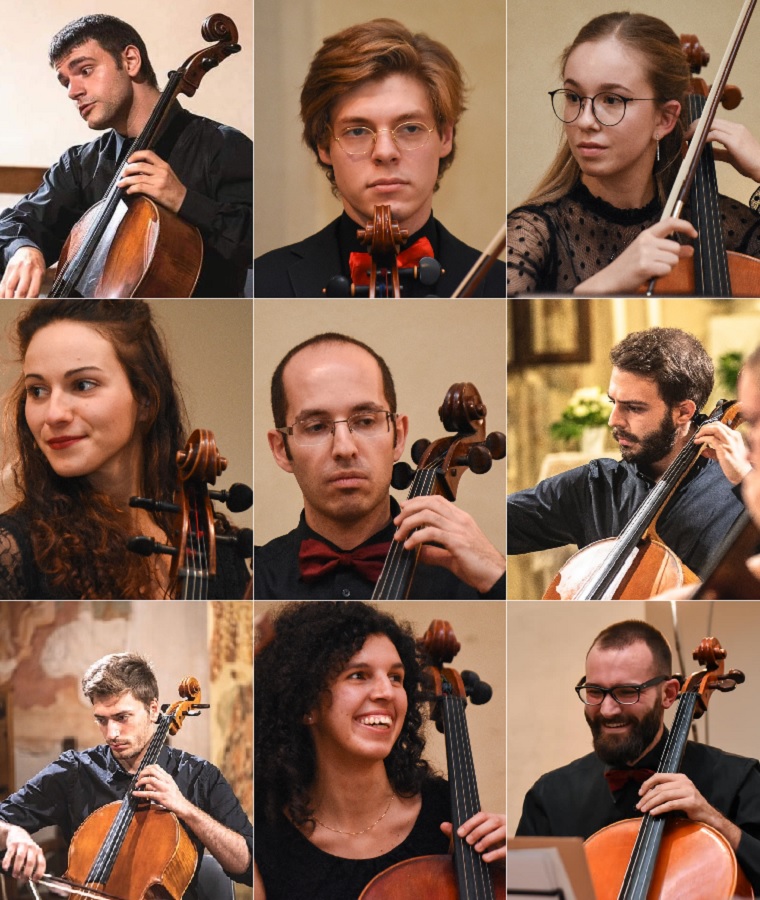
I have a CD in my hands. I read “On The Bridge. Cello Ensemble“, in the cover photo I see eight smiling cellists. But soon I find out that there are actually nine. Their paths crossed and they decided to start a good adventure together. Let’s get to know them together.
When did you begin studying cello and why did you choose this instrument?
Stefano Cerrato I began studying the cello at the age of 4. In my family everybody played an instrument and, when the time to start playing came for me too, I told my mother: “I want to play the cello so that I could sit”.
Alessandro Brutti I started to play the cello very late, at the age of 15. I was fascinated by its sound and by the art of lutherie.
Simone Ceppetelli Following the steps of my brother I began playing the cello at the age of 4. However the choice of this instrument was dictated by the fact that the violin class was already full. The discovery of a great passion for the cello, grown year by year, made me realize how lucky I was that day.
Benedetta Giolo I approached the cello at the age of 6: having been born in a family of musicians, my parents took me to a concert and I immediately noticed the cello, its sinuous forms, and its sound. From that moment on I had no doubt about the instrument that I wanted.
Sara Merlini I began playing the cello when I was 11, impressed by its sound, so close to the human voice, encouraged by my father, who would have liked to be a musician but did not have the chance to. From the very first times, I have had the cello in my hands I have been fascinated by the surrounding warmth of its sound.
Lucia Molinari I remember, since I was very little, having attended the rehearsals of my parents’music school orchestra. When finally, at the age of 6, the time to choose an instrument came, the attraction for the “dark side” of the orchestra and the team spirit one could feel in the cello section were determinant.
Emanuele Rigamonti At the age of 3 I enjoyed strumming toy instruments. I approached the cello when I was 6. My sisters already played the piano and the violin: I wanted a more beautiful instrument!
Matteo Vercelloni I began studying cello at the age of 9. Since I was very young I did not show a particular interest in music. The turning point came thanks to an old musical cartoon: “Peter and the Wolf”, in which the silhouette of a cello appeared. It was love at first sight. And that love never weakened.
Vittorio Zelocchi My parents, both former musicians, have always told me the importance of music. At the age of 10, encouraged also by my sister, who a year before had started studying the flute, I began playing the cello. I don’t know the exact reason for this choice, I just remember that for me it was the most fascinating instrument.
What have been your most significant ensemble music experiences?
Stefano Cerrato The most significant ensemble music experiences are surely the ones I lived both during the first years of study, when I entered the Turin Suzuki Orchestra, and –once graduated- through the study of chamber music as a member of the Trio Caravaggio, together with my brother, with whom, in addition, during the last years I undertook a stylistic research path about the late baroque music with the employment of original instruments establishing the Armoniosa ensemble.
Alessandro Brutti I consider significant all the experiences that can teach you something: there is nothing better than working with someone you can learn and “steal” something from, or that can offer you new and original perspectives about things you thought you already knew. During the last years I have had the opportunity to work with some of the greatest conductors and soloists, and I have learnt that their greatness relies in the message they are able to convey through their art. For these precious experiences I must thank, among others, institutions such as Orchestra Giovanile Italiana, Orchestra L.Cherubini and Orchestra Filarmonica V.Calamani.
Simone Ceppetelli Especially in the last years, my relationship with chamber music has been very intense, since I specialized precisely in this field. As a matter of fact my musical activity is mainly linked to chamber music groups, with which I had the opportunity to create a solid relationship. Among these I have to quote my trio (trioBIS) with which I had the opportunity to take part in many competitions and festivals in Italy and abroad.
Benedetta Giolo I have always preferred ensemble music, rather than solistic, because you can feel a sense of commitment to a common goal, shared emotions, a team. In 2015 I took part in the Orchestra dei Conservatori della Lombardia e del Canton Ticino and in 2018 to the Orchestra Giovanile Italiana: these have been fundamental experiences, since I had the opportunity to work along with important soloists and conductors, growing up both musically and humanly.
Sara Merlini The memories of my first orchestral experiences are still vivid: I was no more than a budding young cellist who tried to hide her emotions among the elder and more experienced members of the Orchestra Senzaspine, a group in which, during the last years, I had the chance to grow up as a musician. About educational experiences I surely must remember the ones with the Orchestra Erasmus, as principal cello, and with the Tiroler Festspiele Erl Orchesterakademie with Gustav Kuhn.
Lucia Molinari Ensemble music has always been my passion and in it and its fundamental values of interaction, sharing, empathy and respect I see the deep sense of being a musician. Personally, the experience that marked me the most from this point of view, which has enriched itself thanks to years spent in youth orchestra and ensemble in Stefano’s class, is the path I have undertaken with my string quartet(Quartetto Daidalos).
Emanuele Rigamonti I have dedicated my life and study to chamber music. All the experiences I did with my groups are important, without exception, in particular the ones with my sisters, with whom I established a permanent trio(Trio Rigamonti). Each concert, lesson, recording project that allowed me to relate with other musicians has been extremely formative to me.
Matteo Vercelloni From the very first weeks it was clear that my cellistic concept would have been in the spirit of the word “together”. The first orchestral experiences have been decisive, and the concerts during the years more and more numerous. I will always remember a wonderful orchestral course in Villadossola: a Mahler 4th full of emotional tension. I must mention chamber music, that represents for me the pulsating heart of my musical soul. All the groups with which I played were important, each one of them enriched me. I am very thankful to all the colleagues with whom I had the chance to work.
Vittorio Zelocchi I started to appreciate chamber music a few years after I began studying. It was Pietro Scalvini, my first chamber music teacher, that taught me the importance and above all the beauty of playing together. I learn to have fun, to share ideas and thoughts with my colleagues, and to appreciate the fundamental chamber music repertoire. In the following years I had the opportunity to live beautiful experiences playing with the Orchestra Giovanile della Via Emilia(OGVE) as principal cello and with colleagues from the ISSM “Vecchi-Tonelli” in Modena.
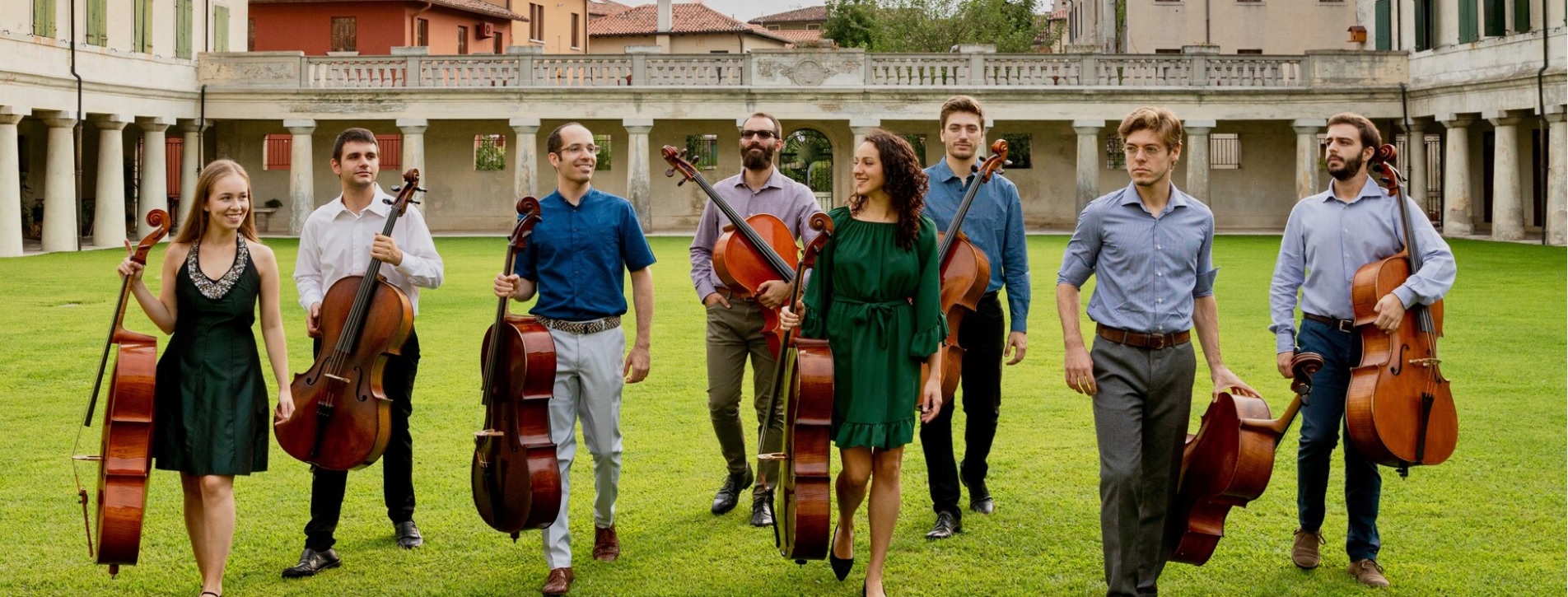
When did you establish your group? Who had the idea and how did you choose the name? Where do you rehearse?
The activity of On the Bridge was born in 2019 from our common passion for cello ensemble and following an educational project within the class of Stefano at the Scuola di Musica Dedalo di Novara; one of the first, target was the preparation of a musical program to be recorded and published, collaborating with external elements convened for this purpose. The name was born as a joke between Lucia, Emanuele, and Stefano, because the latter often asked us to play closer to the bridge in order to obtain a more focused and refined sound. We meet for intensive sessions at Stefano’s rehearsal room in Asti or at Scuola Dedalo in Novara.
Why did you decide to begin this experience?
Stefano Cerrato The will to constitute a group of cellos comes, in my case, from the passion for this kind of ensemble that my teacher Antonio Mosca passed onto me during my studies with him, through various summer activities in which the didactical core, both with children and teenagers, was represented by ensemble-playing. As a matter of fact, during the years, I started to look for pieces, even unpublished ones, specially conceived for this unusual type of ensemble, as well as transcribing music, until I fulfilled the dream of having a group of my own.
Alessandro Brutti Before the birth of “On The Bridge”, for me, the cello ensemble had always been a “side activity” to masterclasses or temporary projects. During August 2019 I received the proposal to take part to this group and I had no doubt, both because from the beginning we set important goals, such as the recording of the CD Vocal Chords, and because the work was to set out to be aimed towards the maximum seriousness and accuracy.
Simone Ceppetelli My participation in the formation of a permanent cello ensemble goes back to many years ago, when Stefano, the real creator of this project, opened his first cello studio. I have always believed in the great potentiality of a cello group, but, up until a year ago, it was just about temporary didactical projects to learn how to play together. During August 2019, however, we have been able to realize the initial idea, and a real group, bond by the common will to create a very interesting recording project, was formed.
Benedetta Giolo Since before the birth of On the Bridge, Stefano often planned ensemble music projects for cellos, to which I took part: from the beginning I felt an atmosphere of complicity and collaboration, reaching immediately brilliant results. As soon as, last year, Stefano proposed me to participate in this new rising group I eagerly accepted. As time went by, in addition to being a group of cellos, we became very good friends and during our rehearsal a joke, a smile, a wit are never spared.
Emanuele Rigamonti In the class of Stefano cello ensemble activity has never been missing. For years, in my mind, there was a desire to form a permanent group and to bring this extraordinary chamber music experience into concert halls. Personally, in my own small way, I tried to create some chances to realize this project. At a certain point, in some way, we forced us to give birth to On The Bridge. It had been in the air for too many years, and the success was guaranteed: among cellists it is impossible not to get along!
Vittorio Zelocchi I had always desired to try out the experience of an only-cello ensemble, because of its potentiality and the nuances one can obtain. Moreover, dialogue between the same instruments is always immediate, in a way: voices blend into one intention, and I feel lucky to take part in this adventure with amazing fellows and wonderful people.
Sara Merlin Even if at the beginning one could be frightened by the idea to play with other 8 cellists, worrying about competition, I gladly accepted Stefano’s invitation. I had the chance, so, to realize that, besides the very interesting repertoire, it is possible to learn a lot one from the other and to exchange opinions, ideas, and points of view by which I am discovering to be enriched as a performer.
Lucia Molinari Cello ensemble has always been a recurring experience during my studies with Stefano, and I have always been amazed by the versatile and expressive features of this type of ensemble. To me, forming a permanent group was something special, not only for the quality and seriousness of the work we do together but also for the friendship, mutual support, and team spirit that bond us.
Matteo Vercelloni I have known Stefano for a long time, and during the years, the possibility to form a cello ensemble whose strong point was steadiness presented itself many times, but each time difficulties of some sort came up. Obviously problems did not disappear, but in the end the strong will to get to the bottom of this project, and the aggregation of the right people brought us to the achievement of our target. The atmosphere is dynamic, rich of cultural and intellectual incitements, but also full of calm and friendliness. With such colleagues, or better, companions, you don’t worry about anything. It would have been impossible for me to turn down such an offer!
How are you organized within the group? Is there anybody in particular that decides the repertoire or takes care of obtaining concerts or organizing trips?
As in any work team anyone has its task: Emanuele and Stefano decide the repertoire, but anyone is free to submit proposals. Stefano adapts and arranges, Alessandro deals with translations of interviews or booklets in English or German, Emanuele promotes and advertises while the occasions to play, in addition to Benedetta, are sought after by any member of the group. Beyond the musical sphere, everyone gives its contribution to keeping the group together: Matteo’s role, always ready to keep up the spirit and the enthusiasm (and to chauffeur us here and there); Emanuele’s culinary contribution: the more difficult the pieces the more sweets he cooks; the sense of humor, and the always-ready wit of Alessandro; Simone’s hair lock, without which, one of most conversations central topic would miss. Vittorio, without doubt, is the “kind soul” of the group, the pacific spirit that supports everybody. Anyone knows that every group, especially if large, needs someone who knows how to keep the feet on the ground and that is able to give actual and clear opinions: that is Benedetta, whose organizational precision is often critical for the ensemble. Sara is a great enthusiast, full of energy, and a source of smile and guaranteed goof mood. Lucia is the “zen soul”: when tension arises she is able to listen to the others, to calm down worried minds, to reassure: she is certainly a balance point for the group.
What kind of repertoire did you address and what repertoire would you like to deal with? Is there a specific repertoire for your ensemble or do you have to work on arrangements?
The infinite expressive potentiality of a cello ensemble allows for great creativity, and among our targets there is the (re)discovery of original compositions, transcriptions, adaptations, and commissions to living composers. “Vocal Chords”, our first CD, displays a multifaceted repertoire with pieces belonging to each of the aforementioned categories. There is also a Toccata for four cellos, especially composed by Francesco Cerrato. It would be great, in the future, to become a reference point for composers that aim to write for this type of ensemble.
Is it easy to find an agreement about interpretative choices? In case of contrast, do you calmly discuss, follow someone’s indications or…fight?
Interpretative choices are often dictated by the musical text itself; a thorough analysis takes away any doubt about how they should stand out. Concerning personal choices, we try our best to deal with them so that we manage to reach a common agreement. There is no musical group in the world that sometimes does not face interpretative disagreements. However, weighted choices, both on the human and professional level, allowed us so far to avoid fights about musically conflicting ideas, so far.
Which have been the most satisfying concerts so far?
Live exhibitions are always special chances to return our work to the public, and allow us to set a goal to which we can direct our work. Although concerts are not yet very numerous, each of those experienced was in its own way unique.
You have already made a CD. What difficulties did you have to overcome and how did you manage to overcome them?
The CD was born simultaneously with the ensemble: we immediately needed an ambitious project that allowed us to start the group. Organizing this recording project was not easy at all: cutting costs as much as possible, finding a singer willing to collaborate with us, looking for a suitable location to record and a professional sound engineer, finding an opportunity to test the program in front of an audience, are just some of the problems we had to face. Although studio sessions put any group of artists to the test, regardless of their experience, during our session we managed to maintain an atmosphere of calm and peaceful collaboration, not without moments of hilarity. However, there were also difficult times: even the steadiest certainties can crumble in a recording.
What are your projects for the future?
Our future projects are about continuous research of old and new music, production of transcriptions, finding occasions to play, and a new recording project with exceptional and unusual guests, for a cello ensemble. But most of all we can’t wait to make up two concerts, that we would have done in March in Novara and Treviglio, postponed due to Covid-19.
We all hope to be able to resume our musical life soon! A special wish to you because your adventure can continue with the enthusiasm with which it started.
A site to quickly and effectively find everything a cellist asks on the web