
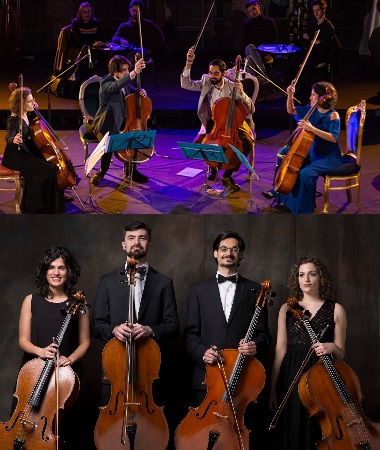
Federica Castro, Simone Cricenti, Carla Scandura and Francesco Tanzi, four young friends who have decided to form a cello quartet: the “Quartetto Zuena”.
How old were you when you started playing the cello? Why did you choose the cello, and what was your course of study?
FEDERICA: I started studying cello when I was 8 years old with Maestro Flavio Bombardieri, whom I still consider my dad-of-cello and to whom I will be forever grateful for being able to sow such a particular passion in a small girl and in such a constant and lasting way. I believe that attention to music was naturally passed on to me by the family, in my house listening has always been something habitual, something that I learned naturally and spontaneously. I fell in love with the cello in 2001, the first time I hugged it. And since then it has become like an extension of my body. I continued my studies at the conservatory “G. Donizetti “of Bergamo with Maestro Roberto Ranieri and, after the traditional diploma, I chose to improve with Maestro Andrea Cavuoto whose precepts I still follow.
FRANCESCO: I started playing the cello when I was 11 years old as a “fallback” from piano studies. I could not know then that unconditional love would be born. I followed the teacher Marcello Forte in Monopoli until I graduated in Conservatory and then moved to Milan for my master’s studies. Here I met Maestro Andrea Cavuoto and now I work with him.
CARLA: I started studying the cello at the age of seven, actually a little bit for fun. One day my father brought me to hear a concert lesson during which a cellist played “Pierino e il lupo” and from that day my goal was to play that piece. Since that day a lot of years have passed during which I attended the Conservatory, I graduated from “B. Marcello ”of Venice. Later I attended some specialization courses including those of M ° Sollima and I was part of the Italian Youth Orchestra.
SIMONE: I am Simone Cricenti, born in Genoa on 19/02/1994. I started studying cello at the age of 10, because the violin class of the school extracurricular course was full! I graduated and completed the Master at the N. Paganini Conservatory, I attended the Accademia del Teatro alla Scala and studied at the Accademia Santa Cecilia in Portogruaro in the class of E. Bronzi; I attended masterclasses with U. Clerici, G. Gnocchi, M. Polidori and G. Geminiani. I am in the second year of Music Therapy at the Associazione Espressione Project. I study every day!
During your study years, you have had experiences of ensemble music, which were the most significant?
FEDERICA: During the years of study in the Conservatory, I have always participated with passion and dedication in academic activity, gaining good experience in chamber ensembles, as well as orchestral ones. For this reason, I believe that chamber music is the language that I feel closest to, similar to my way of expressing myself and that, for this reason, I prefer. The most significant experience to date, and among many in the orchestral field, is certainly the collaboration with the Accademia del Teatro alla Scala for the two-year period 2017-19. In this context, I not only had the opportunity to fulfill the dream in every artist’s drawer, that is to perform at the Teatro alla Scala but also to have experience in symphonic, operatic and ballet programs accompanied by names of an international caliber such as David Coleman, Vladimir Fedoseyev, Michele Mariotti, Ádám Fischer, Paul Murphy, Daniel Oren, Leo Nucci, Woody Allen. To date, I continue to cultivate my passion for chamber music not only with the Zuena Quartet, of which I am extremely proud, but also deepening the chamber repertoire in other formations (duo, trio, and quartet) with other colleagues.
CARLA: During the years of the conservatory I had the opportunity to gain experience both in a chamber and orchestral formations. One of the most beautiful and significant experiences was to perform in front of the President of the Republic in the rooms of the Quirinale with the Chamber Orchestra of the Conservatory of Trieste. But the experience that formed me most was that with the Italian Youth Orchestra of Fiesole, which gave me the opportunity to work with important Masters such as D. Gatti, J. Axelrod, A. Poga and perform in the most important theaters Italian.
FRANCESCO: During the years in the Conservatory I made ensemble music right away. The strongest experience was that with the string quartet with which I had the opportunity to explore a large part of the repertoire for this formation.
SIMONE: All Music is Relationship, with oneself, with the other: as a member of the Zanardi Quartet I understood it immediately. As a member of the Januensis Quartet, I had the opportunity to study with C. Costalbano, the Cremona Quartet, the Prometheus and Delian. I studied chamber music with M. Damerini. I was selected for the ONC and ONCI: I remember with pleasure the productions at the Quirinale, the Arena of Verona and the indelible production with E. Dindo and M. Rizzi. Even the work with the Noos ensemble, a contemporary music laboratory has enriched me as a musician and person.
Was there any cellist in particular who was an ideal point of reference for you?
FEDERICA: We all know the “Greats” and it is obvious to mention them: Rostropovich, Yo-Yo Ma, Capuçon, Maisky, Tortelier, Gabetta … the very Italian Sollima, Polidori, Bronzi, Dindo, Brunello, Gnocchi and many others. But one of the “greats” I carry in my heart. During the years of study, in fact, the figure from which I drew most inspiration was certainly her: Jacqueline du Pré. It is for this reason that at the graduation I chose to present myself with the E. Elgar concert, the concert that made her more famous than she already was and whose interpretation is described as legendary and definitive. For Jacqueline du Pré I have a kind of devotional admiration, not only as a cellist but also for the charm that conceals her life and history. Not least, I felt close to her because she was a woman, an icon of gender emancipation.
FRANCESCO: In the Conservatory, we grow up with the Rostropovich holy card in the classroom, so it was certainly an important point of reference.
CARLA: There are certainly many cellists to draw inspiration from, but the cellist who thrilled me most was Jacqueline Du Pre. I would not like to go for the feminist of the group, but I like to remember her among the innumerable male names.
SIMONE: I have esteem and affection for N. Zanardi, P. Ognissanti, E. Bronzi, E. Dindo, M. Brunello, M. Polidori, G. Sollima, M. Leskovar, Yo-Yo Ma, M. Rostropovich, J. Du Prè, S. Gabetta, G. Capuçon, F. Dillon and G. Porcile.
How did you meet? Why did you decide to create a quartet of cellos and how long have you been playing together?
It was a blind date combined by Federica that of the Quartet! The opportunity to form a cello quartet presented us to participate in the first edition of the MaMu Cello Tenzone, a friendly competition for cello ensemble held on December 2, 2018 at the Magazzino Musica in Milan. We can say that the meeting and the union of the four of us were born only for fun. However, after winning the first edition of the MaMu Cello Tenzone, on the occasion of which we presented the piece Mare Nostrum by Francesco, we understood that this formation was close to our heart and so the Quartetto Zuena became a real project. The name “Zuena” was born in a pizzeria in Genoa between a smile and a “focaccia” and means “young” in the city’s dialect. This word not only wants to represent the flame of the youth but also the “popular” aspect of the project.
Is it easy to find compositions for four cellos? Is there anyone among you who takes care of the arrangements, or do you do them together?
One of our mantras is: There is no ‘easy or difficult’, but ‘I want it’ or ‘I don’t want it’. The original repertoire for our ensemble is not vast, but there are numerous transcriptions. Many cellists, including Grutzmacher and Sollima for example, made historical arrangements of songs famous for this group. As far as we are concerned, Francesco and Federica take care of putting together our ideas, subverting the “classical” hierarchy of the parts. In our arrangements, in fact, all cellos are important and the part of the fourth is always as a protagonist as that of the first.
Cellists, among the musicians who play “classical” instruments, seem to be the most open today to perform even in “non-classical” contexts, or to offer pieces of “classical” music to the public accustomed to listening to “pop” music and songs of “pop” music to the audience accustomed only to listening to “classical” music. In your opinion, what is the reason for this phenomenon?
Why are we the most beautiful and nice, of course! Given that we are talking about a phenomenon, which we understand, not accompanied by studies, we could think that this is due to the great versatility and timbre-expressive potential of the instrument and different roles also interpreted in different musical genres. In recent years some musical phenomena have contributed to making the instrument known, including the Italian 100Cellos and the international 2Cellos, making it famous to the general public.
Are concert organizers interested in proposing your quartet to their audience, or do they prefer to propose more traditional chamber ensembles? What have been your most significant concerts so far?
We find great curiosity and interest in proposing what we want to share! At the prize-giving concert of the CelloTenzone competition, we realized our dream of playing with Giovanni Sollima. At the San Donato hospital, we tried to donate our humanity. We also thank Milano Classica for giving us the opportunity to perform in the suggestive atmosphere of the Palazzina Liberty. Our most beautiful concert? What will come!
In these days, when you are forced to stay physically distant from each other, you still managed to make a nice video. What were the problems you had to overcome?
This was necessarily our first “remote video” and we must admit that it was not easy. Perhaps the most complicated thing was to synchronize between us. Despite this, the kilometric distance has never frightened us! After all, having to confront each other electronically is something we have always done. We try to stay united, understand everyone’s personal moments, improve our communication, all the more so in these difficult moments. In addition to time, internet connection is the first big obstacle to this way of proceeding: we would like to do many more things! We see new technologies as a moment to update ourselves, learn new possibilities of expression.
When you can finally leave the house and find yourself playing together, what will be the first piece you will try?
We are currently very busy with the present works that we are not thinking about what will come next and when. Much will depend on what will be the first date that we hope will happen as soon as possible! It will certainly be a new “first time”. Maybe we can start with Jackson’s Five to give us the charge.
What are the musical projects you are working on with your quartet?
Until a few weeks ago, we were working on several projects that would see us busy next summer. Among these are some concerts in Milan for Milano Classica and the Summer Sforzesca, the highSCORE Festival of Pavia, in October a double day for the Giovine Orchestra Genovese on the occasion of the Rolli days, and other private events.
Many of our dreams in the drawer on which we work to try to make them come true !!!!
THANKS FOR READING AND TO THOSE WHO SUPPORT US, QUARTETTO ZUENA
Thank you for your availability and good luck for the future of your quartet!
A site to quickly and effectively find everything a cellist asks on the web