
Good morning, Roberto Soldatini, and thank you for your kind answers to my questions. Before talking about your lonely experience of the sea, can you tell me something about your previous life as a musician?
After receiving my first musical training from my father (first trumpet of the Orchestra of the National Academy of Santa Cecilia), I studied at the Conservatory of Santa Cecilia in Rome. From the age of 15, he gave concerts as a cellist. I was also a member of the Orchestra of the Teatro dell’Opera di Roma, where I met Giuseppe Patanè, who offered me to become his assistant. Later I was chosen by Myung-Whung Chung as his assistant at the Opéra Bastille. Since my debut in Italy, in Spoleto, as a conductor, I have worked as a conductor, equally divided between the symphonic and the operatic genres. In 1992 I opened the season of the National Theater of Athens and I participated in the inaugural concert after the restoration of the “Maria Callas” theater, directing L’Assedio di Corinto of Rossini. On that occasion, I met a collector who gave me his eighteenth-century cello. Together with Leo de Berardinis, I created Studio sul Don Giovanni di Mozart (represented in Bologna, at the Sacra Malatestiana, in Spoleto, etc.), which gave me the opportunity to start a long collaboration and friendship with the famous actor-director (told in a chapter of the book La terza, published by Titivillus). After the first chamber opera lyric Come le maree sotto la Luna (on libretto by Leo de Berardinis, taken from Shakespeare’s Re Lear, Teatro Verdi 1997) I dedicated myself to the activity of composer: in collaboration with Ruggero Cappuccio and Claudio di Palma I wrote some works aimed at merging the drama theater with the lyrical theater: Pulcinell’Ade, Manfred (from Byron), La favola dell’amore (by Hesse), represented at the Benevento Città Spettacolo festival. Since 1984 I have worked as a cello teacher at the Conservatory of Music. Currently to that of Avellino. In Naples, I enjoyed debuting as a leading actor in Meglio la morte che una tal sorte, taken from José Saramago, directed by Luca di Tommaso, at the Teatro Bellini. As a writer, I published three books. In 2014 La musica del mare (Marinkovich Prize for Literature) and in 2016 Sinfonie Mediterranee (both editions Nutrimenti). The French translation (edition Zeraq), “La musica del mare” won the Prix Albatros 2017 (first non-French award-winning author). The novel Denecia, autobiografia di una barca, was published by Mursia in May this year.
How was your choice to sail in the company of a cello? Which cello and what scores do you take with you in the waves?
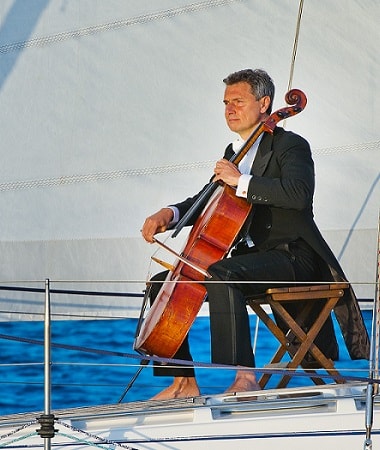
Actually, when I decided to live on a boat, I was fondling the idea of leaving the cello, because I was going to turn the page and launch myself close to a new adventure. Then it was the sea itself that suggested a new way of considering music and interpretation. At first, my sea suggested a different way of playing, returning to the rhythms of nature, then a concert inspired me, the one I’m carrying around in Italy, entitled “La musica del mare”, where I play and act simultaneously. But I do not simply read texts with a musical accompaniment: the rhythms and melodies of the voice are written in the score together with the part of the cello. An imaginary route through mythical scenes of sea literature. The scores of music I carry with me are white sheets, on which I write notes with sea water. Moreover, it is difficult to load many things onto the boat – and the return to the essential is one of the things that fascinated me the most about the idea of living on a boat – so the scores I brought are those in my memory. And then the sea is already a score: the sound of the wind, the one that generates inflating the sails or making shrouds and halyards vibrate, the sound of the waves breaking and that of the hull that furrows them. All this is already music, with its rhythms, its melodies, its polyphony, its harmonies. The cello that sails with me is the only one I have, the one that was given to me by a Greek shipowner collector. It is said to be a Stradivarius, but the appraisals that have been made to verify this attribution are discordant between them. However, Stradivarius or not, it is the only eighteenth-century cello to have salt on the skin.
As far as you know, in the past, were there other musicians who were in love with the sea like you?
The Sea has always inspired artists of every age. However, as far as I know, there are no others who have chosen to live on a boat, especially with a cello. But it would be nice if others had this dream and formed a small fleet of “music-sailors”, or an aquatic condominium of musicians. Among other things, I discovered another advantage of living in a boat: you can play at any time of day or night. The hulls are very well insulated and the water itself acts as an insulator so that nothing can be heard of what happens in the boat alongside. A not inconsiderable advantage for a musician, who is often harassed by neighbors. And the neighbors are often very right.
What are your solitary routes? Which ports do you like to come back to?
For the past seven years, I have sailed alone for 23,000 miles (about 45,000 km) far and wide for the Mediterranean. I dreamed of going around the world, but I realized that there is so much to see in Mare Nostrum that life is not enough. Mile after mile, my soul is filled with beauty, friendship, stories, culture, and history of our origins. Everything was born here: democracy, medicine, philosophy, theater, and music. This sea is the cradle of modern civilization. Greece is certainly the place where the sense of harmony, beauty, and philosophy has been better preserved. Its ports are those where I always come back willingly. The gods still live there.
Defining the experience of music is certainly a complex thing … the same for surfing. In fact, many authors and writers have dedicated themselves to one or other of these two themes. In your opinion, however, is there a relationship between these two worlds? Can you tell us about it?
I often like a bow in a while, with my feet hanging from the boat and my mind running in infinity. I would never get tired of looking at the sea, always the same, always different. And it reminds me of the writing by Johann Sebastian Bach, where the apparently equal thematic cells always self-regenerate. Looking at the waves, I often hear the Prelude of the Suite n. 1 for solo cello: a wave that sells like a musical phrase, then fringes and gives way to another, which seems the same but it is not. Coming out of the abdomen of the previous one, he carries the germ with him, varying it and taking it to the next wave. The same thing happens in Bach’s music.
Do sailors and musicians have similar personalities? The conductor has to do with a hundred musicians, including orchestras, singers, and choirs. So he must have perfect self-control to perceive everything. It is as if the brain worked on two tracks. One that records what he feels by catching the errors or sounds to correct, even instantly. The other hand is moved forward because it must anticipate the sound of the orchestra with the movements of the hands and arms to guide it. The seafarer must do the same thing: record the sounds of water and sails, and at the same time predict how the boat will behave with respect to the waves and the wind. From symphony orchestras to concert halls, I moved to direct the tides in the infinity.
The musical language is very rich and can express the depth of an individual more than others. The charm of the sea is in its extension, but is its enigma in the depths? Can music be a sonar that explores the abysses of our soul?
More than the abysses, what I find stimulating is the horizon, which moves ever further into the sea. The view of an infinite horizon is the ideal condition in which the subconscious can be freed. Thus thoughts run faster and farther. While the seawater cleans the soul from encrustations, from the bad habits that stick to the skin on the mainland. Sailing is necessary to strip off the artificial habits, prejudices, and imperfections of the civilized world that poison the soul, and find in the solitude and grandeur of nature a more correct harmony. On the sea, it is easier to continue the battle to wipe out and then kill that fake part, that part of Mr. Hyde that is in each of us. Every route by sea is also and above all a spiritual pilgrimage.
The sea of Joseph Conrad is the place of the soul, the sea of Melville is titanic and biblical, and the sea of Stevenson climatic station of noble legends: how is your sea?
The sea is all these things together and none of them at the same time. The sea empties and then fills, like the tides. But the sea for me represents love, quoting Denecia, the autobiography of a boat: “Above all, I will not tire of telling love, which is in itself the thing for which you humans would be worth living. Now I know. It is the thing that honors you most, that redeems you from all the horrors and the havoc of which you are capable, of which you have been stained by that memory. At the end of each route what really matters is having loved. So do not miss the chance to do it every day of your life. It is in this feeling that immortality resides. Only in this. Because love is like the sea, always comes back under different forms. It never ends”.
Music is a universal language that respects and values all cultures. In your opinion, does this also apply to the sea? A middle world that unites all the lands?
Continuing to mention Denecia: “Moreover for those who live in the sea even the continents are large islands. Because it is the water that is king on earth, buy seven-tenths of the globe. From the perspective of humans, it might seem that the sea divides the lands, but we know that yachts are not like that. The sea is like a liquid glue, which keeps the people of all the continents united. The sea unites“. For all the sailors of the world, there is a universal language, of solidarity, respect, and curiosity. Among them, there is an osmosis that reminds me of what, until recently, was also among the musicians.
A CD by Giovanni Sollima is titled “We Were Trees”. But what if, first, were we fish?
The evoking nature is a fashion that risks sometimes encroaching on speculation. A risk that I too, like everyone else. I can not say that we were originally fish, but we still have a very strong connection with water and the sea. Living in a boat is like finding the mother’s womb, floating isolated, and protected from the outside world. It is like finding the kennel that you are looking for as children by building small shelters or choosing the inside of the closets as a place to play, isolate yourself, and feel protected. In short, a boat is a house-kennel-floating womb. And playing in the middle of the sea, where the vibrations spread in nature can make us return to being part of the whole. Once, while I was playing The Swan of Saint-Saëns when the sun was plunging into the sea, I saw a bunch of dolphins coming towards me. Then they began to jump. They made very high jumps, very close to where I was playing. So close that I could hardly believe what I saw. And I like to think that they were attracted to music, as in Greek mythology. Here, return to be part of nature, the universe, of everything.
Thank you so much for your kind availability. See you soon and good sailing.
A site to quickly and effectively find everything a cellist asks on the web