
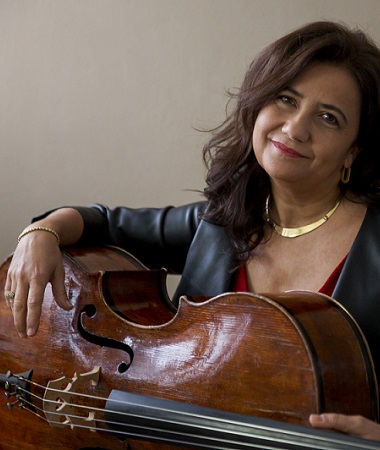
Good morning Silvia Chiesa, thank you for your interest in “MyCello”, and thank you for the interview you gave us.
How did the choice of an instrument like the cello come about? Did anyone in the family play it? Were your parents musicians?
My parents loved classical music very much. My father was self-taught and learned to play several instruments. My two brothers and I immediately “breathed” music and, thanks to our father’s patience, we learned to read music and sing together at home. On Sundays, we met and had real four-voice choirs. I, being the youngest, had the difficult fate of the soprano line! After these first experiences, we were all enrolled in the conservatory, but without any of us expressing a preference for a particular instrument: the cello happened to me. I was 6 years old.
What is your study curriculum: where did you graduate and with whom? Did you then perfect yourself with other cellists?
I studied at the Milan Conservatory for nine years with the principal cello of La Scala, M. Antonio Pocaterra. But before graduating I moved to the class of M. Rocco Filippini who led me to the diploma in 1985. Afterward, I took several courses, but I would like to particularly mention the meeting with M. Antonio Janigro. For me it was a real turning point: I changed my way of thinking instrumentally speaking and I opened up my musical perspectives a lot. I began to understand what it really meant to be a professional musician and from that moment I began to establish fixed points in my musical path.
Can you briefly recall your career as a musician: the initial stages and then the fundamental ones?
The initial stages were the first competitions as the first cello in the orchestra: in those days seeing a young, female first cello was not so usual. Then the first chamber ensembles and, fundamental for me, the call from the Trio Italiano (with Sonig Tkacherian and Giovan Battista Rigon) who needed a new cellist. They were very beautiful years, even if at the beginning I had to work hard: in fact, they had an immense repertoire and I had to learn it all in the first year of collaboration, a real massacre! From then on, many chamber music experiences with internationally renowned musicians and my first solo performances at a national level. Then the meeting with the pianist Maurizio Baglini marked another important career moment: we have been a stable duo for ten years and have almost 250 concerts on five continents to our credit! With him we built many important things and the Amiata Piano Festival, in Tuscany, which is our musical “son”.
Which CDs have you recorded so far? And with which record companies?
I started with ARTS and the Trio Italiano with the complete Schubert, then for Amadeus Schumann and Bach Brandenburghesi. Then the first duo CD with the Concerto: Chopin and Debussy Sonatas but also a beautiful new release by Azio Corghi dedicated to us. And again Amadeus who, as a duo, gives us a total Saint Saens. Then I began my recording challenge on the repertoire for solo cello with orchestra supported by the Sony record company. The first CD contains the two concerts by Rota, the second Casella Pizzetti (world premiere) and Respighi, the third G.F. Malipiero Riccardo Malipiero (world premiere) and Castelnuovo Tedesco (Italian premiere). But I don’t stop with chamber music and special projects for the Decca record company: All Rachmaninov in duo; all Corghi in the solo/chamber music field; Haydn’s Concerto in C major; Schubert’s Quintet.
We come to the twentieth century: a courageous choice, almost against the grain. Do you want to talk about it? The motivations, the difficulties but also the results obtained?
In fact, there are not many musicians interested in this repertoire: I believe that it is considered by many to be of little success and certainly not part of the usual repertoire, therefore tiring to study and program. However, I have a real passion for these authors: I discovered that they left us extraordinary music and that it just needed to be brought to life again. And here is my commitment, planned over eight years which gave birth to eight solo concerts by Italian composers from 1925 to 1974: a real discovery for me and for many experts. A difficult but exciting project in the moments of study and recording. Many people have contacted me for information and many interested artistic directors have invited me for my first performances abroad. Of course, there were difficulties, but when you truly believe in something that goes beyond your own personal success, you overcome any obstacle.
They wrote about her that she is “the lady of Italian sound” and also “an ambassador of Italian music in the world”. Do you recognize yourself in these definitions?
I’m flattered by it. I can only say that I put passion into it, a great curiosity, and the true and profound need to make everyone understand that Italy boasts composers of the highest level, who have been unjustly forgotten. Technically, what characteristics does twentieth-century music have for a cellist? It’s difficult to explain it succinctly. Let’s say that the instrumental music of this period exploits all the expressive potential of the instrument: it takes the registers to extremes and adopts a hyper-virtuosic technique. The cello is often led to play in the highest register as if it were a violin. But it is also on the color that a lot of work needs to be done: in fact, the orchestral part is often intense, not to mention heavy, and therefore forces the instrumentalist to always have well-focused sounds in every musical moment, both softly and loudly. The structure of the concert itself can be large: the Castelnuovo-Tedesco Concert for example lasts almost 33 minutes! But each concert I recorded has different compositional and expressive characteristics. This was the best thing: I had to expand my technical-expressive baggage in order to be credible in every single composition in order to always arrive at an appropriate interpretation.
At the time of these composers, how did the public and critics react to the novelty of these musical proposals? Was melodrama still the only real interest in the musical world at the time?
Yes, melodrama was still very present and the work of these composers was precisely to create new ways of musical expression. I don’t know how successful these concerts were at the time, we only have testimonies for some, but I can say that they were programmed in the most important concert seasons, with the best soloists and conductors of the moment. For example, the Castelnuovo-Tedesco concert was performed in New York with Toscanini on the podium and Piatigorsky solo.
What commitments and projects for the near future…. And for the distant one?
Many concerts, some debuts with foreign orchestras, and some new recording ideas that I cannot reveal (for good luck!). I would like to found a festival but I am still looking for a venue that can inspire me and I would also like to work towards a music school for children with modern criteria. For the distant future: I would like, as a teacher attentive to involving young people in concerts with me, some of them can carry on this work of spreading Italian music even after me. There are still many musical treasures to discover…
Thanks again for your availability. See you soon.
Thanks to you
A site to quickly and effectively find everything a cellist asks on the web