
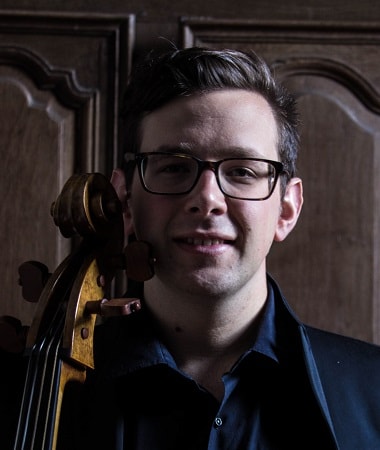
The Ensemble Locatelli, a group of soloists from the Schola Cantorum of Basel and the choir of the “Secco Suardo” high school in Bergamo have just concluded a beautiful performance in the original language of the “Dido and Eneas”. On the stage many young people, bound by the passion for ancient music. I take this opportunity to interview the cellist of the group, Thomas Chigioni, who this evening, at the harpsichord, has directed Purcell’s work. Thomas, still excited about the success of the performance, talks to me about his family: his grandfather, who at the age of 88 is still dedicated to singing, his father, who graduated in piano, organ, composition, and choir direction, a flutist sister, a brother and a sister violinists.
How much do you think the family environment in which you grew up has influenced your choice of studying music?
Music has always been a very important part of our domestic life. Since my early years, my father’s students, friends, and other musicians have come and entered my house. My father, who in the early years of my life founded his first musical groups, was my teacher of all theoretical and complementary subjects. But I also remember when my grandfather organized bike tours for us nephews: we were often a small group of 3 or 4 bikes and the grandfather taught us to sing “happy songs”, like the final of the Barber of Seville… Then, after the afternoon nap, he let us listen to the symphonies of Beethoven and Mozart, or Beethoven’s Missa Solemnis, his favorite. It was therefore inevitable, perhaps, that we all start a musical career.
And why did you choose to play the cello?
I chose it almost by chance. I remember that at 5 years I asked to play the trombone, fascinated by the coulisse, or the electric guitar, but they were too cumbersome for a child like me. The meeting with the cello was casual. My father had organized a musical twinning between the school where he was teaching and a school in Furtwangen, a small Black Forest municipality. At our house, we were hosting a boy, Florian, who played the cello, and that filled me with attention. I became attached to him and so when my parents asked me what I wanted to play, I chose the cello.
What are the difficulties and what are the satisfactions for a guy who, like you, decides to dedicate himself to music? And in particular to a repertoire like the baroque one?
The difficulties that a child has to face (I see it also in the students that I have had during these years) are the constancy in the effort and the sacrifice that the study requires. A child who studies music at a non-amateur level lives a different kind of childhood from his peers and, inevitably, this makes him suffer: his companions go to play football, while he has to stay home to play… Moreover, in the early years, the study of classical music was often focused almost exclusively on the acquisition of technical skills and did not offer great rewards. In short, only after having spit blood for years, you finally have a way to fall in love with the beauty that music offers to anyone who knows how to take it. One of the main difficulties for a musician (and his family) is also the expense to be faced to have tools and accessories up to the situation. Who then, like me, after the academic studies on “modern”, decides to specialize in an instrument such as the baroque cello, sees these expenses double. As a result, being able to make one’s passion a trade is a privilege for the few, and after a concert, satisfaction is such that it repays all the efforts and sacrifices made.
After studying in Italy, you decided to go to perfection abroad. You can therefore compare different ways of studying and learning music. What are, in your opinion, the strengths and weaknesses of the two training systems with which you have faced?
In fact, after studying at the Milan Conservatory, I am now following the courses of the Schola Cantorum Basiliensis, which hosts students from all over the world. Of course, now the Italian school system is formally uniform to other European academies, but I have noticed many differences between Italy and Switzerland, especially in the teaching organization. One of the strengths of Italian Conservatories is, undoubtedly, the attention focused on the main subject, which leads students to have a high level of technical mastery of their instrument. In my opinion, a little more fragile is the link between the main subject and the complementary subjects, which in Italy often seem to compete with one another to be more important than the others, instead of trying to create interdisciplinary links. Perhaps because of this, these subjects rarely leave a significant trace of the student’s training path. In Basel, on the other hand, all subjects seem to me to be complementary to each other in the true sense of the word: they try to enrich you without stealing too much time and without losing sight of what your instrument is and what your aspirations are. The courses of harpsichord, basso continuo, and song for example, in my case, in the weekly lesson plan, take up only half an hour. Another difference I noticed is the relationship with the teachers. While in Italy there is a certain distance between teacher and student, and a tendency to mythologize the teacher, in Switzerland the relationships are much more informal, and it seems quite normal to give the “you” even to that which gives you a lesson a few weeks after directing the Berliner. In summary, in my opinion, in Switzerland at the center of the educational path there is the student and he alone (with merits and defects of this choice), while in Italy there is the system, to which the student must adapt.
In your relationship with the teachers who have followed you so far, what were your main difficulties? Which one, or which of your teacher (s) has most influenced your training?
Perhaps it would be more interesting to ask the teachers who followed me what their difficulties were with me… In my first years of study my motivation was fluctuating, and Marcella Moretti, who was my teacher before admission to the Conservatory, worked hard to make me study with perseverance and passion. I was very lucky in the Conservatory in Milan where, thanks to the loving care of Nicoletta Mainardi, with whom I have always had a wonderful personal relationship, I was always able to feel accompanied step by step in my every decision. It was she who supported my desire to study the viola da gamba by contacting Nanneke Schaap, the person who first opened my eyes to the indissoluble link between music and speech, and led me to discover some of the absolute masterpieces of Baroque: Membra Jesu Nostri by Buxtehude, and Bach’s Passions. When I realized that I wanted to seriously undertake the study of ancient music, Professor Mainardi suggested I study with Cinzia Barbagelata, Emilia Fadini, and especially Roberto Gini (absolute thickness musician, from whom I learned deep respect toward the score and research of the true, or at least of what is closest to it) and finally Marco Testori, excellent teacher able to combine both the technical and the interpretative aspects, decisive in motivating me to the choice of specializing on the baroque cello and my guide for the admission to the Schola Cantorum of Basel. And now, for three years, I’ve been studying with Christophe Coin and Petr Skalka, two superlative cellists, who are poles apart in a teaching methodology, which allows me to get the best out of each of them. I have to make a special mention for Giorgio Paronuzzi, my basso continuo teacher at the Schola Cantorum, who encourages me to always go beyond my limits: he, too, certainly belongs to the masters I owe more to. So how do I owe so much to the teachers of related subjects that I follow in Basel (Florian Vogt, Johannes Menke, Kate Dineen, Markus Hünninger), and also figures that have not been properly my teachers, but from which I learned a lot: Andrea Marcon, Vaclav Luks, Marco Pace, Nicola Moneta… however the teacher who formed the most was my father, Francesco, with whom I learned the love of music to 360 °, and with whom I deepened the study of harmony and the history of music. If today I can aspire to live out of my passion and enjoy every note I play, it is thanks to him.
In the student-teacher relationship, do you learn more by listening to a theoretical explanation or by listening to the teacher playing?
I think that, in order to answer this question, it is always necessary to consider the student, his characteristics, his interests, and his different reactions to different cognitive stimuli. For many years my relationship with teachers has been based more on verbal communication and on the discussion of the piece dealt with. With my current teacher, the teaching method is based almost exclusively on the teacher’s observation, and to a lesser extent on the conversation. Personally, I think that a good compromise between the two opposites is ideal: if one limits himself to playing the passage, the student will tend to mimic or imitate the master’s interpretation. On the other hand, if you limit yourself to a verbal explanation, the risk is not to be concrete enough and not to get the core of the discourse to the student. For this reason, when I teach, I try to mix these two methods: first of all, I contextualize the piece to be dealt with (or in the case of a study, I highlight the technical aspect on which the study focuses) and then illustrate in words thing can be improved and what defects must be corrected, finally, playing in the first person, illustrating to the student concretely what has been said in the previous minutes. In some cases, if necessary, I also deal with philological questions… I think, however, that teachers often do not devote sufficient attention to the part related to the historical and stylistic contextualization of the pieces dealt with. Just to give an example: every cellist studies the Études de Duport. And yet, very few teachers lead students to face the Études through the study of the Duport Method, the gradual path designed to enable the student to face the Études. Certainly, we should also give more space to the study of historical treatises that allow us to deepen the interpretative practice of each era.
If you had the chance to do a concert choosing if you prefer to play alone or with others, what would you choose and why? and what would you like to play?
Since my first steps I have played with others: my father, when I was 6 years old, founded a children’s orchestra to allow me and my brother (then 4 years old) to play with other children. Some of the relationships created in that preparatory orchestra have become profound friendships on which even today my affections are based. Of course, I would play with others: one of the greatest satisfactions for a musician is to be able to make music together, to get involved with other sensitive souls to try, experiment, and get excited together. And when you can convey to the audience even a minimum of the emotions you feel on stage… maybe this is the greatest satisfaction! Regarding the choice of a program, the music scene is really vast and full of wonders. Perhaps I would choose to play one of Bach’s great masterpieces: the complete Brandenburg Concertos, which I have been listening to for years. But also the Passions, the Mass in B minor, and some of Händel’s works … better to go to the next question!
What are your short-term musical projects and what are your dreams for the future?
After Didone and Enea I will focus on my studies (I have a diploma from the Schola Cantorum this June), on a tour that will take me to Switzerland and Germany with the Ensemble Locatelli, and on the activities with Academia Montis Regalis. We will also perform in my Bergamo next November, after a busy summer, first of all, the Innsbruck Festival. For the future, I dream of a career with my group. Together we have dreamed and looked for sounds now for almost 4 years and with them, I have a unique relationship. But above all, I dream of never losing my love for what I do, which deeply animates me.
Good luck with the diploma and… that your dreams come true!
A site to quickly and effectively find everything a cellist asks on the web