
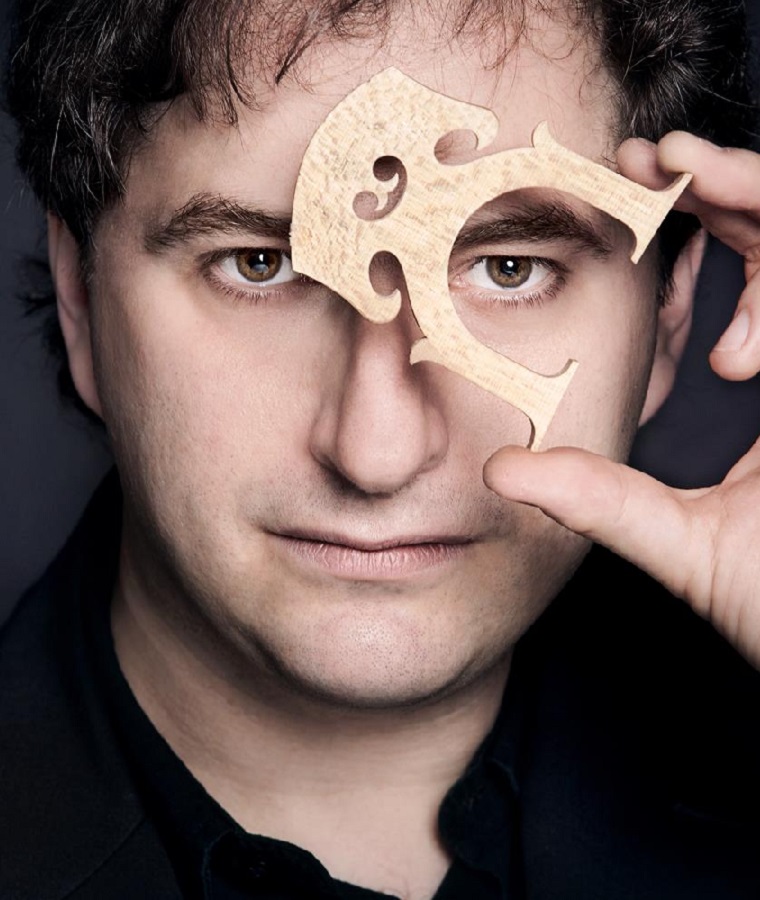
Enrico Bronzi is one of the most interesting cellists on the Italian scene today. In the home of his website he welcomes visitors with a Nietsche maxim: “Without music, life would be a mistake”. And of course, with his life full of music, Enrico Bronzi did everything to prevent his life from being a mistake. But … let’s start from the beginning.
When did you see a cello for the time and hear its sound? What impression did it make you?
When I was a child, my parents were subscribers to the Parma Concert Society. My first clear memory of a cellist is that of Paul Tortelier, who combined the energy of sound with impressive physicality.
Was that the moment you decided to play the cello?
When I started, I wanted to be a luthier and the cello would have been only a preparatory approach to the world of bowed instruments. Then things turned out differently.
Which teachers have been important in your training path and from which points of view?
I have had an infinite number of teachers with different and fascinating ideas. I can’t name them all, but only the ones I spent the most time with Enrico Contini was my first teacher, then Vendramelli, Janigro, Brunello, Geringas, Meneses, and above all the decisive experience of meeting with the Trio of Trieste. So many possible worlds, I would say. Then there is the need for a personal summary.
When and where did you play in public for the first time? What do you remember about that experience?
We experimented in small cultural associations in our city with those who would later become my partners in the Trio di Parma. Often ramshackle situations, but useful to start with. What I felt like a debut was a cello recital at the beautiful Sala Bossi in Bologna.
Working in a prestigious orchestra or working as a “free” concert player: advantages and disadvantages of the two options?
In the second case, you have to take on many things: organization, study, calendars, travel… But enjoy some intellectual freedom. In the first case, you have the privilege of regularly attending the most ambitious and largest repertoire that there is, the symphonic repertoire.
How important is the type of audience in front of a concert performer? And how important are the characteristics of the place where you play? And how important is the tool you use?
It may be that the cellist plays facing the audience, but I feel enough about the atmosphere that is generated in the concert hall. As for the instrument, there is an unstable balance relationship with an object that makes you feel the limit of your possibilities, but which also gives you the great privilege of expressing yourself.
Are there pieces that can be played anywhere and in any circumstance and others that, on the contrary, must be selected according to the place and occasion?
This is more of an obsession with promoters. Valuable music, if played with respect and adherence, can be played anywhere. If anything, in certain contexts it can and must be told and explained, not just performed.
If you were to organize a concert for primary school children, who have never been to a concert, where would you organize it? And which program would you propose?
I would divide the stage of a theater, because theater is a sacred place, and going on stage is a unique experience. I would try to show the breadth of possibilities, the ductility of the cello voice, and its ability to lend itself to very different musical situations. Sometimes I do it: my oldest child attends primary school and sometimes I play for her school.
In many countries of the world, groups of cellists have formed and they are playing together, often just for the pleasure of doing it. The phenomenon appears strange enough because those who play other instruments do not seem as interested in socializing with colleagues. What, in your opinion, can be the reason for this phenomenon?
The cello often climbs boldly into violin registers, while the reverse is impossible. This means that you can play in ensembles homogeneous without too much compression of the parts, as in a four-part chorus, sufficiently spaced. To this, he can add the vocation of the cello to a certain audacity. If he tries to listen to the same melody in the same octave played on viola or cello, he can perfectly understand what I mean. The burnished sound of the viola leads to a certain introspection, while the cello is more assertive, more communicative, and perhaps more vain.
What are your musical dreams for 2020?
I will debut in a few days with a new beautiful cello concert by Gianluca Cascioli. I have my own mission which is to generate a new repertoire for cello and string orchestra. Several composers have joined with excellent results. I feel I should go on.
Thank you very much, Maestro, for your availability. We hope that his “personal mission” gives us very new pieces for cello, all beautiful.
A site to quickly and effectively find everything a cellist asks on the web