
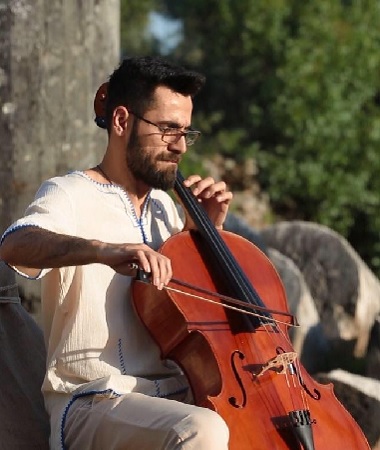
Surfing the web, I found a very suggestive video: a cellist plays in the ruins of ancient Ephesus. Intrigued, I decided to contact him to find out more about him. So begins my conversation with Melih Selen, a Turkish cellist.
When did you see and hear a cello first?
When I was 13 years old, I saw and I listened to a cello during a concert.
And, when did you decide that you wanted to play that instrument?
Since I was 12 years old, I have been playing classical guitar. When I was 18 years old, I won the Music Faculty exam and the professors told me that my talent and physiological structure fitted very well to play the cello. So, they suggested that I try playing the cello. When I took the instrument to play the first time, they really surprised to notice that I was playing the cello with great ease as if I had been playing it for a long time. So, at that moment, my teachers discovered my natural talent for cello. It is said that I was really born to play the cello. This was, for me, the start of playing the cello and ending of playing the guitar. I have adapted to cello many exercises and etudes that I applied for guitar. That’s why, following this way, I improved very fast.
Which of your teachers do you think was the most important for your musical and human training?
First of all, my music teacher at primary school, Sultan Göknil Kara was the first person who discovered my talent. After that, these 3 teachers such as one of them was an Azerbaijan conductor Associate Prof. Dr. Yusuf Habibov, the other one was an old cellist at Moscow Radio Yuri Semerov and the last one was a folk artist & cellist Prof. Dr. Eldar İskenderov, who were the most important people holding me at the forefront and affected both my music education and my music career as well.
What was the moment of your professional career that you remember with more pleasure?
All the concerts I give make me happy and pleased much more than before. My very best pleasure moments come first are that the concert in 2018 which I played cello as a soloist with the Ukraine Poltova Symphony Orchestra, and then a concert in 2019 when I played cello as a soloist, composing and conducting my own composition as a maestro with Ukraine Ahşaruma Chamber. Besides, one of the other moments that I remember with more pleasure is filming my music projects which have been realized at antique cities in Turkey and foreign countries such as Ephesus Suite Music, Nysa Suite Music Documentary, Tralleis Seikilos Music Documentary, Music Envoy Ukraine.
What are your favorite cello composers and compositions?
Here are my main favorite composers and compositions of mine: Alfredo Piatti, Capricci – Michail Evseevič Bukinik, Concert Etude no.4 – David Popper, Etudes & Works.
Do you prefer to play alone in small groups of musicians or with the orchestra?
I prefer to play the cello as a soloist with an orchestra.
Is the cello an instrument used in the traditional music of your country?
There are two different kinds of Turkish music. In Turkish folk music and Turkish classical music Cello is not a usable instrument. But in classic music (last 30 years) it’s possible to use it.
When and why did you decide to enhance the traditional Ukrainian repertoire?
Actually, the reason for using Ukrainian traditional music is just the first step of the big project ‘Envoy of the music’. Other parts of this project will be about the music of Morocco, Italy, Mexico, and so on. The goal of this project is a cultural dialog between Turkish music and other different world music. I hope we can do a great part of Italian traditional music too.
In your compositions, do you use elements and instruments typical of traditional music as sound materials?
I am using special Turkish music elements in some of my compositions. But, in general, I use classical music, jazz music, and modern music elements as sound materials. I like to carry all these to the future by adding in each time new techniques and new sounds to my music.
Your videos often invite the reader to stop and reflect on the meaning of life. Do you think this is the mission of a composer today?
Music sometimes describes the past sometimes the future. But, I, mostly try to describe the current world and further. I believe that a composer can continue to exist in the future if he can think ahead of the age. A composer sometimes is a person like a mirror of society and sometimes he is pure music by himself.
Music is the most universal language that exists. Do you think it can contribute to creating bridges of peace between peoples at war with each other?
The big composer Ludwig Van Beethoven said that “Music is the bridge between the souls”. All over the world, these bridges have suffered because of being loss of purity in music and art. Last year, in 2019, I started a new project in order to spread unconditional love and music by going around all over the world. [We called it “The Music Envoy” and, in Turkish, we called it “Müzik Elçisi“]. Briefly, I can say if all the world has been covered with the energy of music, there would be neither war nor any kind of conflict that happened.
What are your musical dreams for 2020?
I want to realize the concerts and projects in 2020 (in relation to “The Music Envoy”) which could not have been realized in Europe last year due to different reasons. For example, one of my biggest dreams (and realizing it would be a great pleasure for me) is to hold a concert in Italy at a historical place described as an open-air museum and an art gallery.
Thank you so much for your availability and best wishes for the realization of all your dreams.
A site to quickly and effectively find everything a cellist asks on the web