
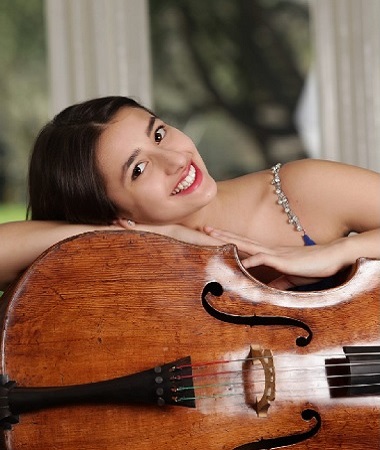
Caterina Isaia is one of the most interesting of the young Italian cellists. At the moment she is studying in London and is happy to accept an interview proposal that comes from Bergamo, the city where she spent a few years of her life.
Why music and why the cello? Do you think your family has somehow influenced your choice?
I lived the first years of my life in Sicily and, at the age of 6, I sang in the Chorus of white voices of the Teatro Lirico Vittorio Emanuele of Messina and in the Summer Season of the Greek Theater of Taormina. I grew up in theaters because my mother was the choir director and piano teacher. Listening to the rehearsal of the symphony orchestra, I was struck by the voice of the cello. I would have liked to start playing it right away but, due to my family’s travels, I was able to start my studies in Bergamo, a few years later.
A che età hai iniziato lo studio del violoncello? Dove hai studiato e quali sono stati i tuoi primi maestri?
I started at the age of nine, taking lessons for nine months at the Bergamo Conservatory with Flavio Bombardieri and then, with the support of my family, to follow the lessons of the Sino-American cellist Marianne Chen, in Parma. Since 2015, I have been a student of Monika Leskovar. And, in October 2016, I participated in the “Antonio Janigro” International Cello Competition in Croatia. On that occasion, a jury member of the competition, cellist Giovanni Gnocchi, suggested that I try to enter the Yehudi Menuhin School in London, to continue my studies there. After two rounds of auditions (first video and then live in London), I was admitted with a scholarship covering 90% of the annual tuition amounting to forty-two thousand pounds! From Italy, the remaining 10% thanks to the Accademia Filarmonica di Verona and to UBI Banca, to which I am very grateful. At the age of fourteen, I moved to London to Menuhin School College to study under the guidance of the American cellist and teacher Bartholomew LaFollette.
Before moving to London, you attended a year of musical high school. Which of the subjects that have been proposed to you during your studies do you think are the most important for the training of a musician and which ones did you perceive as more distant from your interests?
I attended the first year of high school at the Liceo Musicale Secco Suardo in Bergamo, before moving to England. Having attended very little the Conservatory, or an institution with musical subjects, I immediately realized how important it was to have a vision of music also through the study of musical theory, harmony, and history of music; I also deeply understood the educational importance of Literature, Art History and Mathematics for the growth of a musician. I think all subjects are important because each of them offers you a different approach and perspective. Personally, I have a particular interest in humanities and foreign languages.
And now where are you studying? How is your study curriculum structured?
I am finishing my third year at Yehudi Menuhin School, where I will study until next summer. At the Menuhin School, the days are structured so that people study school subjects, such as English, German, Mathematics, Biology, etc. together with theoretical-musical subjects such as History of Music, Harmony, Composition, and Ear Training. During the day we have about four / five hours to study our main musical instrument and in the evening one hour to pay for the homework. The day starts at 7:45 in the morning with the first hour of study for everyone and ends at 8 in the evening. We receive two instrument lessons per week from the main teacher and one lesson from the assistant. The school curriculum follows the guidelines of the British government, so we have summer exams at sixteen (called GCSE) and then at eighteen (A Levels). In addition, we have chamber music groups, such as string quartets or trios for violin, cello, and piano. Chamber music is very important to the growth of each of us, both as musicians and as people.
Which are, from your point of view, the most significant competitions, you have participated in? Do you think participating in competitions is important for a young musician?
Since I was a child I have participated in many national competitions. to get used to playing on different occasions, meeting new people and making new friends. At the “Antonio Janigro” International Cello Competition, I won the first prize and the special prize consisting of a concert with the “Zagreb Chamber Orchestra”. I remember very well the summer spent in preparation for my first international competition. I am very grateful for the support I received from my family, who has always supported me every day, even in moments of despair. Personally, I think it is very important to participate in competitions, as the preparation and study that precede the performance are a great moment of growth, musically and technically. You also learn a lot from other competitors and jury members. However, it is also important to take breaks from competitions, to focus on yourself and study aspects that, under the pressure of competition, cannot be addressed. Since I entered Menuhin School, I have not done any competitions until last January, when I won the first prize at the “14th Jan Vychytil International Cello Competition” of Prague.
Already many important concerts are present in your curriculum: which have a particular meaning for you?
There are many concerts that, for different reasons, I will remember for a long time. The first soloist with the orchestra at eleven years old. I played Haydn’s Concerto in C major. I also remember with pleasure the opening concert of the Festival Violoncellistico “A. Piatti”, in the Sala Piatti, in Bergamo, with the program that I would bring to the Competition in Croatia. The first chamber music concert at Menuhin Hall, in London, will always remain in my heart: with my friends, I played the Quintetto di Schumann and a year later the Quintetto di Dvorak. In April 2018, I was chosen by the school for a tour of seven concerts in Scotland, where I played solo accompanied by the piano and in a duo with violin and guitar. It was great to do my first tour with my friends in the welcoming Scottish atmosphere. In October 2018, the Menuhin School Orchestra made a tour of Spain, where I had the privilege of being the shoulder of the cellos. We played in Madrid, Valencia, Zaragoza, and at the suggestive Auditorium Pablo Casals in El Vendrell. Last December I was chosen to play R. Schumann’s Concerto in A minor with the Marlborough Concert Orchestra. Certainly, Schumann’s concert is one of my favorites and it has been an unforgettable experience. Last, but not least, the concert in the marvelous Sala Martinu of the Liechtenstein Palace in Prague. Recently, I was invited, together with my quartet, to play “Introduction and Allegro” by Elgar, at the Royal Festival Hall with the senior orchestra of the workshops of Nicola Benedetti and the Benedetti Foundation. It was an exciting experience to participate in such an important project in which the famous British violinist brings many children of all ages closer to music and the study of the instrument.
Your career started very early. Has this, in your opinion, somehow influenced your relationships with peers?
Definitely. I often had to give up going out with friends and practicing artistic gymnastics. Competitive activity that, at twelve years old, with regret, I had to leave because of the study of the cello. I was born in Sicily, still a child I moved to Lombardy and, as a teenager, I went to live in England. I had to settle in different cultures and lifestyles. However, I have non-musician friends that I know as a child, with whom relationships have not changed, indeed I receive a lot of support from them and they are understanding when I am not available because of my study and artistic commitments. On the other hand, I am sure that these years spent at Menuhin School have allowed me to create bonds of friendship with people of different cultures, that will remain for life.
Do you like playing in an orchestra? What do you appreciate most in team play?
I love playing in an orchestra, especially since I’m at Menuhin. I think the orchestra is the perfect place to learn a lot from a musical point of view, thanks to the advice of the conductors. But above all, it is ideal for putting your ego aside and learning to listen to others to make the orchestra a single instrument. Not just listening to ourselves, but listening to what is happening around us.
What score do you have right now on your music stand? Who is the composer you feel most in tune with at this time in your life? And why this choice?
Right now, I’m working on Bach’s fourth suite. Bach is the composer with whom I feel most in tune because his dense writing leads me to deepen a spiritual dimension in which I find myself, especially in this period of distance from my family. However, I am working and writing for the composition class of hip-hop / modern songs, so I also listen to a lot of music from other genres (jazz, electronic, concrete, pop).
What cello do you play? How important is the instrument you play with for you? Does your cello have a name? In your instrument, you see more of a mature father who reassures and instills courage, an older brother who offers empathy and listening in the various moments of our day, a carefree and cheerful friend who gives moments of vitality and joy, to remember in the future, or …?
I play an anonymous cello from the late nineteenth century. This instrument was played by my teacher Monika Leskovar for a few years before I played it. I care a lot because it has a very soft sound. It is the only cello, of those that I have played so far, to which I have not given a name! I have always seen him in Monika’s hands and therefore I see him very much as a mature father who reassures and instills courage. Of course, his “physiognomy” changes, in relation to the music I’m playing.
What are the plans for your near future?
Thanks to the Associazione Musica Con Le Ali, which has been supporting me since 2019, I will have the opportunity to play at the Sale Apollinee of the Teatro La Fenice in Venice, at the Teatro Politeama in Palermo and in other prestigious Italian musical institutions. I would also like to participate in other international competitions and play a lot of chamber music. Meanwhile, I want to concentrate on studying and, in the future, I would love to teach children and create a school similar to the Menuhin School in Italy!
Thank you so much for the time you have dedicated to me and good luck with your career!
A site to quickly and effectively find everything a cellist asks on the web