
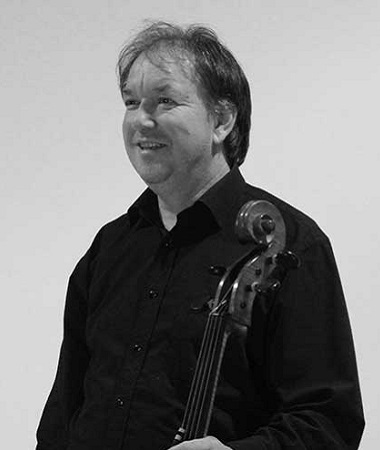
There are many cellists who use the internet and social networks in an intelligent way, but among them, David Johnstone stands out for his desire to share and disseminate useful materials and information for cellists. A desire that MyCello shares with him. Therefore, I decided to contact him and ask him if he wanted to answer some questions. He accepted the proposal with enthusiasm.
When, in your life, did you first see and hear a cello and why did you decide to choose it as your instrument?
Well, first of all, thanks so much for inviting me, and I will try to be very transparent and honest in my replies! The truth to your first question is that I can’t really remember hearing a cello for the first time; apparently, I asked to play the violin at age 6, but there weren’t any music lessons taking place at my village school at that moment. Then, soon after, we moved to the regional capital (Reading, Berkshire, England) and there yes there were many instruments available; I chose the cello and liked it a lot from the very beginning. My parents didn’t play at home when I was a young child, but my father had once been an almost semi-pro jazz drummer in his youth and my mother also had quite a number of years of piano lessons and was able to play some ‘easier’ Chopin pieces; in turn, her father was the lead trumpet player in the town band. So, I suppose there were some musical genes passing from generation to generation.
Which of the teachers that you met during the years of study most influenced your training and from what points of view?
I grew up in the pre-internet age, so we didn’t have the advantage of seeing marvelous videos on YouTube, it was all face-to-face. At about 13 I was suffering a bit; I sensed that something was not right with my playing, I didn’t seem to be progressing like I wanted – I didn’t know at that moment that in fact my teacher was…very poor! However, the conductor of the local youth symphony orchestra where I had recently started playing fixed me up with a change to the cello professor at the local university – a then semi-retired German cellist called Martin Bochmann. This was like an answer from heaven! He was quite strict but very analytic (anecdotally he was almost the last student of Hugo Becker, and he was playing as orchestral principal cello in Germany/Austria in the 1940s), but just the sort of approach that I connected to. For example, when I started with him, he hated my circular-motion ‘croony’ vibrato and fixed two wooden blocks (tied by tough string) on top of and underneath my left arm to restrict unnecessary movement – it hurt a bit, but I loved doing it as I could see it was working!
The proof is that in just two years I went from the UK Grade 6 level to being accepted into the National Youth Orchestra of Great Britain. After school, I went to the Royal Academy of Music – for the first three of the four years I could have done much more, perhaps, but I was a bit overawed in London; not with music but learning how to cope for myself (and I’m not sure I did!). Musically I did not feel pushed enough, although my teacher Derek Simpson was a wonderfully kind man with whom I covered an amazing amount of repertoire which well served me later, so it was not a bad choice at all. Towards the end of my time at the RAM I saw that cellists with a glorious tone such as Lynn Harrell were those who I most admired, and so I contacted him personally. I almost went with him to Juilliard, but, anyway, he would occasionally receive me in London and invited me to his masterclasses. A definite big influence on me. Finally, occasionally I sought a specific performer for specific works; for example, I worked on Rubbra and Enescu works with William Pleeth, or the Finzi Concerto with Christopher Bunting.
You studied in England, but now you work in Spain. What are, in your opinion, the main differences between the world of music in these two countries? Which of the two offers the best opportunities for students? Which offers the best job opportunity?
if you had asked me thirty years ago when I was starting to make my way, I would have probably given many answers but today there are not so many differences. The UK scene is still freelance-based, whilst in Spain it is very contract-based. That means UK cellists are great sight-readers; but in Spain, although the first rehearsal may be found wanting there is time to really polish up the works, it’s usually one concert program per week (often with repeat performance, or performances of the same). The UK probably trusts their leading string players more, they have more say on extra players coming in and are invited more often as soloists themselves. Spain has rather more an ethic of ‘working’ as a civil servant so it’s more difficult to be considered over and above what is expected of your normal daily input as one of the orchestral mass. Any student opportunities such as Orchestral Academy projects are so welcome and should be snatched up if invited, regardless of country. As for job opportunities in general I would actually prefer Spain nowadays; you have the same core repertoire works as Britain, the same conductors and invited soloists, but with a solid regular wage, and generous holidays which means you can still afford to buy a house and have a family!
Which concert of your career do you remember with the most pleasure and why?
Not one, but lots, so many, and it’s so hard to choose, so very briefly:
– Third-year exam at the Royal Academy – everything just clicked in a public recital exam (including Dvorak Concerto) and got a high distinction mark, and a definite change of respect afterward by the ‘establishment’ there, haha!!
– First major orchestral concert in London (Barbican Centre) as a young pro, with the London Concert Orchestra (the first of about 150 concerts with them)
– late 80s – Playing the complete Beethoven works in two recitals in Oxford’s Holywell Room to fine critical reviews with the fine English pianist Paul Turner.
– late 80s – playing in the Feria of Seville with the Royal Philharmonic Orchestra and accompanying the famous Spanish Cantores de Hispalis – helped open my mind up to Spanish culture!
– early 90s, in my first concerto opportunity in Spain playing the Tchaikovsky Rococo Variations for cello and orchestra
– 2002 – a wonderful Moroccan tour playing in a tango quintet, including big cello solos
– 2010 – premiere in Pamplona of three independent pieces for strings which together form an Easter Symphony
– 2017 – playing as an invited soloist with the full Navarre Symphony Orchestra in the premiere of two difficult concerto works in the same program [works by Joseba Torre & Koldo Pastor], and in a major Spanish hall – the Pamplona Baluarte, as part of the NAK Contemporary Music Festival.
But there are SO many, I could name dozens and dozens, and I’ve played in about 18 countries!
What are the compositions that you play most lovingly? Who are some of the other musicians with whom you collaborate most?
I play nearly everything with pleasure. Well, I’m not really a baroque specialist though I do respect those who are of course. I feel happiest at Beethoven onwards. Late romantics and the first half 20th century are wonderful – nearly all of them. Russian, Czech, British, and German music have so many good figures. Contemporary also, up to our days, but you never know what will be put in front of you!! I have not played for long periods of my life in the same string quartet or piano trio – the big two combinations – but have played for over twenty years in a clarinet-cello-piano trio called B3 Classic in a wide-ranging repertoire of about 75 works. Though I do miss in Spain those fun evenings just reading through stuff for pleasure, any combination really, I did it more often in Britain… doesn’t seem to happen here much. Tango music based around Piazzolla has been something in which I feel that I also have many years of experience; principally with the Spanish accordionist Javier López Jaso and other string players (but much less recently though). I’ve dabbled a wee bit in jazz and Celtic styles, there are a few of those, somewhere on the internet, but flamenco is so specialized – you either do it rather seriously or it doesn’t sound good! I have always felt committed to contemporary music too, both classical and light/popular music. Here is a list of most dedications & first performances.
Specifically, I’ve premiered more than 30 works by over a dozen composers from the Navarre region of Spain, in large part due to my involvement within the Centro de Música Contemporánea Garaikideak (Spanish contemporary music association) and in the ensemble Espacios Tímbricos.
When did you start composing? What were your first compositions? Which composers do you think have influenced your way of composing the most?
I’ve always composed, well from about 11 or 12 years old! It’s that I find it difficult ‘not’ to compose!! Firstly, as a boy, I just imitated some ‘easy’ Mozart or Beethoven, but it felt good, at least to me anyway! At the RAM, the Scottish composer Norman Fulton looked after me – in harmony, orchestration, fugue, and composition; however, as someone placed on the ‘performing’ course most of the academic things were extra and not obligatory, with no pressure! I did some mad things like arranging Finlandia for 16 cellos, making a 20-minute set of variations on Happy Birthday for 8 cellos, and tried writing my own Grosse Fuga for string-quartet – alas, most of these mad young efforts have been lost, but a few – such as Brandenburg No.3 for 10 Cellos – still survive! I got more seriously into composition after many years of arranging for cellos, especially the London four-cello group The Cello Company. I was also helped by a film producer in London, Julian Roberts, who had a number of his creations produced for Channel 4 TV, and he gave me the confidence to write for weird combinations because he believed in me…and so the activity flourished in Spain.
Which of your compositions do you like best and which is the most successful?
Again too difficult to narrow down, so briefly (some are on YouTube):
Sinfonia of Passion, for two soloists (varying possibilities) and string orchestra; romantic, a mix between Bach, Bruckner, and Franck. My own 4 Seasons for Violin and Strings (never been officially premiered in concert, I don’t know why!!), Tango World, a series of 6 pieces for three cellos in tango style, in which I’ve covered many tango aspects in 20 minutes – the easier ones have been performed numerous times these past three years or so!
My latest concertos: Concerto-Rhapsody for Double Bass and Orchestra (strings and wind) [26-27 mins], and Concerto (Elegiac) for Viola and Chamber Orchestra (strings and 2 horns) [19-20 mins]. I like both these works because the soloist dominates without resorting to ‘cheap’ virtuosos, and the orchestral parts have things of interest too, not just the soloist.
Chamber music groups: The Song Sonata, a popular classical work for the duo of Accordion and Piano [12-13 mins] – very well-liked in Spain! Violin and Viola Friends, for Octet of 6 Violins and 2 Violas [8 mins].
Recital/Solo: Breaking Into Bach – 2 albums of original Bach-influenced pieces for the Young Solo cellist – [18 pieces, 35 mins in total] – also versions for Viola and Double Bass. Sonata, for Solo Oboe [12 mins] – really good I think, but very hard/virtuoso! Sonata for Solo Violin [17’ 00”] – not premiered, again VERY hard!
These days you are presenting a new version of your Cello Concerto. What are the characteristics of this concerto and what are the changes that, in this new version, have you made to the original composition?
This originally dates from 2007 and uses in equal proportions symphonic development with a more lyrical popular song atmosphere. Why change things you ask? The answer is easy: earlier this year I had the enormous privilege to record with the Basque National Orchestra (San Sebastian) my Symphony-Concerto for Txistu (=Basque flute) and orchestra, and the central movement of the three is a big solo movement for soloist and orchestra; here it works fine as an increase in tensions before the energetic third movement. But, in the Cello Concerto, there was also a large cadenza for the cello soloist between the two other movements, and in retrospect, I felt that this section separated the outer parts and didn’t help them come together. So I made a new central movement, a Scherzo-type movement, which used parts from the old cadenza and incorporated new things but this time fully involving the orchestra as well. The following cadenza (newly composed this summer, not based on previous work) is much shorter but makes for a better transition. It is more logical and structurally coherent this way!
How did you come up with the idea of creating the Johnstone-music site? What difficulties did you have to overcome to create it and why did you decide to allow users to download the many scores available at a symbolic price?
I’m quite proud of my website, it’s been working successfully for over 20 years now. In fact, it must be by now one of the biggest in the world in the area of violoncello – it is a kind of open house to an abundance of music scores for cello recitals (and also other instruments though less), ensemble music pieces from 2 to 40 cellists – many of these connected to links to audios, videos, and performing groups from around the world. There are currently well over one thousand individual pieces of sheet music for varying sizes of groups, ranging from elementary stage cellists in their first years to professional virtuoso soloists. Plus articles and a lot of historical information on the cello and its history. A lot of people have also made generous contributions, for free too. So, on this website Johnstone Music, you can find most of my work from the last 30 years – otherwise, surely it is simply very shortsighted to have all these pieces lying almost unused on the bookshelves or only used for a premiere and then forgotten? I would much prefer that they be shared around. For many years everything was in fact free but, a few years ago, my webmasters convinced me it was better to ask for symbolic payments because all this is so big that it does cost well in excess of 1000€ a year simply to maintain. In no way should anyone think that this is a commercial adventure; not at all, and it often gives me headaches but I love it – one could say it’s a “professional hobby” !!
If you had a magic wand that allows you to fulfill three wishes, which wishes would you like to fulfill?
1 – I wish that jealousy and pointless criticism could be eliminated from classical music; we all do what we can, and we are all different. No one knows everything. Music is to make us feel BETTER! If you cannot say something nice it is better to say nothing!
2 – Although the benefits of technological advances can be of much use and help, we should remember that they should serve us; we should not be the prisoners of technology!
3 – Compassion – a world where people can move more freely, accept immigrants better, not be so prejudiced by old generation opposition on sexual orientation, and where religions try not to impose themselves on others…and neither too people upon animals, who in my opinion have the same ‘right’ to live as us.
I feel that these three will still need a few generations yet!!
Thank you very much for giving us the opportunity to let our readers know you better. We hope you find the right magic wand soon…
A site to quickly and effectively find everything a cellist asks on the web