
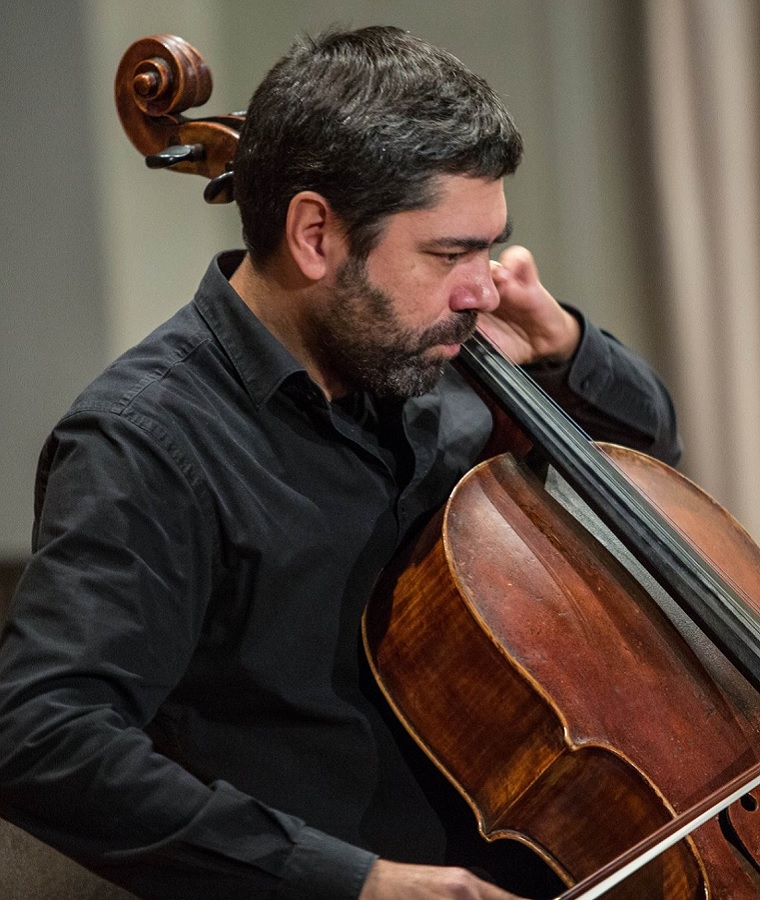
On the eve January 8, 1822, the bicentenary of the birth of cellist Alfredo Piatti, Andrea Bergamelli gladly accepts to answer some of my questions to introduce himself, and to introduce the Alfredo Piatti Association, of which he is artistic director.
What were the most significant stages of your artistic training?
Certainly, my artistic training was born in the family. My father, Attilio Bergamelli, is a very active pianist, not only in the field of chamber music, but also in organizing concerts, and therefore I have always grown in contact with music and musicians. I believe I inherited from him, in addition to the passion for music, two objectives: to discover the lesser-known repertoire and to enhance young musicians. In fact, my father founded the “Rare Music Association” and he has always organized musical seasons to give space to young performers. After some initial uncertainty about which instrument was most suitable for me, I chose the cello and began my studies at the Bergamo Conservatory. However, I soon moved to Budapest, where I studied at the “Franz Liszt” Academy with Csaba Onczay. Upon my return to Italy, I obtained my diploma as a private student under the guidance of Giovanni Sollima and I have deepened my studies with Mario Brunello, Antonio Meneses, and the Trio di Trieste. I think that a particularly significant experience for me, both from a human and a professional point of view, was the one with the Gustav Mahler Jugendorchester, but it was certainly very important to have the opportunity to collaborate not only with Giovanni Sollima, but also with interpreters such as Jörg Demus, Antony Pay, Bruno Canino, Calogero Palermo, Dimitri Ashkenazy
When was your interest in particular for Alfredo Piatti born? And what were the steps that led to the creation of the Associazione Alfredo Piatti?
For any musician who lives in Bergamo, the Sala Piatti is a particularly significant space: a space where you play, but also a meeting space, where bonds of friendship with other musicians are easily intertwined. I believe that all the musicians of Bergamo have wonderful memories of their youth linked to this room: the first essays, the first concerts, the first friends … For a cellist, then, playing under the watchful gaze of Alfredo Piatti, serious and benevolent in his portrait, becomes an even more precious experience. Of course, like all cellists, I got to know his compositions starting from the 12 Capricci, but soon, I dedicated myself to the discovery of his other compositions. An easy task for me, because almost all Piatti’s compositions are kept in Bergamo, in the Fondo Piatti Lochis, and therefore very accessible for a Bergamo cellist. So, already in the late 1980s, before the idea of a real association was born, together with my father, I started performing Piatti’s compositions in public. And then, in June 1997, the Associazione Alfredo Piatti was born. At first, the distant goal was to organize a Festival for Piatti, and the closest goal was to organize the celebrations for the centenary of Piatti’s death in 2001. At the end of the intense activities of 2001, together with my father, I recorded, in a CD Phoenix Records, two of the six sonatas and other particularly significant chamber compositions by Alfredo Piatti. In the following years, together with my sister Ljuba, who in the meantime had graduated in singing, we dedicated ourselves to spreading also Piatti’s vocal compositions, creating the Trio di Bergamo. The first edition of the Festival Violoncellistico Internazionale Alfredo Piatti, in 2006, was however the most important milestone we reached because, at that time, there was no other Festival entirely dedicated to the cello in Italy.
In November of this year, the Festival Violoncellistico Internazionale “Alfredo Piatti” reached its sixteenth edition. What are the reasons that prompted the Associazione Alfredo Piatti to give birth to this event and to carry it on, despite a thousand difficulties? What are the results achieved?
The Festival Violoncellistico Internazionale Alfredo Piatti was born with the desire to rediscover Alfredo Piatti’s compositions, not only to the public, but also to cellists. In these sixteen years, we have certainly managed to achieve excellent results in this sense, because today many of Piatti’s compositions are available on CD and are regularly performed by cellists from all over the world. Until the end of the last century, however, the only compositions of Piatti that were really known were the 12 Capricci, op. 25, which constitute a fundamental passage for the growth of cellists. There were very few cellists who knew that Piatti had been a very prolific composer, not only of chamber compositions and compositions for cello and orchestra but also of music for voice, cello, and piano. Certainly, starting the festival and carrying it forward was very difficult, especially in the last years, but we have always been able to count on the support of the MIA Foundation, which guarantees us the availability of the wonderful Sala Piatti, one of the most beautiful concerts halls in Italy, especially from the point of view of acoustics. We, then, had the support of local authorities, bank foundations, and other sponsors who believed in the validity of our project but, above all, we had the availability of great interpreters, such as Antonio Meneses, Giovanni Sollima, David Geringas, Frans Helmerson, who have willingly accepted to give voice to Piatti’s compositions, and of many young cellists who faced the challenge of studying Piatti’s compositions, almost always extremely demanding from a technical point of view, with courage and determination.
What are the projects of the Associazione Alfredo Piatti for the celebrations of Piatti’s bicentenary?
Unfortunately, due to a series of unfortunate circumstances, also linked to the pandemic situation, we were forced to cancel at the last moment the Giovanni Sollima concert that we had planned to celebrate on January 8th, but we hope to be able to do it again in the coming months. As soon as the situation has settled, and we can therefore return with greater serenity to the concerts in the presence, in addition to the traditional November festival, we plan to organize concerts that will be held until the end of 2022, and not only in Sala Piatti. In fact, we would also like to create an interweaving of art, culture, and history by enhancing alternative spaces such as the Biblioteca Civica Angelo Mai, the Accademia Carrara, and the many historic houses of our territory. We have therefore involved the most important academies where cellists are trained, so that young performers are the protagonists of some of these events. Obviously, Alfredo Piatti’s compositions will not always be performed, but everyone will be asked, as always happens for the Festival, to offer the public an all-around view of the cell repertoire. The details on the individual appointments of this annual season, as soon as the situation allows for a greater definition, will be made public not only through the association’s website but also on the FB pages of Associazione Alfredo Piatti e del Festival Violoncellistico Internazionale Alfredo Piatti.
And what are the plans for a not so immediate future?
In 2023, Bergamo and Brescia will be European Capitals of Culture and we are working to activate a close collaboration with the Associazione Bazzini of Brescia. The violinist Antonio Bazzini and Alfredo Piatti were very friends as well as colleagues and it seems very nice that even the associations named after them can collaborate as good friends. In the future, we would like to expand the collaboration network to other associations similar to ours, such as the Associazione Bottesini of Crema or the Servais Society of Halle. Among the most distant dreams, there is certainly an international cell competition dedicated to Piatti, in his city.
Thanks, Andrea, for your availability with best wishes for 2022 full of good music!
A site to quickly and effectively find everything a cellist asks on the web