
How did you choose to study the cello? Were there musicians in the family? How was your “musical” childhood?
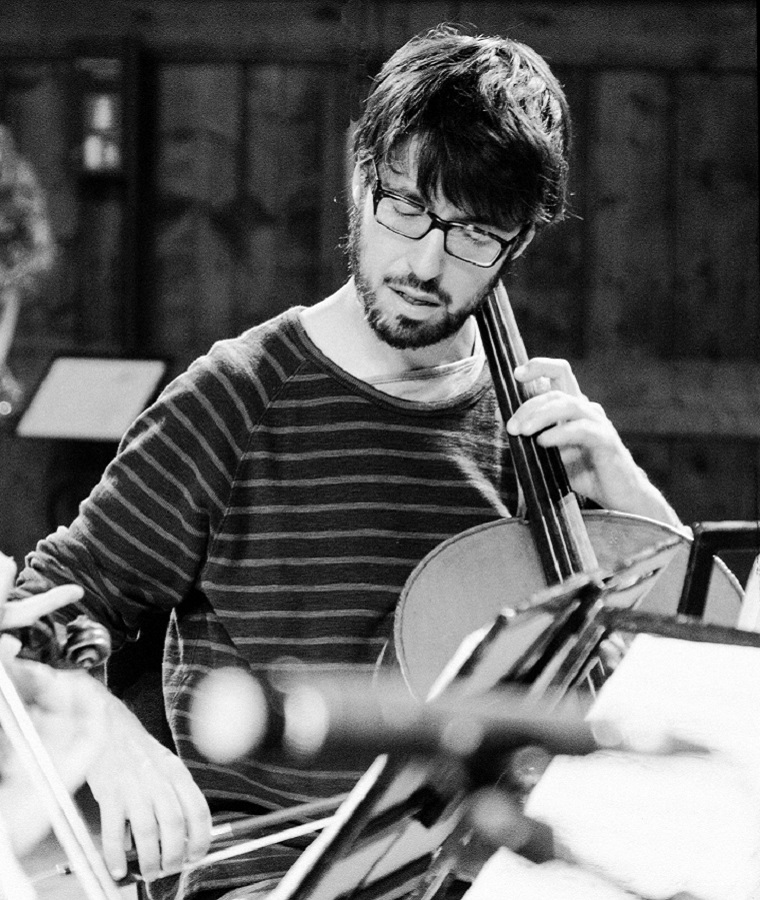
I come from a family of art historians, and passionate music lovers. From an early age, I was taken to the Opera: first at the Fenice (I grew up in Venice) and then at the Municipal Theatre of Florence. Needless to say that, for a few years, I slept, lulled by the notes that surrounded me. It is said, in the family, that the turning point was when I was eight, with a splendid Beethovenian Fidelio, who held me close from start to finish! I confess that when I enrolled in the Conservatory of Florence, my desire was to play the double bass or the horn. In the 1980s, in Italy, it was not common for a 10-year-old to be able to start directly with one of these instruments, and I was advised to do two years of cello, then move on to the double bass class when I had grown up a bit. Needless to say, it never happened! I was more and more fascinated by the voice of this instrument, and I never abandoned it. Mine was a childhood where music certainly played a fundamental role, but alongside figurative art (the family traveled regularly to visit exhibitions of all kinds), to read books (the home library was provided and has become well soon to be discovered), to the cinema and (needless to deny it!) to more “prosaic” interests such as football and … comics !! I believe that the sum of all these stimuli, of which I thank my parents, was fundamental for the type of musician I am today: in love with sounds, but thirsty and curious also towards other forms of art and creativity.
Can you tell us briefly about your studies? The Conservatory, the teachers who trained and, I believe, encouraged you. With which cellists did you then study to improve yourself? Can you tell us about the main details, also to understand their importance in your professional growth?
The first fundamental teacher was certainly that of the Conservatory years in Florence: Andrea Nannoni. He helped me develop my musical curiosities without foreclosures, sending me the precious lessons of bow technique learned at the school of André Navarra. In parallel, and in the following years, I perfected myself with famous cellists such as Amedeo Baldovino – a man of extraordinary vitality, a witness of a great tradition that descended from Mainardi – Mario Brunello – who supported me and always appreciated my musical research and David Geringas – thanks to which I worked a lot on the relaxation of the body, the executive rigor and the focus of the gestures. I cannot fail to mention a few more sporadic encounters in masterclasses that have been decisive for my journey – firstly two long summer courses with Jozif Levinson at the St. Petersburg Conservatory in the last years of the Soviet Union. It was a totalizing and exciting experience – a dip in a musical culture of the highest level that gave me a great deal of energy and definitely pushed me into the study of the instrument. And still, I can’t omit two wonderful masterclasses with Anner Bijlsma – unfortunately recently disappeared – a musician in whom creativity, research, culture, virtuosity, and imagination met at a very high level – an inexhaustible source of inspiration… As for quartet studies, a fundamental meeting was with Rainer Schmidt – a musician who pushed us towards the deepening of mutual listening. Finally, I cannot fail to mention an extraordinary opportunity for a trio lesson (with Lorenza Borrani e Matteo Fossi) none other than with Mstislav Rostropovich – as a teacher he had an infectious enthusiasm and extraordinary verve and was full of beautiful words for our group.
You studied composition with Sciarrino: how much and how did it influence your training as a musician? Can you tell us a significant episode to understand the personality of this composer?
It was undoubtedly a decisive experience in my training. The meeting with a real “master” – in the fullest sense of the term. Whole afternoons were spent in the composition class and they were afternoons of continuous stimulus, where the real Socratic dialogue with Sciarrino could pass from the analysis of our works to the look on its more or less recent composition (sometimes still unpublished or handwritten!), from orchestrating a prelude to Debussy to visiting a museum. I also want to mention the extraordinary reading master of the score Romano Pezzati, also a refined composer. In his class, we analyzed, discovered, sang, and played many pages of Schumann, Bach, Berg, Kurtag, Schubert …
Can you, briefly describe the main stages of your career as a soloist? And with the various orchestras?
I owe my debut to Sciarrino, who wanted me as a soloist in the Variations for cello and orchestra in his hometown of Palermo in the mid-1990s. I later developed this activity with great interest, especially in creating a new repertoire for cello and orchestra, collaborating with important international orchestras: Philharmonic Orchestra of the Scala, Maggio Musicale Fiorentino Orchestra, RAI National Orchestra, SWR Radio Sinfonieorchester Stuttgart, RSO Radio Symphonie Orchester Wien, Orquesta Estable del Teatro Colon, Ensemble Resonanz, Lithuanian National Symphony Orchestra, Oulu Sinfonia Finlandia, Lithuanian State Symphony Orchestra, Orchestra Regionale Toscana… It is a way of making music less intimate and refined than the chamber music that I love, where it is necessary to develop a sound and “rhetorical” presence that can be compared with the, sometimes imposing, orchestral mass. In 2021 I plan the Italian premiere of Thomas Larcher’s beautiful Ouroboros with the Haydn Orchestra of Bolzano and Trento, the absolute premiere of a new concert composed for me by Josè Maria Sanchez Verdù with the Orchestra of Padua and Veneto, and a new triple concert by the Portuguese Luis Antunes Pena which will be scheduled at the Philharmonie in Koln and at the Casa da Musica in Porto.
Quartetto Prometeo: what can you tell us about this project?
It is a fundamental part of my activity and my being a musician. I helped found the quartet in 1993 (it really makes an impression to write this date so far away!) So I literally grew up with and together with this formation, making music together in a widespread and in-depth way. Beyond the numerous satisfactions, tours, concerts, published records, and awards obtained by the quartet, what is most dear to me is precisely what I have learned and still learn, in “dissolving” my individual part, my sound, in an agreement, in a multi-voice musical discourse. It is a different perspective of making music, which must include, at the same time, an active presence/participation and a real “listening” at the very moment you play. A lesson that inevitably deeply influences my way of making music.
Ensemble Alter Ego: another important collaboration.
The Alter Ego experience also began many years ago – again in the 90s, when Salvatore Sciarrino, my master of composition in those years, asked me to replace their cellist for his Trio n.2 in a concert scheduled a few days later. This “dive”, a little improvised, proved to be a splendid experience destined to continue for many years and to evolve into a contemporary chamber music activity of great liveliness and variety. The quintet has had a trajectory and a freshness of approach that had often anticipated the times and trends (in the varied repertoire, in the freedom to combine chamber music with electronic language …) opening over the years to an enormous variety of aesthetics and often breaking that somewhat “ideologized” and very institutional rigidity that characterized the music scene still in the last years of the twentieth century. The only compass was to try and play music we believed in and that we felt significant and artistically original and strong.
His biography shows a great interest in contemporary music: why this choice? Which composers did you collaborate with?
I have always felt strongly about the “ethical” theme of making new music – of carrying on the creative process in our time, of reacting to an education and an institutional system often focused on the music of the past. But it was a choice only partially: in addition to the rational decision that I have described (and which I would not hesitate to also define “political” and “progressive”) in fact, I have always felt absolutely natural and I would say any music is necessary – from the most radical to the more traditional, from the repertoire of tradition to what did not yet exist. Naturally, Sciarrino and my classmates during our studies were the first composers with whom I collaborated closely. Later, I have always chosen, with a large breadth of views, the pages that somehow rang in me. There are too many names to mention: Fedele, Filidei, Francesconi, Gervasoni, Romitelli, Scodanibbio, and among the foreigners Bauckholt, Glass, Harvey, Hosokawa, Lachenmann, Lucier, Part, Reich, Saariaho to name only the most famous. The complete list would be truly endless… and in any case to be updated with new names almost every month!
When you collaborated with Stefano Gervasoni (from Bergamo, like MyCello): do you tell us about this partnership?
I have known Gervasoni’s music since the early 90s when, with Alter Ego, we regularly played his chamber works: one of our workhorses was the splendid “Two French Opera by Ungaretti“, for soprano and quintet. We soon became friends and the collaboration continued over the years, until the desire to create a cello concert for me. In 2014 this mutual dream came true and in the best possible conditions and context. The first performance, at the Teatro alla Scala with the Philharmonic conducted by Susanna Mälkki, of his wonderful “Heur, Leurre, Lueur”, a piece of great imagination and really surprising colors that I hope to resume at the most prest.
He has recorded with many labels: what were they? The main ones and for which recordings?
Between chamber music projects, in a duo or quartet, as a soloist with orchestra and experimental music recordings, I certainly have a large and varied discography (summarized exhaustively on my site). These are different labels, from the most “institutional” and widespread to splendid limited editions … In a duo with the pianist Emanuele Torquati, I explored great romantics such as Schumann, Brahms, and Liszt (of the latter we recorded the complete work for cello and piano) through original works and very rare transcriptions that appeared in their time. They are CDs released by the Dutch label Brilliant Classics. In the rich discography of the Quartetto Prometeo, I am particularly fond of a CD, Arcana, published by Sony. One of our projects on wonderful works of the Italian seventeenth-eighteenth century, including Scarlatti, Gesualdo, and Monteverdi, transcribed for us by important Italian composers today such as Sciarrino, Fedele, Gervasoni, Battistelli, and Filidei. The idea behind the disc is that precisely the practice of creative transcription is an ideal field of comparison to enhance the peculiarities of today’s composers. Another very special record with the Quartetto Prometeo is Reinventions, released for the “mythical” German label ECM and dedicated to the pages written for us by Stefano Scodanibbio: a poetic anthology that unites many distant sound worlds, such as Bach and Mexican popular music, reinterpreted through the alienating and kaleidoscopic lens of the recently deceased composer from the Marches.
Can you tell us about the three Schumannian rarity CDs?
Schumann (I write knowing that I venture a totally “naive” and superficial definition) is my “favorite composer”. I love his masterpieces very much and not least his oddities. I love the complicated and visionary works of recent years, often considered the result of incipient psychic instability. I empathize with his humoral and unstable sensitivity (and fragility), and I consider him an absolute poetic reference for the identity between Opera and Lived. To my ears, his notes always tell the truth, sometimes almost naked and defenseless. Many years ago, on a trip to Copenhagen, I bought an old and dusty Peters score of Schumannian transcriptions made by Friederich Grützmacher, a name that we Italian cellists know well (and fear!) For his virtuoso studies, mandatory in our conservatory exams. The volume remained for a long time stacked among the things to read until one day I met, thanks to a Spanish Internet correspondent, a second interesting Schumannian rarity in the cellist version of Grützmacher: the famous Kinderszenen. The pianist Emanuele Torquati and I read this oddity with curiosity and openness, being gratified by what turns out to be a delightful elaboration with precious touches of compositional finesse. Shortly later, in that (virtual) mine of music that the IMSLP (Petrucci Library) site, I found what is my absolute favorite sonata, namely Schumann’s Sonata n.2, op.121 for violin and piano in the version (always by Grützmacher) for cello. With Torquati we began to insert some of those transcriptions into the programs (another jewel is the 17 Lieder collection, as well as the interesting piano accompaniment that Schumann wrote for Bach’s III Suite). I had completely changed my perspective on transcription – a practice that I considered ancient and artistically inferior and that instead suddenly seemed to shed new light on a nineteenth-century musical world. Then I couldn’t help but dream of a recording project that would collect these pages.
What is your work as a teacher instead?
I started teaching at the invitation (or even affectionate imposition😉) of Piero Farulli (you couldn’t say no …) at the Music School of Fiesole, just graduated, at 21 years old. I have taught there regularly for over ten years. It was a wonderful form of learning for me too: in order to explain and teach you must understand and analyze what you do with the instrument and how you deal with the musical text. A process of rationalization of something that over the years tends to become less and less conscious, which induces new ideas and reflections and leads to further awareness. In recent years, I have felt the need to have more time for study and executive projects and I wanted to concentrate teaching on courses and masterclasses. I keep them with some regularity at Italian conservatories (in recent years Bologna, Perugia, Avellino…) and prestigious foreign institutions (Royal College of London, Liszt Academy of Budapest, Tchaikovsky Conservatory of Moscow, Untref of Buenos Aires, Pacific University in California… ) and every summer I hold a course during the CastelCello festival in BrunnenBurg in South Tyrol and, from 2019, at the historic Portogruaro Festival.
Artistic director of two festivals: Music@villaromana and Castelcello. What is the fatigue of an artistic director? Are these two festivals very different or similar? Can you tell us about them and describe them?
These are two projects that started at different times and with a different nature. The first takes place at Villa Romana, a historic “German” residence for artists in Florence. I founded it together with the pianist Emanuele Torquati, a friend and musical accomplice, who is dedicated to experimental music. This year marks a remarkable tenth anniversary. The second, born from the meritorious initiative of the composer and violinist friend Marcello Fera, takes place in the charming castle of BrunnenBurg, near Merano. I have collected the artistic direction from him since the sixth edition of 2019 and it is an event dedicated to the cello. What I want most is to create memorable and immersive listening experiences that will speak to the listener and capture him, transporting him to a different dimension. Music has this power when it is “in the hands” of great performers. So, in the case of both festivals, my research is double: on the one hand, it is incessant on programs and repertoire (of every era and style). In the Florentine festival, classical contemporary music is often accompanied by moments of electronic, performative, and improvised music, in the belief that all of them are part of contemporary musical expression; in Castelcello the cello is declined, in different forms (solo, chamber, jazz, folk …), and every year there is a more “transversal” appointment. In 2019 this “role” was given to the extraordinary Dutch musician Ernst Reijseger, in 2020 it will be the turn of the spectacular Viennese duo BartolomeyBittmann.
Maestro, recently an important trip to Japan, with many concerts. Do you want to talk about this important experience?
I have been to Japan regularly in recent years and it really is a country where the conditions for playing are ideal. The rooms always have excellent acoustics (sometimes truly extraordinary as in the splendid Munetsugu Hall in Nagoya), which enhances the sound of the instrument and which allows a truly wide variety of colors and dynamic levels. Equally important, if not more important, is the availability and listening skills that I perceive from the Japanese public. A careful audience, participant, and, finally, often extraordinarily warm.
Last: which cello do you play?
For many years I have owned a Rivolta cello of 1835 with a warm and deep sound that has become a bit of my road companion, my “voice”. It is a flexible and complete instrument, which allows me to move from the baroque to the romantic repertoire without forgetting the contemporary, as well as from the quartet to solo roles without obstacles or worries. Recently I had the luck and the opportunity to play and record a new album on the Stradivari of the Accademia Musica Chigiana (which I want to thank here), from 1685. I chose to record a personal anthology of the very first pages ever written for our instrument, which were born in those years in today’s Emilia, by authors such as Gabrielli, Degli Antoni, Galli, Colombi among others. I wanted to put them in dialogue with the one I consider a true “baroque” of our time as Salvatore Sciarrino. A recording to which I am giving the final touches of editing and should see the publication in the coming months!
Thank you very much, Francesco Dillon, for your availability to MyCello. Best wishes for your future as a musician and beyond.
A site to quickly and effectively find everything a cellist asks on the web