
Welcome Julia Kent, I want to thank you for accepting this interview. Here are some questions that may present you as a cellist and as a composer to our readers.
How and when did your passion for the cello start? Do you come from a family where there were musicians or music lovers? Or were there other types of artists or intellectual professionals in your family as well?
Thank you so much for the invitation; I’m very happy to be introduced to your readers! I come from a musical family: my mother was an accomplished amateur violinist and my sister a professional violinist, who performed for years in London with a chamber group. My father was a photographer. My parents always claimed that I chose the cello but, since I started around the age of six, I suspect there was a bit of parental influence involved!
Tell us about your training as a musician: where did you study. Who were your teachers, at least the most representative ones?
I studied at the University of British Columbia for a year or so with Eric Wilson, and then transferred to Indiana University, Bloomington, where I studied with Helga Winold: both very inspiring teachers!
What is your musical “backround”? What are your sources of inspiration and which arts do you refer to in order to express your musical ideas?
My musical background is quite eclectic. Obviously, I came from the classical world but, after moving to New York, I became interested in the kind of music that you heard at that time in downtown Manhattan. Fortunately, it was a really interesting time for music! Now, I find inspiration from a lot of different sources: visual art, nature, ideas that connect to the human condition, and my own interior emotional world.
What cello do you use? Or maybe you use different instruments according to the type of music you play?
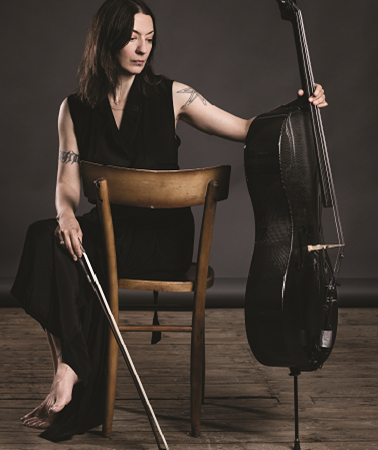
I have several quite different cellos. For recording, I use a cello made by contemporary luthier Robert Brewer Young. For touring, I use a carbon fibre cello made by Luis and Clark. It’s very resistent to changes in humidity, so it’s great for outdoor shows, and it also is easier to travel with. I also have a beautiful, unidentified, old cello that was my instrument while studying, and, for me, is imbued with all the emotions and dreams of that period. And I have an electric cello, which I have to say is a bit less interesting to play, because you miss all the vibrations of the instrument.
You were born in Vancouver (Canada) but now you work in the Big Apple (New York): certainly these two very different cities have characterized your artistic choices as a musician and composer. Do you want to tell us about the different influences of these two, I think antithetical, geographical cultures?
For me, Vancouver is very much a city of nature: it’s so connected to the sea and the mountains. The landscape there is always an inspiration. And the sense of openness that comes with being on the sea. New York, of course, is a dense urban agglomeration with a very special energy. It also feels like a very open city, but in a different way. I have so many memories and emotional geographies connected to both cities: they are part of my history. But I feel as though you might remember a city, but the city does not necessarily remember you.
In your life as an artist, up to now, 6 CDs: do you want to briefly present them in a synthetic way, perhaps, instead, describing your latest work “Temporal”?
Each of my records has revolved around a concept: Delay, that of encountering airports as liminal spaces; Green and Grey, searching for the patterns of nature; Character, mining an inner emotional world; Asperities, approaching the conflicts of the natural world as a metaphor for the personal; and Temporal, presenting music I made for dance and theatre and exploring the ephemerality of time-based art. I feel as though Temporal is slightly different from my other records, as most of the pieces were inspired by theatrical texts or choreographic concepts, so it feels more outward-looking than some of my other work.
Rasputina and Antony and the Johnson: these are two collaborations some time ago. What kind of musical experiences were they? What did they represent for you?
Both were formative for my musical career. Rasputina, because, in a way, it started my relationship with technology, in terms of figuring out amplification and working with pedals. And also because we did so much touring and made some indelible memories! And Antony and the Johnsons, because Anohni is a unique musical artist from whom I learned a lot. As a group, we had some very special shows together and, I think, grew together in a beautiful way.
You also came to Italy, in some occasions. What is your relationship with our country and with our music in a more specific way?
I am so fortunate to come to Italy often! I feel as though the audiences in Italy are truly special in terms of their receptiveness and in the way one can make emotional connections, both onstage and off-. And, of course, the venues are always spectacularly beautiful. The breadth of Italian music, from the Renaissance and Baroque through 18th- and 19th-century opera to the avant-garde, minimalism, and pop, is truly inspiring. And there are so many amazing Italian cellists, both historical and contemporary!
Tour: your presences in the main countries are truly numerous. Can you tell us about the most significant experiences?
I’ve been all over, playing, and I feel as though it’s always so special to come to a country as a performer: you are very privileged in terms of the way you can connect with people. The most important experiences, for me, have involved playing in places where you have a sense of all the performers who have inhabited the stage before you and left some of their energy there, whether it’s a tiny, jewel-box, historic theatre, or a big, modern one. Or playing outside, in nature, which almost can create a collaboration between the music and the ambiental sounds. And of course I have a lot of tour stories, which I probably shouldn’t tell here!
Live, on stage you play barefoot: what does it mean or represent or what chance does it allow you in your expressiveness?
I play barefoot because I use a MIDI controller that is velocity- and pressure-sensitive, so it just gives me better control over the small movements. Coordinating my foot and my hands is a bit like a choreography onstage. I also like the sense of groundedness that playing barefoot gives me. And I recently found a photo of me, age eight or so, playing cello without shoes, so obviously it was something that started young!
Theater: in Italy you played in Turin for “Mamma Schiavona”, by Giordano Amato. How does a musician composer relate to the words, the acting and the live scene on a stage? So, do you remind us some important theatrical participations?
I have made music for a few productions by Giordano Amato: he’s such an interesting writer and director. I love working with theatre. It’s very much a process, and the way things evolve in terms of the text, the physicality onstage, the communication between performers, and the way the music can support that, is fascinating. Most recently, I composed music for a production for the Royal Dramatic Theatre in Stockholm: a reenvisioning of Euripides’s “Alkestis” by Greek director Elli Papakonstantinou. The music I made ranged from techno to a cappella voices, and evolved a lot during the rehearsal period, so it was a superinteresting creative process.
Dance: from “Inner Space” to “5 for Silver”. Body, movement, choreography and music. What is the link between these elements?
I also love working with dance. The energy that dancers create onstage is almost like a weather system: you feel their breath, the air that they move, the heat of their bodies. Performing onstage with dancers is the ultimate way of communicating without words: there’s a sort of exchange that can only happen when movement meets music.
Films and music: at the beginning the films were silent, accompanied only by a piano and live. Now everything is obviously different, but how? So, you have participated in many cinematographic experiences: you want to remind us at least some of the most important and for which meanings in your career and evolution as a musician.
I’ve done a bit of film scoring at this point, and I’m always interested to do more. It’s different every time, depending on the director’s vision. I feel as though music for film always needs to support the emotional world that we see onscreen, and complement the rhythm of the images and the script. Most recently, I scored a beautiful documentary called “Stories From the Sea,” about women in the Mediterranean: three very different stories connected by the fact of being on the sea. And right now I’m working on a film that is sort of a metaphysical thriller, with a complex and layered script: it’s exciting to see how it’s evolving during the editing process.
Of course, for composing music you use the most modern technology today offers: do you want to describe your technique as a music composer and this technology?
For live performance, I use a software called Sooperlooper to live-loop the cello, and Ableton Live to create electronic and percussive textures, plus a MIDI controller called Softstep. Everything starts with the cello, which, for me, is fundamental. And to record, I recreate the looping process in Pro Tools and I’m freer in the way I can use electronics. It’s always a challenge to create something in the studio and then have to make it work for live performance, or vice versa. And, of course, the technology is always evolving and that creates a learning curve. But I find technology to be an invaluable tool, especially as a solo performer. It enables me to create a whole ensemble from a single instrument, and find the musical colours and textures to create the music I hear in my mind.
What will your next commitments be, what have you written on the next page of your agenda?. Are you in the recording studios for a new album?. Are other tours or other collaborations waiting for you?
I am about to go to Spain do a show called the End of the World, with Ukrainian-Canadian pianist Lubomyr Melnyk and a multimedia collective from Torino called Spime.im. It’s based around Lubomyr’s amazing music for piano and Spime.im’s spectacular visuals and electronic music. We have a few other European shows in the works. I have some solo shows coming up, and also some collaborative ones, including a performance with Balletto Teatro di Torino. And I’m reconnecting with an amazing band I played with a while ago called Burnt Sugar. It’s a collective of incredible improvisers. We’re doing a workshop and a concert at Carnegie Hall next week. In terms of a new record, I have some ideas and some musical material, so we’ll see!
Dear Julia Kent: Thank you for your willingness to answer our questions. To you every best wish for your profession as a musician but also for every other aspect of your life.
Thank you for your wishes, and thank you so much for the really thoughtful and beautiful questions! It means a lot to me that a web site that focusses on the cello would be interested in my work: it makes me feel part of a larger community and part of a historical tradition that is so nourishing and important.
A site to quickly and effectively find everything a cellist asks on the web