
When I interview some cellist, he usually tells me that he started playing when he was very young, that dad and mom were musicians and, at home, they all lived on bread and music, but it doesn’t always happen that way, and not all children who are fascinated by a cello have the opportunity to start playing immediately. However, the dream remains, kept in a hidden corner of the heart, and it happens that sooner or later it turns into reality. This is what happened to Michèle Ferron, a nice Canadian cellist who has never stopped dreaming …
When and where did you see and hear a cello for the first time in your life?
I was really young, maybe 8 years old, when my best friend’s mom brought me a concert for the first time. It was wonderful! I don’t come from a family where you listen to music and we don’t have records or musical instruments at home. This woman opened a window to me in an extraordinary world that I could not have imagined without her. We got a season ticket for the Saturday morning concerts of the symphony orchestra. They were events organized specifically for children. This woman gave my life the color of joy. It made me discover Art, Beauty, and Nature. She was the most important person in my life.
When did you decide to learn to play the cello? And why exactly the cello? Is there, in particular, a cellist or a cello piece that gave birth to this desire?
I started playing in 2005, a quieter year than previous years in my professional and personal life. I decided to enroll in a cello course. I had been dreaming of it for years, but it hadn’t been possible before. Unfortunately, I just had time to start taking lessons that I got sick, and I had to quit, mainly because of financial problems. And, in the following years, I was too busy to think about it. Then, in 2017, in Venice during a concert by the singer Flo, I “fell in love” with his cellist, Marco di Palo. I was about to go home, I was leaving the next day. As soon as I got off the plane, I looked for a cellist professor, and, in the same week, I started lessons with Alejandro Calzadilla.
When did you start studying, what were the main difficulties you had to overcome? Did you find it harder to learn to use your right or left hand?
I was so naive! I grew up with the idea that the result depends only on the effort one is willing to make to achieve it. And I was ready to work hard. Unfortunately, it does not work exactly like that for the arts … I would say that I quickly fell out of my pink cloud. Everything has been (and still is!) difficult. When I focus on the left hand, the bow goes everywhere and, when I focus on the bow, the intonation would kill everyone with a barely sensitive ear. It is difficult for me to put it all together. And I’m not talking about interpretation … Another difficulty comes from my age. I started playing at 64. I already had a bit of pain here and there and getting all these old joints moving is not easy and it is often painful. But my professor is an angel of patience and knows how to adapt the lessons to my situation.
Were you able to find the teacher right for you right away, or did you have to change several teachers?
I have never changed teachers and I don’t want to. He knows me well and, knowing that I will never be able to play many complex compositions, such as studies, sonatas, etc … he helps me with great attention to slowly improve my sound. We focus on this.
What characteristics should a teacher teaching an adult have in your opinion?
Patience and flexibility. Because if the body doesn’t learn as fast as at six or ten, the head goes on and would like to know everything already. I can’t spend hours and hours learning difficult studies, scales, and arpeggios, because my body can’t do it. My teacher had to adapt the lessons in order not to make them too difficult but, at the same time, I had to agree to study some technique. I don’t know how he always manages to be so kind and always repeat the same things. I don’t know if he behaves in the same way with all his students (maybe I have a head too hard), but, with me, he must always repeat the same things and then again … and again.
At first, to understand how you had to place your hands on the instrument and how you had to move them, you looked at how your teacher did, you listened to his theoretical explanations or you simply tried until you got the result you wanted?
I have done all this and I have also watched many videos on the web. I am not very tall and I have very short fingers, especially the little fingers. I had to change the 4/4 cello to a 7/8. Now, I’ve been playing for almost three years, but I still have problems with the bow direction. I found myself a large mirror and I try to look at myself while I play to check where this bow is going because sometimes it seems to like sliding (and it is not artistic ice-skating) on the strings. And my professor still has to make corrections to me every lesson. I watch it, then I try to do the same. Then I forget again …
Have you ever taken an online lesson? What do you think are the advantages and disadvantages of this type of lesson?
Since we are quarantined for Covid, I have been taught online. Better than nothing … I would have been desperate if I could no longer have lessons in attendance: I can’t wait to go back to my professor’s study. When I started classes, I remember that he often turned around me, checking my position. It seemed so strange to me. It certainly would not have been possible online. Another thing is that it is not easy to work on sound quality online and so often I do not quite understand how I should do to improve myself. Maybe I should buy headphones, I don’t know. I think online lessons are good for advanced students but, for beginners, they are not ideal.
Have you ever tried playing with someone else? If so, what were the difficulties to overcome, and what emotions did you feel?
I played once in Venice with some beginner friends like me: a cellist, a violist, a violinist, and a flutist. It was something very intense. The first difficulty was to distinguish the sound of my instrument as a whole: I no longer knew if I was playing the right notes or not. Then, there is the rhythm … alone I can slow down or accelerate as I want, but with the others … I felt completely lost. And it was unknown music for all of us. But in the end, I realized that playing with other instruments makes music richer, deeper. And I really enjoyed living these moments. Unfortunately, I don’t know any musicians from me to redo the experience.
What pieces are you studying now and which ones would you like to play in the future?
Now I’m learning the Sonata Prima by Giovanni Battista Platti. I’m also trying the first Capriccio by Dall’Abaco, Schubert’s Ave Maria, to learn vibrato, and a study by Schroeder. And then the scales. My favorite music is that of the Italian Baroque. I would like to play all this, especially Lanzetti, Vandini, Pericoli, Giminiani, etc … The best thing for me would be to be reborn in the body of a cellist in my next life because in this I fear that I will not have time to become good enough to play these tracks.
Today the Internet gives musicians enormous possibilities to broaden their horizons by also discovering unknown repertoires. What are the compositions that you think are most beautiful among those you have discovered more recently?
I must say that the MyCello site made me discover the cello repertoire. I knew almost nothing before I started playing. Every day I find something new and beautiful. A little while ago I discovered Leonardo Leo and Berteau. I also discovered Angelo Maria Fioré and Diego Ortiz in an Early Italian Cello course with Elinor Frey. Last year I met Miaskosky, Rontgen, Pejacevic and many others.
Since you particularly like baroque music, if someone who has never listened to this kind of music asked you for advice on an author to listen to, which would you recommend? And which compositions in particular?
I wouldn’t be able to recommend just one. But I’m always excessive! I would feel like a traitor to suggest only Vivaldi or Porpora or Willem de Fesh, etc … This music speaks softly to my heart. I need it every day.
Is there a cellist in particular that you listened to live and that you particularly appreciate? And any cellist you would like to have the opportunity to listen to live?
The first cellist I listened to in a live-concert is the great YoYo Ma, many years ago. He was young then and so alive on the stage. He was playing looking at the other musicians behind him with huge smiles and I wondered how he managed to play and almost have a conversation with others at the same time. An unforgettable evening! Then I felt a great desire to learn to play the cello, but it was not possible, with the intense professional life I was living. Now the concerts that I like most are those in small halls, such as that of the Squero in Venice or in the Sale Apollinee of La Fenice. I feel closer to both artists and music.
I know that every year you come on holiday to Italy, to Venice, and that you don’t miss the opportunities that arise to listen to concerts. Is there any Venetian concert that left you with a particular memory?
Last year I heard the group Arte dell’Arco. Nice complicity between the musicians and my favorite music. What more could I ask for?
I know that when you come on holiday in Italy you don’t give up studying cello and that you have found a “creative” way not to risk your instrument while traveling. Can you explain to our readers what your “portable cello” is and how you got it?
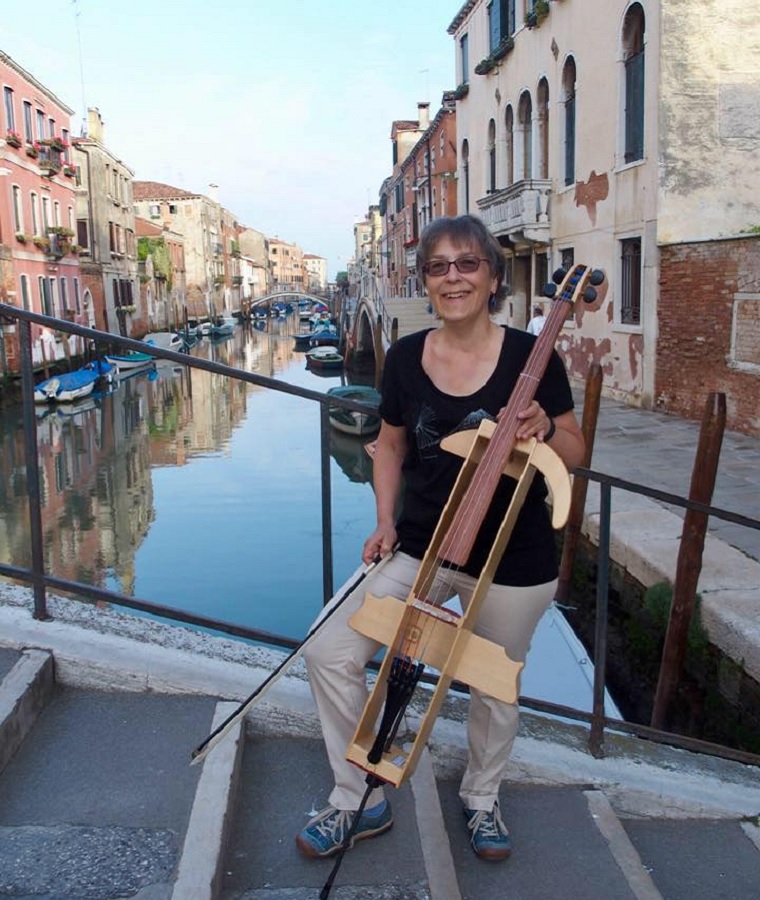
Since 2012 I go to Italy every year for the holidays. When I started playing I felt torn between my two passions: Venice and the cello. My professor then told me about the possibility of having a travel cello. I searched the web and discovered my Prakticello. It is an interesting object, designed by Ernest Nussbaum, an American gentleman who made the tools in his home. I had the bridge improved by my luthier. The advantage is that it can be “disassembled and reassembled” and is therefore very easy to transport. To tell the truth, it doesn’t sound very good, but it’s perfect for me because I don’t disturb my neighbors in the apartment I rent. At my age, I don’t have many years in front of me to study and I can’t stop playing for a few weeks because I would forget everything. So, I travel with the “Vittorino” (this is the name I gave to my Prakticello). But when I get home, what a joy to find my real cello!
Based on your experience, if someone told you they are going to start playing the cello, what advice would you give them?
First of all, especially if the person is no longer young, it is important that he has a lot of determination because it will not be easy and it will take a long time. Without these two conditions, it is not worth thinking about the cello. But it’s the best gift anyone can give. Music is an incredible presence. I don’t know if it’s part of me or if I’m part of her, but we’re together forever.
Thanks, Michèle Ferron, for agreeing to share your dream with us! We hope that you can return very soon to Venice, the town you love, to listen to music and study without disturbing the neighbors, with your “Vittorino”.
A site to quickly and effectively find everything a cellist asks on the web